
Apology Language Quiz
Learn what kind of apology feels most meaningful to you in about 10 minutes. Free and quick, with 20 relatable scenarios that give clear preference scores and blended results when close.


08:30
Scale Explorer
How the Scales are Structured
DATA-BASED USER COHORTS
Who Usually Takes This Test?
BASED ON AGGREGATED, ANONYMIZED DATA FROM TENS OF THOUSANDS OF FREUDLY USERS.
Benchmarking
See How You Compare
Once you complete the test, your results are compared with real-world data from people in your country.
Below is a preview of how scores are typically distributed across each scale.
Below is a preview of how scores are typically distributed across each scale.
Accepting Responsibility (AR)
Accepting Responsibility (AR)
Average
8.8
Normal range
6.9 — 10.8
min.
0
max.
12
This curve shows how scores are typically distributed.
Once you complete the test, your result will appear on the scale so you can see how you compare.
Once you complete the test, your result will appear on the scale so you can see how you compare.
Expressing Regret (ER)
Expressing Regret (ER)
Average
6.7
Normal range
4.8 — 8.5
min.
0
max.
12
This curve shows how scores are typically distributed.
Once you complete the test, your result will appear on the scale so you can see how you compare.
Once you complete the test, your result will appear on the scale so you can see how you compare.
Genuinely Repenting (GR)
Genuinely Repenting (GR)
Average
4.4
Normal range
2.3 — 6.5
min.
0
max.
12
This curve shows how scores are typically distributed.
Once you complete the test, your result will appear on the scale so you can see how you compare.
Once you complete the test, your result will appear on the scale so you can see how you compare.
Making Restitution (MR)
Making Restitution (MR)
Average
8.9
Normal range
7.1 — 10.8
min.
0
max.
12
This curve shows how scores are typically distributed.
Once you complete the test, your result will appear on the scale so you can see how you compare.
Once you complete the test, your result will appear on the scale so you can see how you compare.
Requesting Forgiveness (RF)
Requesting Forgiveness (RF)
Average
7.9
Normal range
6.3 — 9.5
min.
0
max.
12
This curve shows how scores are typically distributed.
Once you complete the test, your result will appear on the scale so you can see how you compare.
Once you complete the test, your result will appear on the scale so you can see how you compare.
Featured On
SAMPLE QUESTIONS
Example Questions From the Test
- Giving me space to decide when I want to reconnect.
- Acknowledging the effect of crossing the boundary.
- Explaining what they have learned about the boundary.
- Taking specific, observable steps to respect that boundary consistently from now on.
- That suits me; I prefer to decide privately whether forgiveness develops.
- I might notice the omission, but it would not affect the apology much.
- The apology can still work, though a gentle request would add something meaningful.
- I would likely feel that an important invitation to reconnect was missing.
- Remorse and repair can make the apology complete for me.
- I might wonder about the future, but I would not need a formal plan.
- I would prefer to hear what the person intends to change.
- Without a credible commitment to different behavior, the apology would still feel unfinished.
WHAT THE TEST MEASURES
About This Assessment
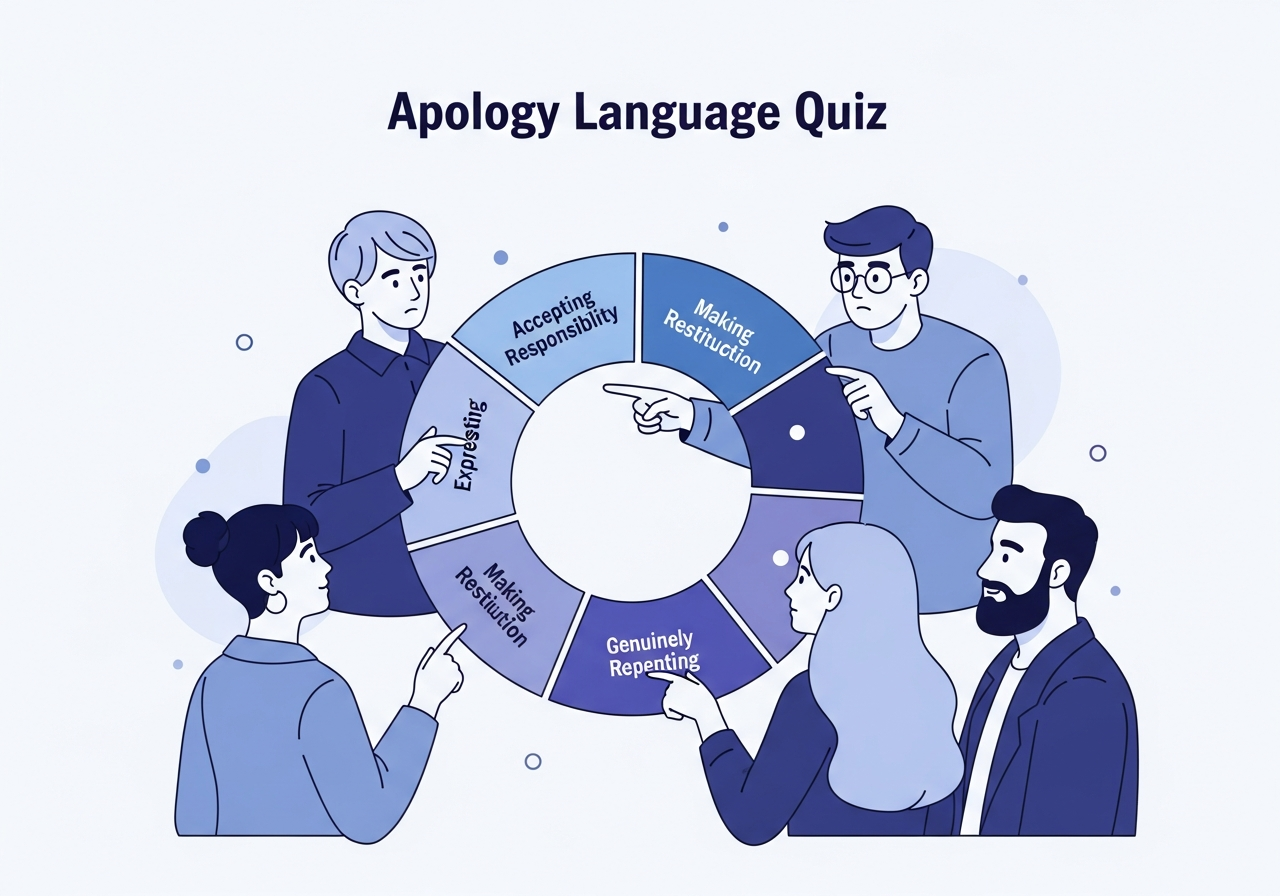
/https://cdn.freudly.ai/media/tests/3335/image/1785110874_day_image_20260727_000754.png "Apology Language Quiz")
Apology Language Quiz - Symptoms and Signs
Explore which of five commonly described apology languages resonates most when you receive an apology: Expressing Regret, Accepting Responsibility, Making Restitution, Genuinely Repenting, or Requesting Forgiveness. This free, unofficial reflection uses 20 everyday scenarios and requires no sign-up. Each language receives a 0–12 affinity score. The highest-scoring outcome is your strongest affinity, and any outcomes within one point of that highest score form a blended result. This quiz measures preferences, not sincerity, character, or relationship health.
Popular tests
Comments
Leave a Comment