
Am I Racist Quiz
In 10 minutes, understand patterns in racial assumptions, feedback reactions, and everyday choices. Free and no sign-up, 15 questions with three scores to guide reflection and growth.


08:30
Scale Explorer
How the Scales are Structured
DATA-BASED USER COHORTS
Who Usually Takes This Test?
BASED ON AGGREGATED, ANONYMIZED DATA FROM TENS OF THOUSANDS OF FREUDLY USERS.
Benchmarking
See How You Compare
Once you complete the test, your results are compared with real-world data from people in your country.
Below is a preview of how scores are typically distributed across each scale.
Below is a preview of how scores are typically distributed across each scale.
Everyday Equity Choices (EEC)
Everyday Equity Choices (EEC)
Average
8.1
Normal range
5.7 — 10.4
min.
0
max.
15
This curve shows how scores are typically distributed.
Once you complete the test, your result will appear on the scale so you can see how you compare.
Once you complete the test, your result will appear on the scale so you can see how you compare.
Racial Assumptions (RA)
Racial Assumptions (RA)
Average
10
Normal range
7.9 — 12.1
min.
0
max.
15
This curve shows how scores are typically distributed.
Once you complete the test, your result will appear on the scale so you can see how you compare.
Once you complete the test, your result will appear on the scale so you can see how you compare.
Response to Racial Feedback (RtRF)
Response to Racial Feedback (RtRF)
Average
8.6
Normal range
6.5 — 10.7
min.
0
max.
15
This curve shows how scores are typically distributed.
Once you complete the test, your result will appear on the scale so you can see how you compare.
Once you complete the test, your result will appear on the scale so you can see how you compare.
Featured On
SAMPLE QUESTIONS
Example Questions From the Test
- I consider whether mentioning race could encourage an unsupported group stereotype.
- I notice it but usually accept the report's framing without examining why it was included.
- I see it as potentially informative about patterns within that racial group.
- I take it as support for concerns I already have about that racial group.
- Thank them for telling me, ask what affected them, and reconsider the phrase.
- Apologize and avoid the phrase, even if I do not fully understand the concern yet.
- Explain my intention before deciding whether their concern changes my view.
- Dismiss the concern unless several other people agree that the phrase was offensive.
- I practice the corrected pronunciation and invite another reminder if I slip.
- I make a sincere effort, although I may avoid saying the name when I am uncertain.
- I explain that the pronunciation is difficult for me and continue using my closest version.
- I suggest a shortened name or nickname that feels easier for me to say.
WHAT THE TEST MEASURES
About This Assessment
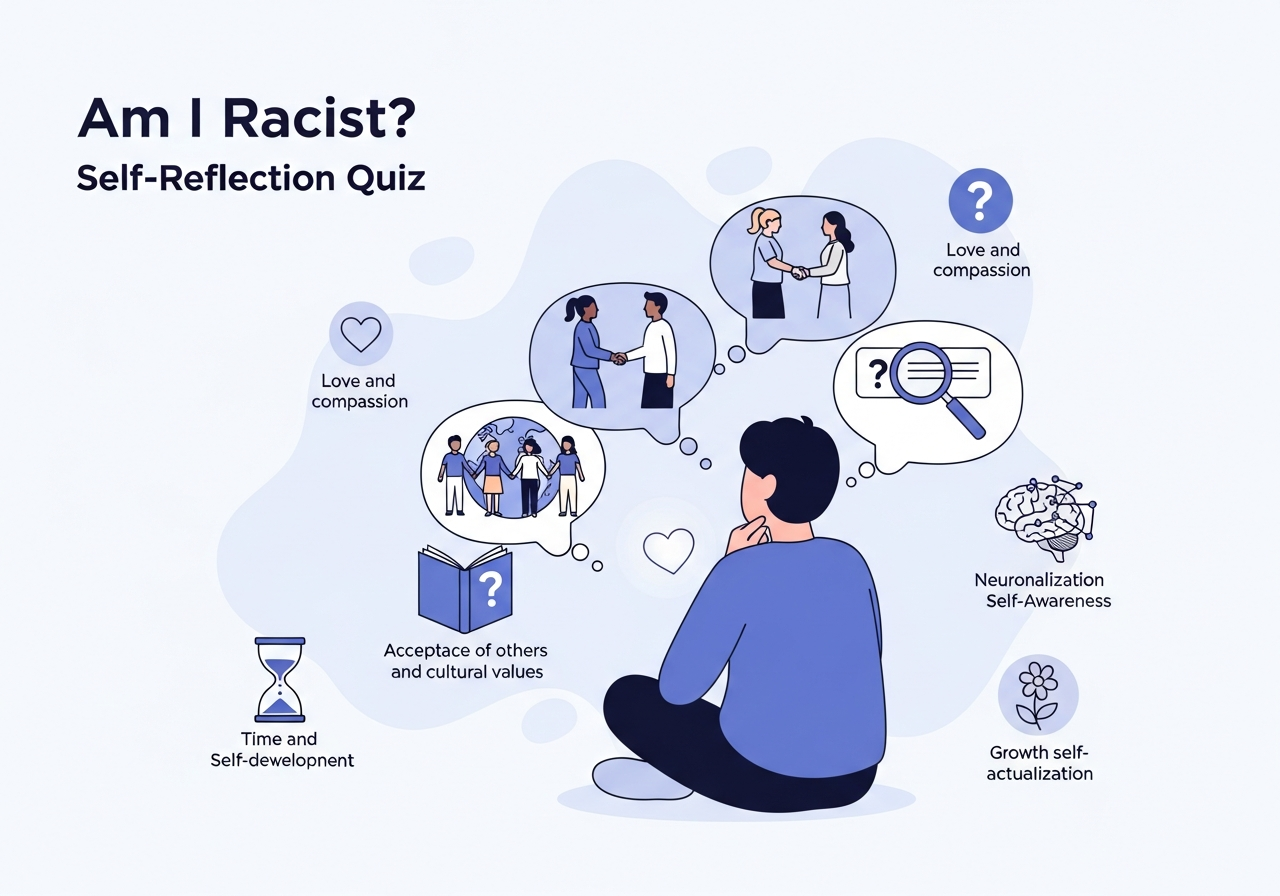
/https://cdn.freudly.ai/media/tests/3299/image/1785024359_day_image_20260726_000559.png "Am I Racist Quiz")
Am I Racist Quiz - Symptoms and Signs
Take this free, quick quiz to reflect on racial assumptions, your response to feedback, and the choices you make in everyday situations—no sign-up needed. It cannot determine definitively whether you are “racist,” measure every form of bias, or replace honest conversation and learning. Instead, its three scores highlight current patterns you may want to examine. Answer based on what you usually do, not what sounds ideal, and use discomfort as an invitation to listen, learn, and reconsider.
Popular tests
Comments
Leave a Comment