
Which Bender Are You Quiz
How the Scales are Structured
Who Usually Takes This Test?
See How You Compare
Below is a preview of how scores are typically distributed across each scale.
Example Questions From the Test
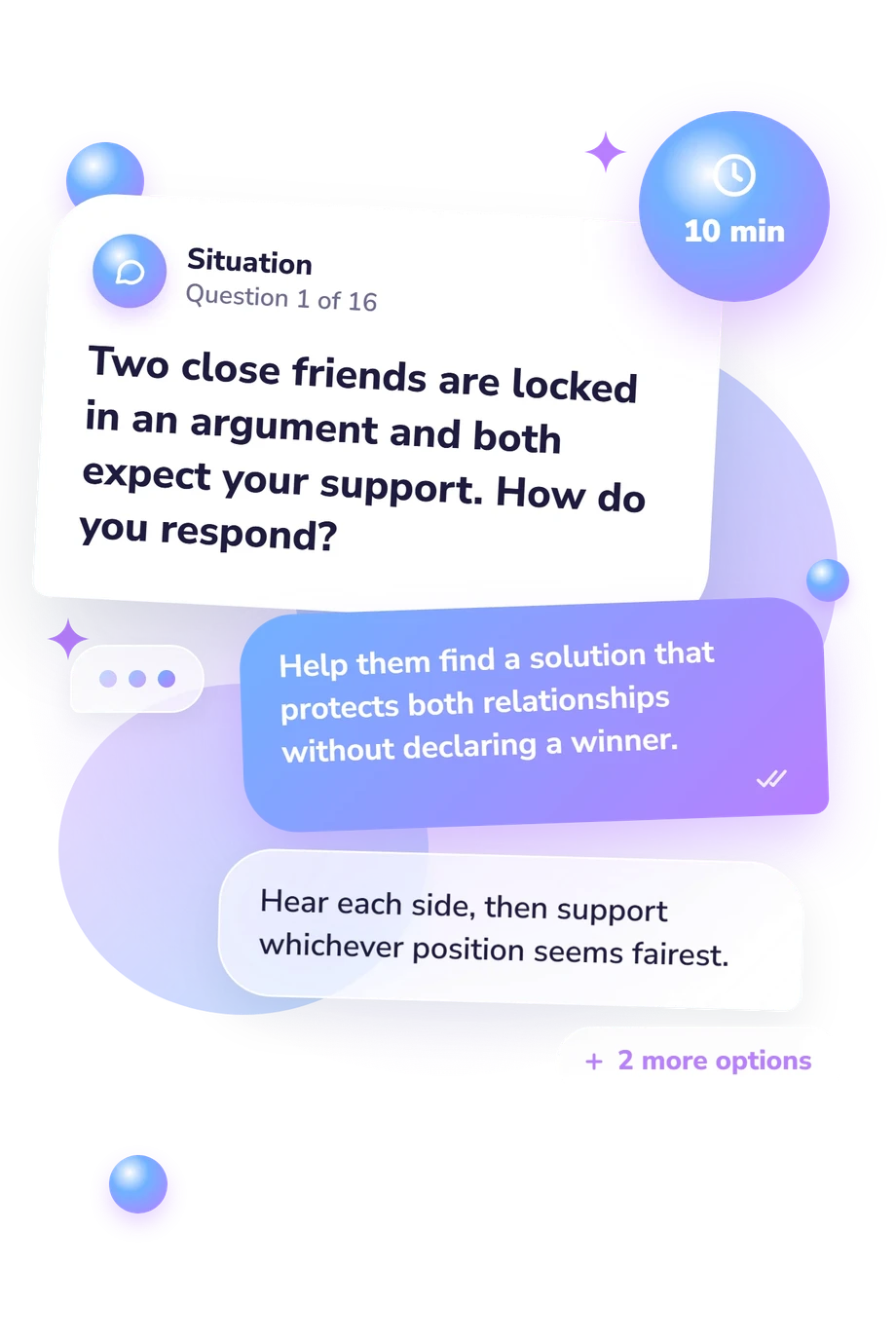
- Help them find a solution that protects both relationships without declaring a winner.
- Hear each side, then support whichever position seems fairest.
- Step away until they have cooled down enough to handle it themselves.
- State the hard truth as I see it, even if one friend dislikes my answer.
- Face it directly, make what repairs I can, and let the lesson shape me.
- Reflect on it privately, accept the discomfort, and continue forward.
- Focus on my present actions rather than reopen what already happened.
- Treat my former choices as belonging to a version of me that no longer matters.
- Demonstrate my ability on my own terms and let the result answer them.
- Calmly explain the experience or preparation I bring to the task.
- Ask a trusted ally to confirm that I am capable.
- Conserve my energy and let their mistaken assumption pass.
Which Bender Are You Quiz - Description and methodology of the test
Designed for fans who enjoy character-based self-reflection, the Which Bender Are You Quiz turns choices into a comparison of four styles of courage, care, independence, and identity. This bender personality quiz is useful for readers who want to think about how they handle conflict, setbacks, loyalty, responsibility, and unfamiliar situations. The outcome places those reflections alongside character patterns while allowing overlap rather than a fixed personality label.
What This Assessment Explores
Questions place the respondent in dilemmas involving conflict, setbacks, loyalty, responsibility, fairness, and unfamiliar situations. They use the four characters as reference points for different ways of acting, caring, persisting, and defining identity. Framed as a What Kind of Bender Are You Quiz, the result offers a comparative profile rather than a single trait.
The four displayed character-affinity scales are:
- Aang (0-12) reflects freedom, harmony, exploration, and creative problem-solving: Different Rhythm (0-4), Shared Currents (5-8), Strong Aang Affinity (9-12).
- Katara (0-12) reflects support, persistence, protectiveness, and compassionate leadership: Different Current (0-4), Caring Resolve (5-8), Strong Katara Affinity (9-12).
- Toph (0-12) reflects self-reliance, blunt honesty, practical judgment, and resistance to limits: Different Ground (0-4), Solid Streak (5-8), Strong Toph Affinity (9-12).
- Zuko (0-12) reflects striving, introspection, loyalty, and integrity through difficult choices: Different Flame (0-4), Kindred Fire (5-8), Strong Zuko Affinity (9-12).
Methodology and Scientific Basis
This is a structured self-report: each item presents a short everyday scenario with four possible responses. The options differ in emphasis, including reconciliation, directness, protection, persistence, observation, independence, guidance, and improvisation. Choosing the response that feels most like you produces a pattern across the four character-affinity scales without requiring a calculation by the respondent.
At the end, the highest score represents the strongest character affinity. Scores within one point are read as a blended result, so a close outcome can reflect meaningful overlap rather than inconsistency. Approached as a What Type of Bender Are You Quiz, the exercise compares tendencies rather than assigning a permanent identity.
The framework is conceptually consistent with Isrow (2022), which discusses contrasting personality qualities associated with the four characters. DiMartino and Konietzko (2020) provide a complementary account of their creative and visual characterization. The questionnaire is a character-based online self-report rather than a standardized personality inventory; its displayed bands are descriptive categories, not population norms. Self-report answers can shift with mood, recent experiences, and self-awareness, so the result is most useful as a focused snapshot for reflection.
- Isrow, Zachary. 2022. “The Personalities of Martial Arts in Avatar: The Last Airbender.” In Avatar: The Last Airbender and Philosophy: Wisdom from Aang to Zuko, edited by Helen De Cruz and Johan De Smedt, 25-33. Wiley-Blackwell. 10.1002/9781119809838.ch3
- DiMartino, Michael Dante, and Bryan Konietzko. 2020. Avatar: The Last Airbender: The Art of the Animated Series, Second Edition. Dark Horse Books. ISBN: 9781506721699
Updated: