
What Shape Is My Bum Quiz
How the Scales are Structured
Who Usually Takes This Test?
See How You Compare
Below is a preview of how scores are typically distributed across each scale.
Example Questions From the Test
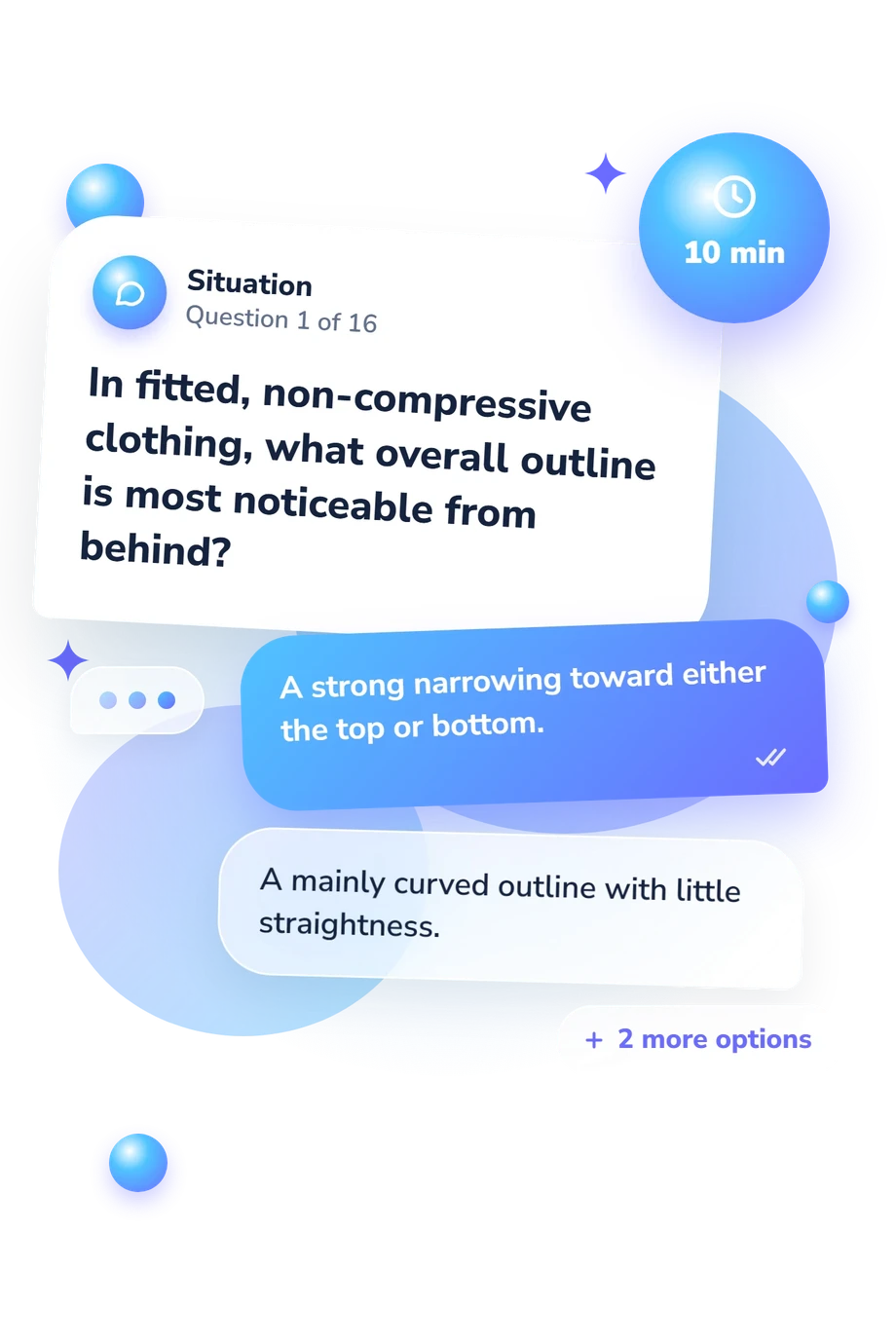
- A strong narrowing toward either the top or bottom.
- A mainly curved outline with little straightness.
- A balanced outline with mildly rounded corners.
- A broad, even outline with relatively defined corners.
- They angle outward as they descend.
- They stay mostly vertical.
- They angle inward gently.
- They form a clear inward taper on both sides.
- The area below my waist is wider.
- The two areas look about equally wide.
- The lower part is moderately wider.
- The lower part is distinctly wider, creating a heart-like flare.
What Shape Is My Bum Quiz - Description and methodology of the test
People who want a more neutral way to think about lower-body proportions can use this assessment to organize visual observations without turning them into a judgment about attractiveness. The What Shape Is My Bum Quiz is suited to readers curious about how width, curvature, projection, and taper combine in their outline. Its visual profile helps classify bum shape by showing how these features relate.
What This Assessment Explores
The questions examine the outline from behind and in profile: fullness, side direction, upper-to-lower balance, projection, and narrowing toward the thighs. The result describes the closest visual pattern; nearby scores can show a mixed profile. This glute shape quiz gives readers language for describing proportions without ranking them.
Four affinity dimensions organize the result:
- Heart Shape Affinity (0-12) measures lower outer fullness and a gentle lower flare: Limited match (0-4), Partial match (5-8), Strong match (9-12).
- Inverted V Shape Affinity (0-12) measures upper width with inward taper below: Limited match (0-4), Partial match (5-8), Strong match (9-12).
- Round Shape Affinity (0-12) measures centered projection, curved sides, and balanced fullness: Limited match (0-4), Partial match (5-8), Strong match (9-12).
- Square Shape Affinity (0-12) measures even width and straighter sides: Limited match (0-4), Partial match (5-8), Strong match (9-12).
Methodology and Scientific Basis
Each item presents four descriptions of a visible outline and asks which best matches the respondent’s back- or side-view observation. The choices focus on concrete relationships between width, curvature, projection, and taper rather than on attractiveness or body satisfaction.
Responses are combined into four displayed affinity scores. The highest score is the strongest match; results within one point are read as blended rather than forced into a single shape. The questionnaire organizes selected observations into a descriptive profile of butt shape, while its displayed scores indicate how closely those observations fit each shape.
Mendieta and Sood (2018) provide the closest conceptual reference for classifying visible gluteal shape relationships. Mendieta (2006) gives earlier classification context, while Raposio and colleagues (2023) discuss related aesthetic and morphometric features. The questionnaire is conceptually consistent with this classification work.
Clothing, posture, viewpoint, current self-perception, and honest observation can affect responses, so the result works best as a reflection aid and should be considered alongside broader context rather than as a diagnosis.
- Mendieta, Constantino G., and Aditya Sood. “Classification System for Gluteal Evaluation: Revisited.” Clinics in Plastic Surgery, vol. 45, no. 2, 2018, pp. 159-177. 10.1016/j.cps.2017.12.013
- Mendieta, Constantino G. “Classification System for Gluteal Evaluation.” Clinics in Plastic Surgery, vol. 33, no. 3, 2006, pp. 333-346. 10.1016/j.cps.2006.04.006
- Raposio, Edoardo, Isabella Baldelli, Matteo Vappiani, Alessandra Gualdi, and Giorgio Raposio. “The Ideal Buttock: Some Aesthetic and Morphometric Considerations.” European Journal of Plastic Surgery, vol. 46, 2023, pp. 915-921. 10.1007/s00238-023-02138-1
Updated: