
What Is My Theme Song Quiz
How the Scales are Structured
Who Usually Takes This Test?
See How You Compare
Below is a preview of how scores are typically distributed across each scale.
Example Questions From the Test
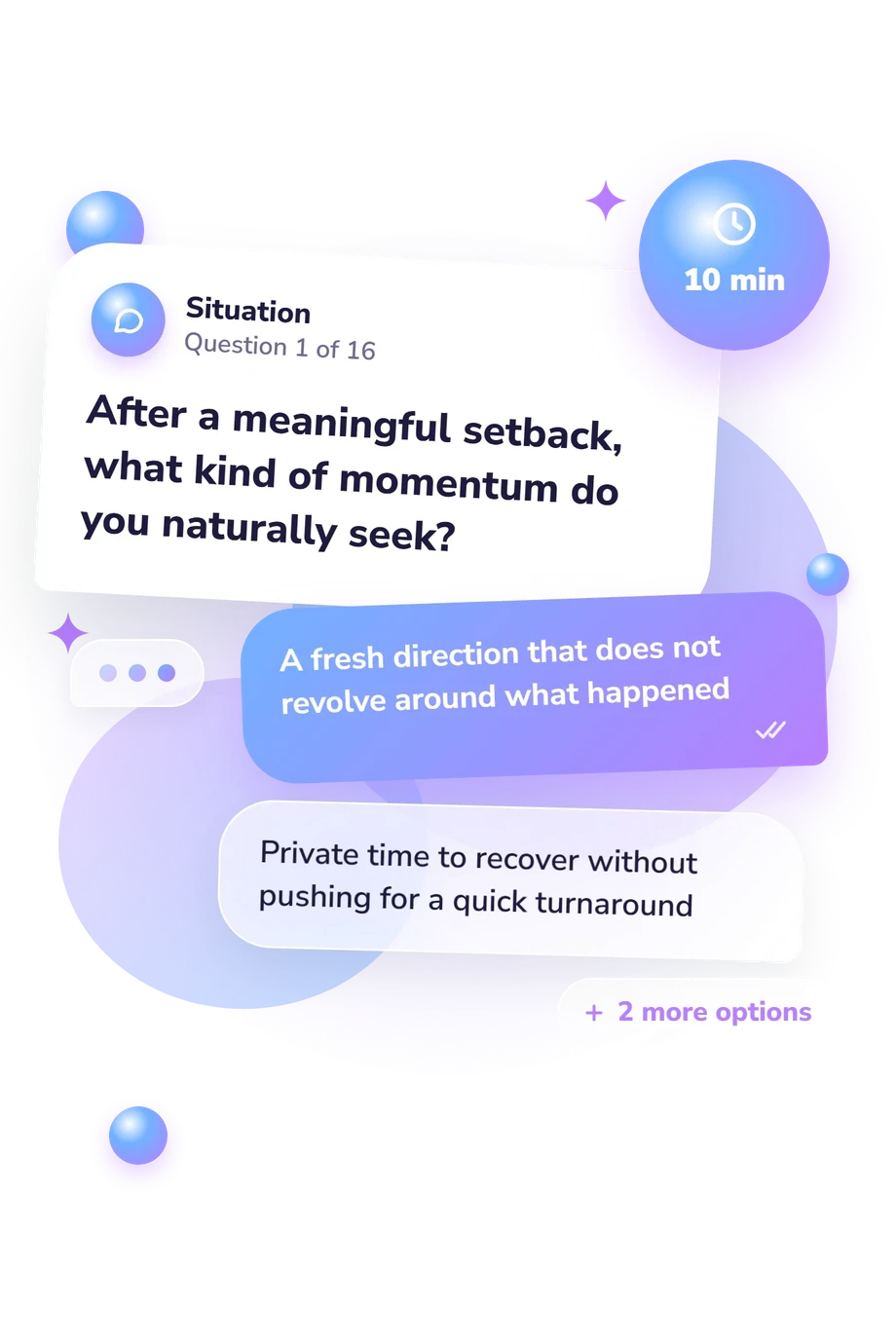
- A fresh direction that does not revolve around what happened
- Private time to recover without pushing for a quick turnaround
- A measured restart built around what I learned
- A determined comeback that turns frustration into fuel
- A polished anthem that makes the destination feel already won
- A quiet instrumental that gives me room to think
- A steady groove that keeps the transition manageable
- A bright pop song that makes the unknown feel inviting
- Gentleness that lets me move slowly
- Optimism that lightens the mood
- Grounded determination that restores focus
- Defiant energy that makes the difficulty feel beatable
What Is My Theme Song Quiz - Description and methodology of the test
People choosing how they want to frame a transition, challenge, or celebration may use What Is My Theme Song Quiz when they want a playful comparison of four anthem messages. Afterward, the result from your theme song quiz can help you decide which message feels most representative right now, without requiring musical knowledge or a fixed identity.
What This Assessment Explores
Items cover setbacks, mood, new chapters, celebration, goals, and persistence. Four responses offer different ways of seeking energy or meaning. When you ask what is your theme song quiz meant to reveal, focus on the overall pattern rather than one answer.
Here are four song affinities:
- “Good as Hell” by Lizzo (0-12) reflects affinity with an anthem of self-appreciation, joyful reset, and expressive confidence.
- “Hall of Fame” by The Script featuring will.i.am (0-12) reflects affinity with an anthem of achievement, impact, and demanding goals.
- “Stronger (What Doesn't Kill You)” by Kelly Clarkson (0-12) reflects affinity with an anthem of resilience and regained momentum.
- “Unwritten” by Natasha Bedingfield (0-12) reflects affinity with an anthem of freedom, discovery, and an open future.
Displayed bands are Different wavelength (0-4), Possible match (5-8), and Strong match (9-12). The highest score marks the strongest affinity; results within one point form a blend.
Methodology and Evidence Base
Each item presents a situation and four possible responses, covering recovery, mood, ambition, planning, celebration, presentation, and challenge. Choose the option that feels natural, not the one that sounds admirable. Emotional fit, not musical expertise, matters when interpreting what's my theme song quiz revealing.
Scores are compared across the four displayed affinities. The highest indicates the strongest affinity, while scores within one point form a blend. The bands describe this questionnaire's internal pattern, not population norms or clinical thresholds. The comparative pattern, not a fixed personality label, determines what's your theme song quiz designed to reveal.
The questionnaire is conceptually consistent with Qiu et al. (2019), which links preferred song words with personality, and with Greenberg et al. (2021), which examines self-congruity in music choice. Greenberg et al. (2016) and Rentfrow and Gosling (2003) provide related work on musical attributes and everyday preferences. None of these studies establishes, validates, or supplies the scoring of this online questionnaire. Honest self-report, self-awareness, and current mood can shape the result, so interpret it as a reflective snapshot rather than a diagnosis.
- Lin Qiu, Jiayu Chen, Jonathan Ramsay, and Jiahui Lu (2019). Personality predicts words in favorite songs. Journal of Research in Personality, 78, 25-35. 10.1016/j.jrp.2018.11.004
- David M. Greenberg, Sandra C. Matz, H. Andrew Schwartz, and Kai R. Fricke (2021). The self-congruity effect of music. Journal of Personality and Social Psychology, 121(1), 137-150. 10.1037/pspp0000293
- David M. Greenberg, Michal Kosinski, David J. Stillwell, Brian L. Monteiro, Daniel J. Levitin, and Peter J. Rentfrow (2016). The Song Is You: Preferences for Musical Attribute Dimensions Reflect Personality. Social Psychological and Personality Science, 7(6), 597-605. 10.1177/1948550616641473
- Peter J. Rentfrow and Samuel D. Gosling (2003). The do re mi's of everyday life: The structure and personality correlates of music preferences. Journal of Personality and Social Psychology, 84(6), 1236-1256. 10.1037/0022-3514.84.6.1236
Updated: