
What Hello Kitty Character Are You Quiz
How the Scales are Structured
Who Usually Takes This Test?
See How You Compare
Below is a preview of how scores are typically distributed across each scale.
Example Questions From the Test
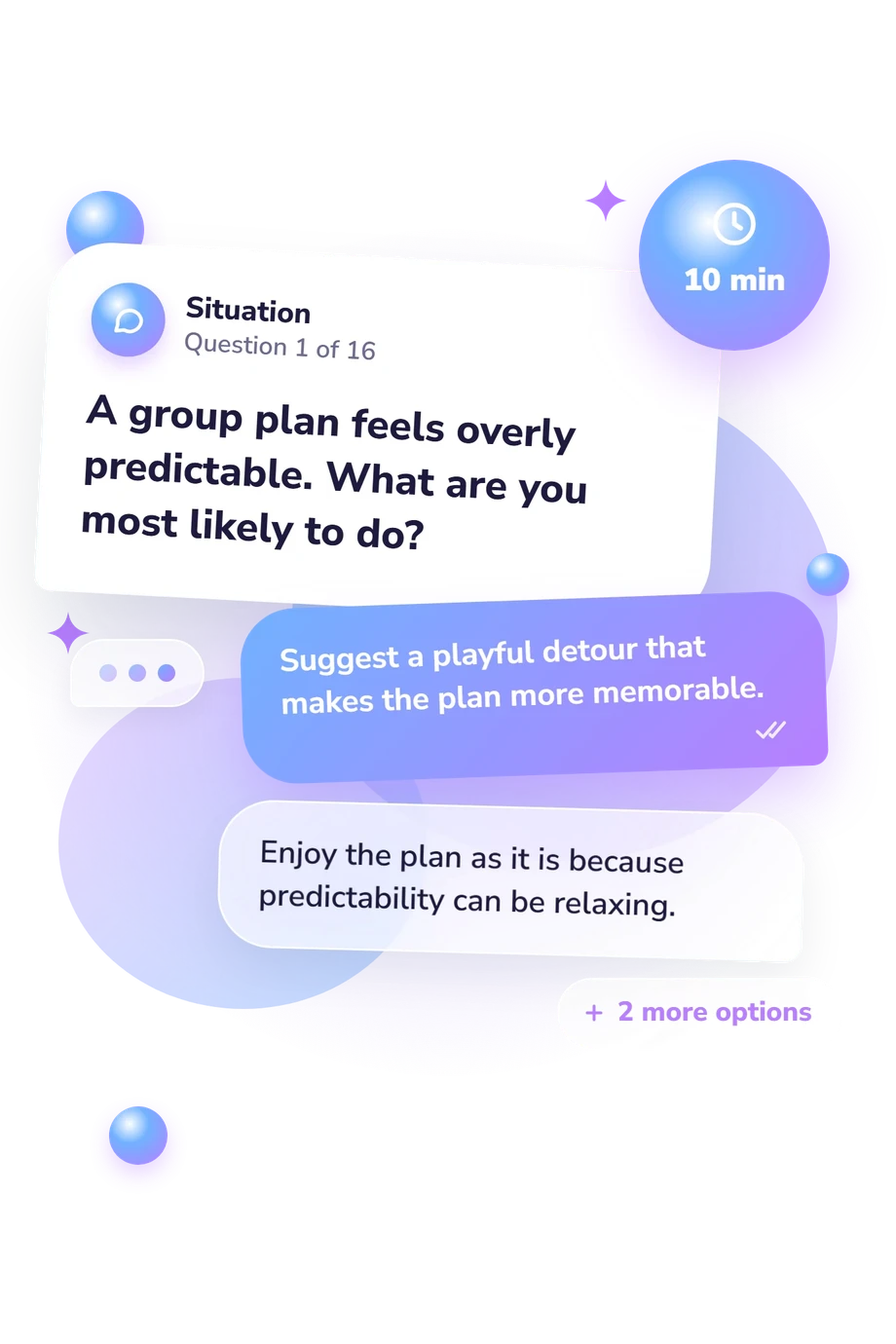
- Suggest a playful detour that makes the plan more memorable.
- Enjoy the plan as it is because predictability can be relaxing.
- Offer one alternative and let the group decide.
- Add a small spontaneous stop without changing much.
- Describe the type of cloud if I recognize it.
- Name the first creature it resembles.
- Invent a tiny story about where the cloud is traveling.
- Ask what they see before sharing my own idea.
- Play it louder and invite them to admit it is catchy.
- Laugh along but switch to something everyone likes.
- Explain why I like it without making a big moment of it.
- Keep it for my own playlists from then on.
What Hello Kitty Character Are You Quiz - Description and methodology of the test
Readers who enjoy playful self-reflection can use this questionnaire to connect ordinary choices with familiar Sanrio character styles. The What Hello Kitty Character Are You Quiz is intended for anyone curious about which qualities feel most like their own. It offers a comparative profile rather than a ranking of people. The Hello Kitty personality quiz creates an easy prompt for discussing warmth and individuality.
What This Assessment Explores
Items cover spontaneity, imagination, inclusion, self-expression, care, and adaptability. This Sanrio character quiz groups those patterns into four character-affinity scales:
- Cinnamoroll (0-12) measures imagination, easygoing adaptability, and calming companionship; Grounded Dreamer (0-4), Breezy Explorer (5-8), and Cloudlike Companion (9-12) are bands.
- Hello Kitty (0-12) measures welcoming optimism and social thoughtfulness; Independent Warmth (0-4), Friendly Presence (5-8), and Heart of the Group (9-12) are bands.
- Kuromi (0-12) measures bold individuality, playful edge, and determined self-expression; Understated Rebel (0-4), Spirited Original (5-8), and Bold Mischief-Maker (9-12) are bands.
- My Melody (0-12) measures gentle sincerity, cozy sensibility, and quiet attentiveness; Practical Softness (0-4), Tender Spirit (5-8), and Gentle Heart (9-12) are bands.
The highest score indicates strongest affinity, while scores within one point suggest a blended profile.
Methodology and Scientific Basis
Methodologically, this self-report exercise uses situational prompts with four response options and comparative character totals. Scenarios cover social behavior, emotional support, creativity, independence, comfort, and reactions to change, allowing comparison across four characters. The Sanrio personality test compares those totals rather than applying a symptom checklist or clinical model.
The character portrayals are conceptually consistent with the descriptions summarized by Humphrey and Hagan (2023) and Sanrio’s official descriptions of the four figures. Situations such as welcoming a newcomer, supporting a tired friend, handling changed plans, or expressing an unusual preference give those fictional qualities concrete contexts. Together, these descriptions supply the fictional qualities used to interpret each character-affinity score.
Scoring is comparative: each character receives a displayed total, and the leading total represents closest overall affinity. The answer-to-point formula is not displayed, so readers should focus on the profile pattern rather than reverse-engineering a formula. Because responses can shift with mood, context, and self-awareness, this Hello Kitty character test is best read as a playful snapshot rather than a fixed personality judgment.
- Humphrey, Kristen Tafoya, and Merrill Hagan. Hello Kitty and Friends Character Guide. Running Press Kids, 2023. ISBN 9780762483648.
- Sanrio Company, Ltd. HELLO KITTY; CINNAMOROLL; KUROMI; MY MELODY. Sanrio Company, Ltd., n.d. Accessed September 24, 2026.
- Kosinski, Michal, David Stillwell, and Thore Graepel. Private traits and attributes are predictable from digital records of human behavior. Proceedings of the National Academy of Sciences, 110(15), 5802-5805, 2013. 10.1073/pnas.1218772110
Updated: