
What Am I Passionate About Quiz
How the Scales are Structured
Who Usually Takes This Test?
See How You Compare
Below is a preview of how scores are typically distributed across each scale.
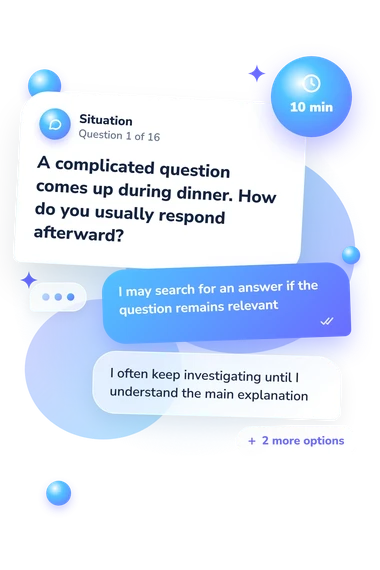
Example Questions From the Test
- Look for reliable sources and compare the reasoning on both sides
- Discuss how the claim might affect people in real life
- Set it aside unless it changes a decision I need to make
- Think of an engaging way to communicate the disagreement
- Enjoy it briefly, then return to whatever I was doing
- Tell someone about it and see how they react
- Turn it into a draft, sketch, recording, concept, or experiment
- Research whether someone has already explored something similar
- Working steadily toward a difficult, visible milestone
- Exploring links among ideas, evidence, or unfamiliar subjects
- Sharing stories and conversation with people I value
- Experimenting with ways to present an idea in an original form
What Am I Passionate About Quiz - Description and methodology of the test
People who feel pulled in several directions can use the What Am I Passionate About Quiz to organise recurring sources of energy into a clearer profile. It suits anyone reflecting on hobbies, study, work, or future goals. The result works like a what is my passion quiz: it points to motivational themes that may sustain interest, rather than naming one permanent calling.
What This Assessment Explores
The questionnaire maps passion across activities rather than assigning one job title. It helps people compare motivation in hobbies, learning, projects, and relationships.
As a find your passion quiz, it describes tendencies, not one permanent answer. The four dimensions are:
- Building & Achieving (0-12) captures motivation from structure, obstacles, progress, and completion; bands: Flexible momentum 0-4, Motivated builder 5-8, Strong achievement affinity 9-12.
- Creating & Expressing (0-12) captures energy from making, imagining, and communicating personally; bands: Occasional outlet 0-4, Active creative pull 5-8, Strong expressive affinity 9-12.
- Discovering & Understanding (0-12) captures curiosity about explanations, subjects, and how things work; bands: Practical curiosity 0-4, Engaged explorer 5-8, Strong discovery affinity 9-12.
- Helping & Connecting (0-12) captures purpose from supporting, including, and empowering people; bands: Selective connection 0-4, Meaningful people focus 5-8, Strong contribution affinity 9-12.
Methodology and Scientific Basis
Each of the 16 items presents a situation and four response options. The choices represent different motives, so the format asks which response feels most natural rather than how often a behaviour occurs. It is a comparative self-report exercise.
Responses form four thematic totals. The highest total marks the strongest affinity; totals within one point indicate a blended pattern. A passion quiz result is comparative, not a ranking of ability.
Its conceptual reference is the Passion Scale (Vallerand et al., 2003), which distinguishes harmonious engagement from controlling, obsessive involvement. This questionnaire is not that published instrument or a direct adaptation. It is conceptually consistent with later passion-measurement work by Sigmundsson, Haga, and Hermundsdottir (2020) and with Dahl and Nierenberg’s (2021) interest-development model.
No norms, reliability estimates, or clinical cutoffs are established for this questionnaire. A find my passion quiz result can shift with mood, current opportunities, and self-awareness, so treat it as a snapshot and compare it with repeated reflection and lived experience.
- Vallerand, Robert J., Celine Blanchard, Genevieve A. Mageau, Richard Koestner, Catherine Ratelle, Maude Leonard, Marylene Gagne, and Josee Marsolais. (2003). Les passions de l'ame: On obsessive and harmonious passion. Journal of Personality and Social Psychology, 85(4), 756-767. 10.1037/0022-3514.85.4.756
- Sigmundsson, H., Haga, M., and Hermundsdottir, F. (2020). The passion scale: Aspects of reliability and validity of a new 8-item scale assessing passion. New Ideas in Psychology, 56, 100745. 10.1016/j.newideapsych.2019.06.001
- Dahl, Tove I., and Ellen Nierenberg. (2021). Here's the TRIQ: The Tromso Interest Questionnaire Based on the Four-Phase Model of Interest Development. Frontiers in Education, 6, 716543. 10.3389/feduc.2021.716543
Updated: