
Vaccine Quiz
How the Scales are Structured
Who Usually Takes This Test?
See How You Compare
Below is a preview of how scores are typically distributed across each scale.
Example Questions From the Test
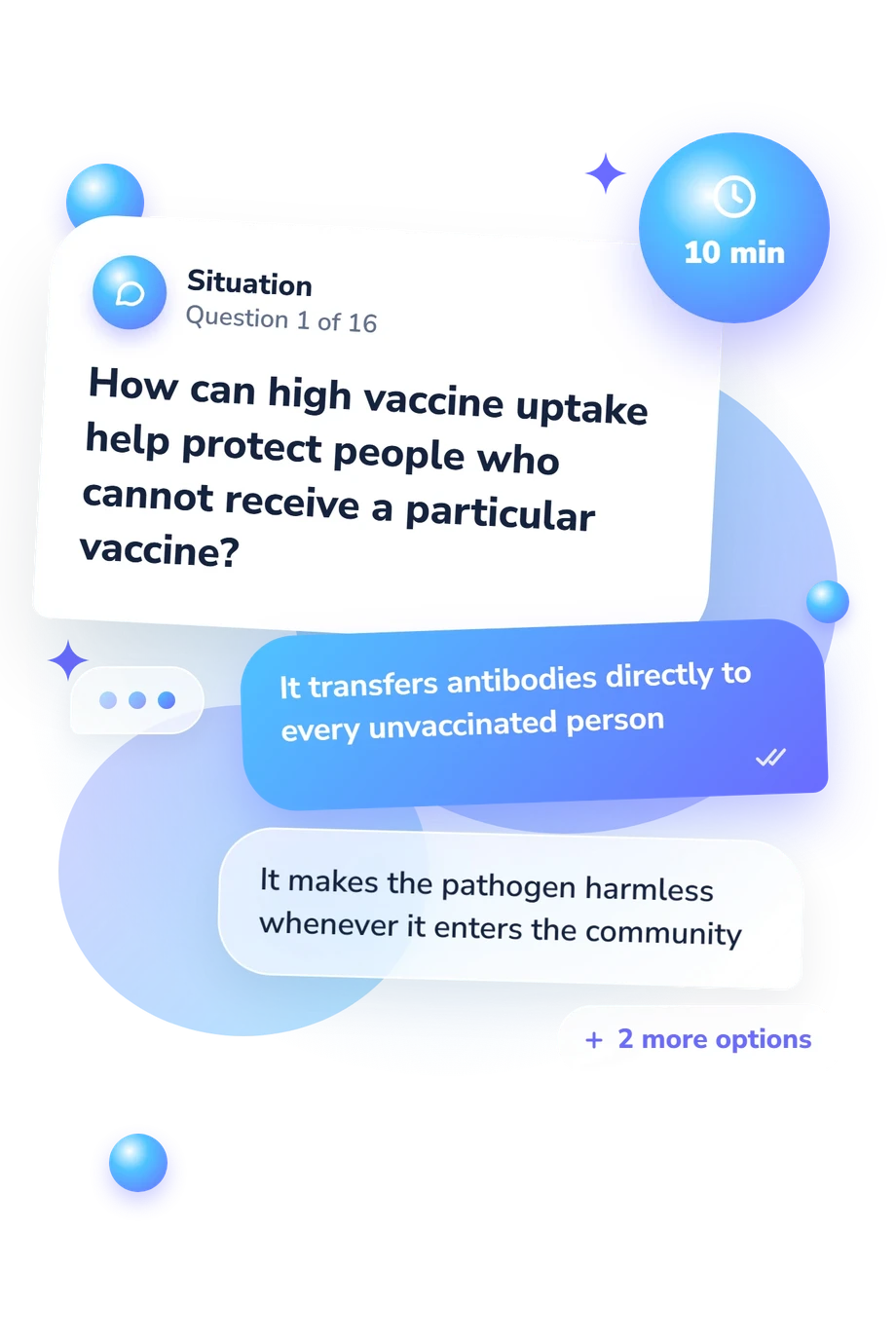
- It transfers antibodies directly to every unvaccinated person
- It makes the pathogen harmless whenever it enters the community
- It can reduce opportunities for the pathogen to spread through the community
- It guarantees that no vaccinated person can carry the pathogen
- A person's immune system responds more quickly after a booster dose
- A person produces immune memory after vaccination
- A population reduces transmission through widespread immunity
- A person receives prepared antibodies that offer immediate but temporary protection
- Measles
- Polio
- Smallpox
- Tetanus
Vaccine Quiz - Description and methodology of the test
People who want to check how confidently they understand vaccination principles can use this vaccine quiz as a focused educational self-assessment. This immunization quiz helps readers review immunity, public-health decisions, and everyday claims about prevention. The result places overall vaccine knowledge in one educational band, giving you a clear starting point for informed conversations and further learning.
What This Assessment Explores
The assessment examines vaccine knowledge rather than personal eligibility. Its items cover immune memory, passive immunity, population protection, disease eradication, storage, vaccine types, efficacy, boosters, mRNA, breakthrough infection, and situations needing clinical review.
For readers working through vaccination quiz questions, the main challenge is applying knowledge to realistic statements rather than recalling definitions. The result reflects recognition of core mechanisms and the ability to distinguish vaccination from treatments such as antibiotics.
Together, these themes test whether a reader can connect immune principles with timing, storage, prevention, and appropriate clinical review.
The result uses one scale, Vaccine Knowledge (0-16), with three bands:
- Foundations to build (0-6) signals that several core ideas need review.
- Developing knowledge (7-12) shows many essentials, with distinctions such as efficacy and adverse-event interpretation still to refine.
- Strong knowledge (13-16) reflects a well-rounded grasp for common scenarios.
Methodology and Scientific Basis
Each item presents a short question or scenario with four answer choices. The respondent selects the best-supported response, moving between factual recognition and interpretation of claims about immunity, exposure, protection, and treatment.
The instrument therefore works as a vaccine knowledge test with a descriptive educational result. The score is presented as an unvalidated educational result, with no documented clinical decision rule or established norms.
Conceptually, it is consistent with Zingg and Siegrist's one-dimensional vaccine-knowledge scale and with the childhood-vaccination knowledge test evaluated by Kocoglu-Tanyer and Yorulmaz Demir. The latter illustrates Rasch-based psychometric evaluation, but those studies do not validate this online questionnaire, which is not a published scale or a validated adaptation of either instrument.
Interpret the result as a guide to topics you understand or need to revisit. Responses can reflect memory, wording, current exposure to information, and attention to each option. It cannot determine whether a specific vaccine is suitable; that requires individualized advice from a qualified clinician or public-health service.
- Zingg, Alexandra, and Michael Siegrist. “Measuring people's knowledge about vaccination: Developing a one-dimensional scale.” Vaccine 30, no. 25 (2012): 3771-3777. 10.1016/j.vaccine.2012.03.014
- Kocoglu-Tanyer, Deniz, and Deniz S. Yorulmaz Demir. “Development and psychometric evaluation of the vaccine knowledge test for childhood vaccinations: using Rasch analysis.” BMC Public Health 25 (2025): 2449. 10.1186/s12889-025-23671-7
Updated: