
Username Quiz
How the Scales are Structured
Who Usually Takes This Test?
See How You Compare
Below is a preview of how scores are typically distributed across each scale.
Example Questions From the Test
- Using several silent or intentionally misspelled letters
- Alternating frequently between uppercase and lowercase characters
- Choosing clear spelling and limiting ambiguous characters
- Using multiple characters that look alike, such as O and 0
- To prove that the account holder is a real person
- To encrypt information sent by the account
- To identify an account or profile within the service
- To replace the need for a password
- CedarSketch
- CedarSketch947261
- CedarrSketcch
- c3darsk3tch
Username Quiz - Description and methodology of the test
People choosing a public identity, portfolio handle, gaming name, or community profile can use this username quiz to examine the practical decisions behind an online identifier. It focuses on clarity, privacy, discoverability, impersonation risk, and account protection, using practical situations to show knowledge demonstrated by your responses and highlight topics worth reviewing. Through this username generator quiz, you can assess generated username ideas as choices you can explain and maintain.
What This Assessment Explores
An online username can carry social, practical, and security consequences. The items consider continuity across services, clear spelling, personal clues, discoverability, display names, availability, and impersonation. This username maker quiz turns these trade-offs into practical criteria for choosing a handle.
The questions cluster around three themes:
- Identity continuity shows whether a name remains recognizable as work or interests change.
- Clarity and memorability indicate how easily others can read, recall, and repeat the handle.
- Privacy, security, and impersonation awareness reflect whether the name exposes personal clues or resembles another account, while keeping username and password roles distinct.
These themes feed Username Knowledge (0-16). Foundations to Build (0-6) means basics need strengthening; Developing Knowledge (7-12) shows room to refine; Strong Knowledge (13-16) indicates practical understanding. The result covers username design, identity, privacy, and security, not guaranteed account safety.
Methodology and Evidence Base
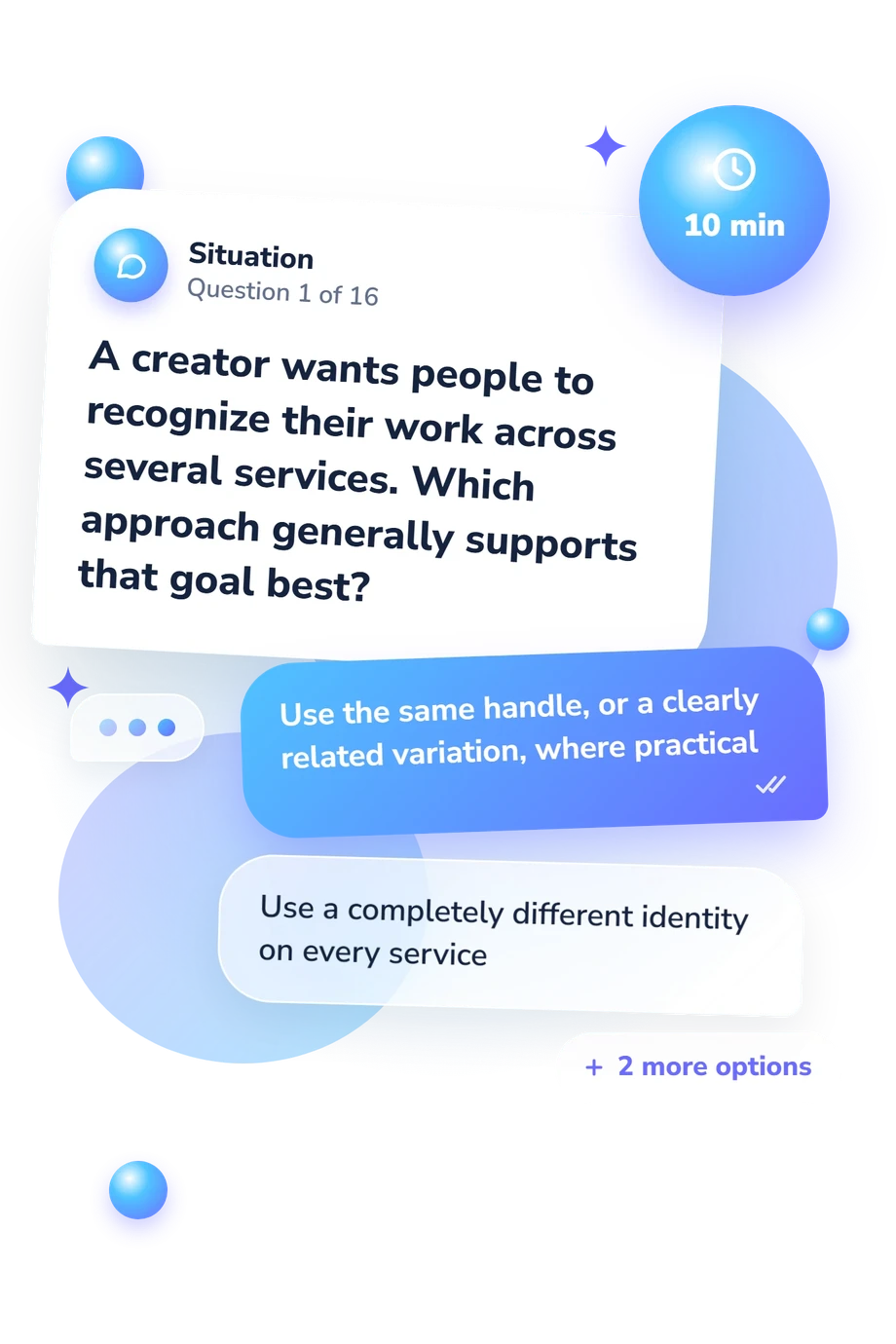
Each item presents an online situation or direct question with four choices. The scenario-based educational questionnaire asks readers to apply judgment to recognizability, privacy, platform rules, passwords, and impersonation. The assessment works as a what should my username be quiz, helping a reader decide what type of username fits their identity, privacy, and usability goals, not style alone.
The questionnaire reports this educational scale and its stated interpretation, so the result is read as knowledge of username design, identity, privacy, and security. Because the items ask for judgments about hypothetical situations, results depend on current knowledge, reading of the scenario, and response bias.
Research on username uniqueness and cross-service identity linkage connects reused identifiers with traceability and linkability; it does not validate this questionnaire or establish its clarity, memorability, or score. Research on profile-name reuse adds context, while work on the value people place on online identifiers explains why a stable handle matters.
Together, these sources support the subject matter; they do not validate this exact item set. Platform rules change, so a sound choice for one service may need adjustment elsewhere.
- Perito, Daniele, Claude Castelluccia, Mohamed Ali Kaafar, and Pere Manils. (2011). How Unique and Traceable Are Usernames? In Privacy Enhancing Technologies: 11th International Symposium, PETS 2011, Lecture Notes in Computer Science, vol. 6794, pp. 1-17. Springer. 10.1007/978-3-642-22263-4_1. (.au)
- Mariconti, Enrico, Jeremiah Onaolapo, Syed Sharique Ahmad, Nicolas Nikiforou, Manuel Egele, Nick Nikiforakis, and Gianluca Stringhini. (2016). Why Allowing Profile Name Reuse Is A Bad Idea. Proceedings of the 9th European Workshop on System Security (EuroSec '16), pp. 1-6. ACM. 10.1145/2905760.2905762. (cordis.europa.eu)
- Mueller, Milton L., Yuri Park, Jongsu Lee, and Tai Yoo Kim. (2006). Digital identity: How users value the attributes of online identifiers. Information Economics and Policy, 18(4), 405-422. 10.1016/j.infoecopol.2006.04.002.
Updated: