
Unit 6 Claims and Evidence Reading Quiz
How the Scales are Structured
Who Usually Takes This Test?
See How You Compare
Below is a preview of how scores are typically distributed across each scale.
Example Questions From the Test
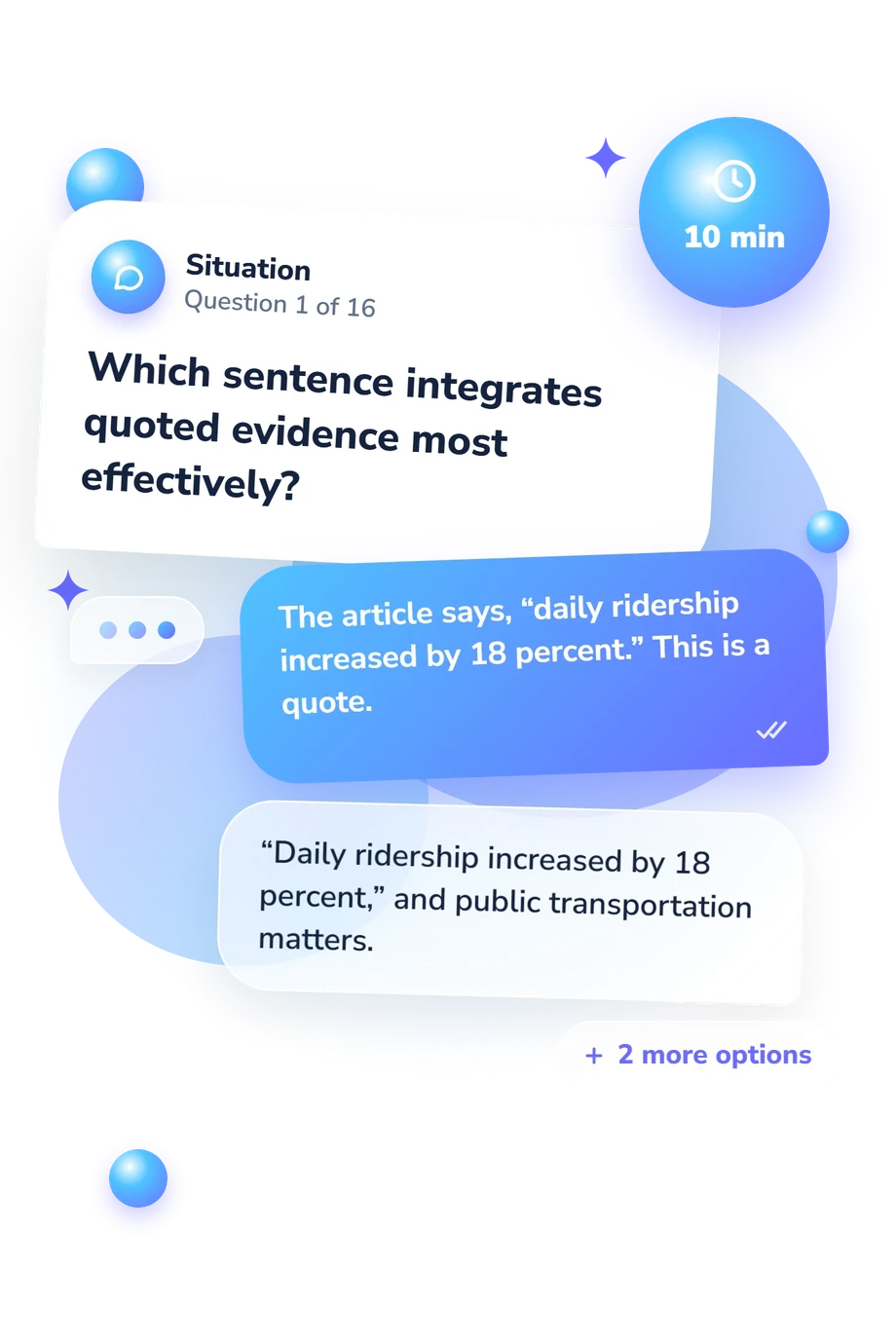
- The article says, “daily ridership increased by 18 percent.” This is a quote.
- “Daily ridership increased by 18 percent,” and public transportation matters.
- The transit report supports the expansion claim by noting that “daily ridership increased by 18 percent” after the new route opened.
- The new route was successful. “Daily ridership increased by 18 percent.” There are many opinions about routes.
- A librarian’s statement that the building looks welcoming in the evening
- A list of novels that students borrowed during the previous month
- A photograph of students standing near the library entrance before school
- Usage records and a student survey showing substantial demand for quiet study space after the current closing time
- To replace evidence with the author’s personal confidence
- To explain how the evidence supports the claim
- To introduce a new topic unrelated to the central claim
- To repeat the evidence word for word without interpreting it
Unit 6 Claims and Evidence Reading Quiz - Description and methodology of the test
For students, educators, and independent learners who want a clearer picture of their argument-reading knowledge, this quiz examines how they decide what a text actually supports. The Unit 6 Claims and Evidence Reading Quiz helps learners check readiness for coursework and identify whether further practice should focus on structure, relevance, or calibrated conclusions.
What This Assessment Explores
The questions examine decisions in argumentative reading: identifying an author’s position, choosing support that bears on it, and judging whether a conclusion exceeds the facts. They test source authority, relevance, sufficiency, counterclaims, and the difference between evidence and inference. Together, these argument analysis skills appear in three areas:
- Claim recognition shows whether you can identify the position a writer wants readers to accept.
- Evidence judgment shows whether you can select relevant, direct, and sufficient support.
- Reasoning and inference show whether you can connect evidence to a conclusion without overstating it.
The result is Claims and Evidence Reading Knowledge, scored from 0-16. Foundations (0-6) signals recognition of claims, evidence, and reasoning; Developing (7-12) reflects evaluation with room to refine judgments about relevance, sufficiency, and inference; Strong command (13-16) indicates consistent evaluation of how support and reasoning work together.
Methodology and Evidence Base
Each item uses a selected-response format with four answer choices. You compare evidence, assess source authority, identify a supported inference, or revise a conclusion so its certainty matches the data. The questions sample argument-reading performance rather than a broad personality trait, and the output is one knowledge score interpreted through the displayed bands.
The conceptual framework is consistent with Christodoulou and Diakidoy (2020), which connects argument knowledge with comprehension and critical evaluation. Münchow et al. (2019) offer related evidence on evaluating arguments in scientific texts. This questionnaire is conceptually consistent with those studies, not an adaptation of either. Toulmin’s model clarifies links among claims, grounds, and reasoning, while College Board (2024) supports the emphasis on evidence, commentary, and counterclaims.
The items also require comparisons of source authority, relevance, and sufficiency, plus caution about causal conclusions. Read the result as a snapshot: attention, familiarity with academic language, and careful comparison of all four choices can affect performance. It can guide study of evaluating evidence, but it does not establish general reading ability across every subject.
- Christodoulou, Stelios A., and Irene-Anna N. Diakidoy. The contribution of argument knowledge to the comprehension and critical evaluation of argumentative text. Contemporary Educational Psychology, 63, 101903 (2020). 10.1016/j.cedpsych.2020.101903
- Münchow, Hannes, Tobias Richter, Sarah von der Mühlen, and Sebastian Schmid. The ability to evaluate arguments in scientific texts: Measurement, cognitive processes, nomological network, and relevance for academic success at the university. British Journal of Educational Psychology, 89(3), 501-523 (2019). 10.1111/bjep.12298
- Toulmin, Stephen Edelston. The Uses of Argument. Cambridge University Press, 1958.
- College Board. AP English Language and Composition Course and Exam Description, Version 1. 2024.
Updated: