
Telugu Movie Quiz
How the Scales are Structured
Who Usually Takes This Test?
See How You Compare
Below is a preview of how scores are typically distributed across each scale.
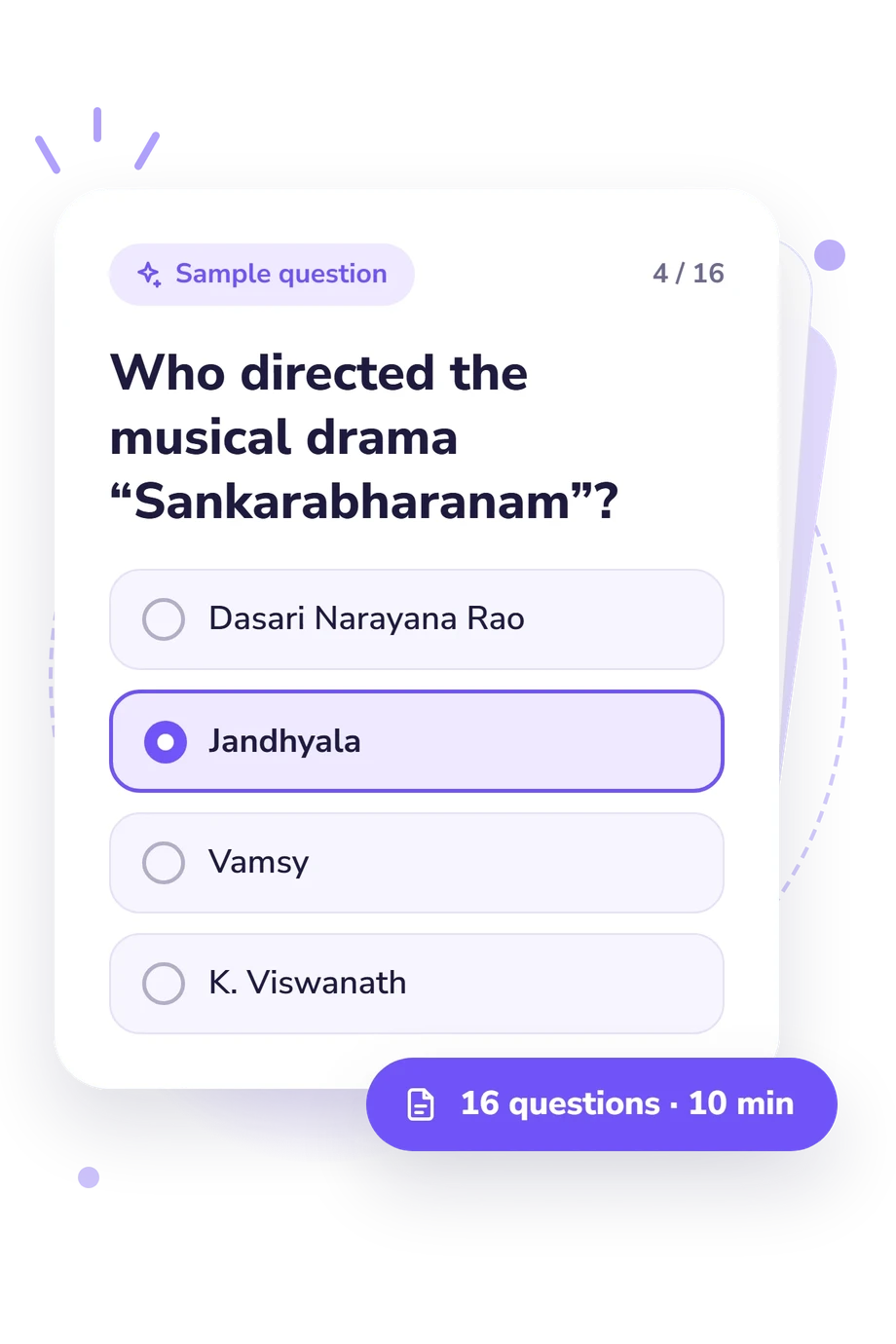
Example Questions From the Test
- Vedam
- C/o Kancharapalem
- Manu
- Chandamama Kathalu
- Sukumar
- Trivikram Srinivas
- S. S. Rajamouli
- Koratala Siva
- Dasari Narayana Rao
- Jandhyala
- Vamsy
- K. Viswanath
Telugu Movie Quiz - Description and methodology of the test
Whether you are a devoted Telugu film follower or still building familiarity with cinema from Andhra Pradesh and Telangana, this telugu movie quiz tests recognition of performers, directors, characters, songs, stories, and milestones. It suits viewers choosing what to watch next, revisiting favorites, or using a score to identify areas for wider exploration. As a telugu cinema quiz, it turns recognition into a practical viewing guide.
What the Test Measures
The questionnaire treats film knowledge as recognition across periods, genres, creative roles, and story details rather than personal taste. Its clues range from early talkies and landmark classics to blockbusters, linking titles with filmmakers, performers, plots, songs, characters, and reference points.
The result combines one overall scale with these areas:
- Telugu Movie Knowledge: 0-16 records correct identifications; 0-6 is Starting Viewer, 7-12 is Developing Movie Buff, and 13-16 is Telugu Cinema Expert.
- Film history and roles reflect recognition of early releases, landmark works, actors, directors, and central characters.
- Stories and music capture recall of plots, songs, adaptations, and cultural references.
The test suits casual viewers and fans. A higher result indicates broader recall across the sampled material, not better taste or complete mastery. Reviewing telugu film quiz questions and answers can help turn unfamiliar titles into a personal watchlist.
Methodology and Evidence Base
Each item gives a clue or description with four answer choices. Selecting an answer tests recognition and recall rather than open-ended writing. One point goes to each correct response, and the total is read through the displayed bands.
This is an online knowledge check, not a standardized scale or clinical assessment. Its cultural framing is consistent with Murthy et al. (2015) on Telugu film communication and Srinivas (2018) on Telugu cinema's social and political history. Bhrugubanda (2018) adds context on cinema, religion, devotion, and politics in South India. Together, these sources support its interpretive frame; they do not make this questionnaire an adaptation of their instruments or validate it.
Results provide a snapshot shaped by viewing history, language exposure, memory, and current recall. When reviewing telugu cinema quiz questions and answers, remember widely circulated landmarks may appear more often than obscure titles. That emphasis reflects its mix of classics and popular releases. Missed items can become a watchlist, and the questions also work as games built around Telugu movies, turning unfamiliar films into prompts for further viewing.
- Murthy, C. S. H. N., Oinam Bedajit Meitei, and Amrita Barua. (2015). Breaking Western Filmmaking Models: An Unexplored Indian Frame of Film Communication-Evidence From Telugu Cinema. Journal of Communication Inquiry, 39(1), 38-62. 10.1177/0196859914549889
- Srinivas, S. V. (2018). Politics as Performance: A Social History of the Telugu Cinema. Permanent Black.
- Bhrugubanda, Uma Maheswari. (2018). Deities and Devotees: Cinema, Religion, and Politics in South India. Oxford University Press. 10.1093/oso/9780199487356.001.0001
Updated: