
Spanking Quiz
How the Scales are Structured
Who Usually Takes This Test?
See How You Compare
Below is a preview of how scores are typically distributed across each scale.
Example Questions From the Test
- Move to a safer, quieter place, use a brief limit, and offer manageable choices once the child can respond
- Threaten a punishment that will happen several days later
- Debate the rule in detail while the child is overwhelmed
- Buy the requested item immediately and explain the limit at home
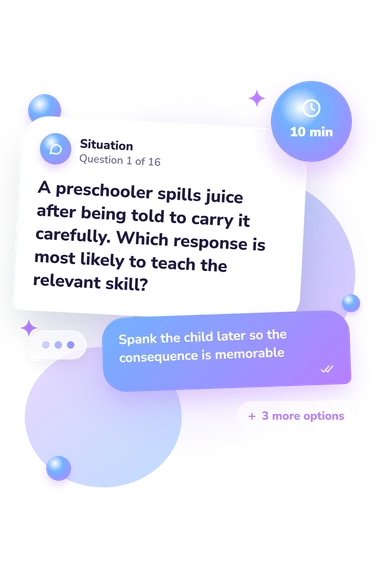
- Spank the child later so the consequence is memorable
- Remove an unrelated toy for the rest of the week
- Give a long lecture about responsibility before cleaning the spill
- Help clean the spill and practice carrying a smaller, safer amount
- Adding an extra chore after a household rule is broken
- Removing screen time after toys are left on the floor
- Praising a child for putting toys away and giving them extra story time
- Excusing a disliked task when a child complains loudly
Spanking Quiz - Description and methodology of the test
Parents, caregivers, educators, and other adults who want a clearer way to think about physical discipline can use the spanking quiz to examine knowledge rather than personal worth. The child discipline quiz focuses on practical choices, research findings, legal variation, and safeguarding responses, helping readers understand their overall knowledge level and recognize which principles deserve further attention before a difficult situation arises.
What This Assessment Explores
Rather than judging a caregiver, the assessment examines knowledge that supports safer decisions around children. It suits parents, caregivers, teachers, relatives, and other adults who may respond to behavior or notice a safeguarding concern.
The question themes cover these practical dimensions:
- Developmentally appropriate discipline measures whether the respondent can choose calm, nonphysical responses that teach skills and set limits.
- Research literacy measures whether the respondent can separate population-level evidence from claims about every individual child's future.
- Safety and legal awareness measures recognition of injury, fear, excessive force, local legal variation, and prompt support.
- Supportive intervention measures whether the respondent can pause escalation, involve professionals, and respond constructively.
Questions about corporal punishment distinguish immediate compliance from lasting learning. These themes connect practical decisions with how evidence is interpreted. The result is shown on Spanking Knowledge (0-16): Foundations to build (0-6), Developing knowledge (7-12), or Strong knowledge (13-16).
Methodology and Evidence Base
Methodologically, the questionnaire uses single-answer multiple choice: each item offers four alternatives, and the respondent selects the response best aligned with child development, evidence, safety, or safeguarding principles. The items cover everyday discipline, evidence, law, escalation, injury, and disclosures.
Because the questionnaire tests spanking knowledge, it produces one educational score rather than separate subscale results. Its bands distinguish foundational knowledge needing review, developing understanding, and strong recognition of safer discipline and support principles. A score should be read alongside situations raised; it does not erase the importance of a concerning event.
The questionnaire is conceptually consistent with Gershoff and Grogan-Kaylor (2016), whose meta-analysis links spanking with harmful child outcomes without predicting every individual child's future. Nonphysical-discipline guidance is consistent with Sege et al. (2018), while the safeguarding emphasis reflects General Comment No. 8. It is not presented as an adaptation of one published instrument.
The score is unvalidated and educational. Self-report may be shaped by memory, context, social desirability, or limited self-awareness, while law and safeguarding procedures vary locally. Use the result to identify learning needs, not as a clinical or legal determination.
- Gershoff, Elizabeth T., and Andrew Grogan-Kaylor. "Spanking and Child Outcomes: Old Controversies and New Meta-Analyses." Journal of Family Psychology 30, no. 4 (2016): 453-469. 10.1037/fam0000191
- Sege, Robert D., Benjamin S. Siegel, Council on Child Abuse and Neglect, and Committee on Psychosocial Aspects of Child and Family Health. "Effective Discipline to Raise Healthy Children." Pediatrics 142, no. 6 (2018): e20183112. 10.1542/peds.2018-3112
- United Nations Committee on the Rights of the Child. "General Comment No. 8 (2006): The Right of the Child to Protection from Corporal Punishment and Other Cruel or Degrading Forms of Punishment (Arts. 19; 28, Para. 2; and 37, Inter Alia)." CRC/C/GC/8. Geneva: United Nations, 2007.
Updated: