
Soul Type Quiz
How the Scales are Structured
Who Usually Takes This Test?
See How You Compare
Below is a preview of how scores are typically distributed across each scale.
Example Questions From the Test
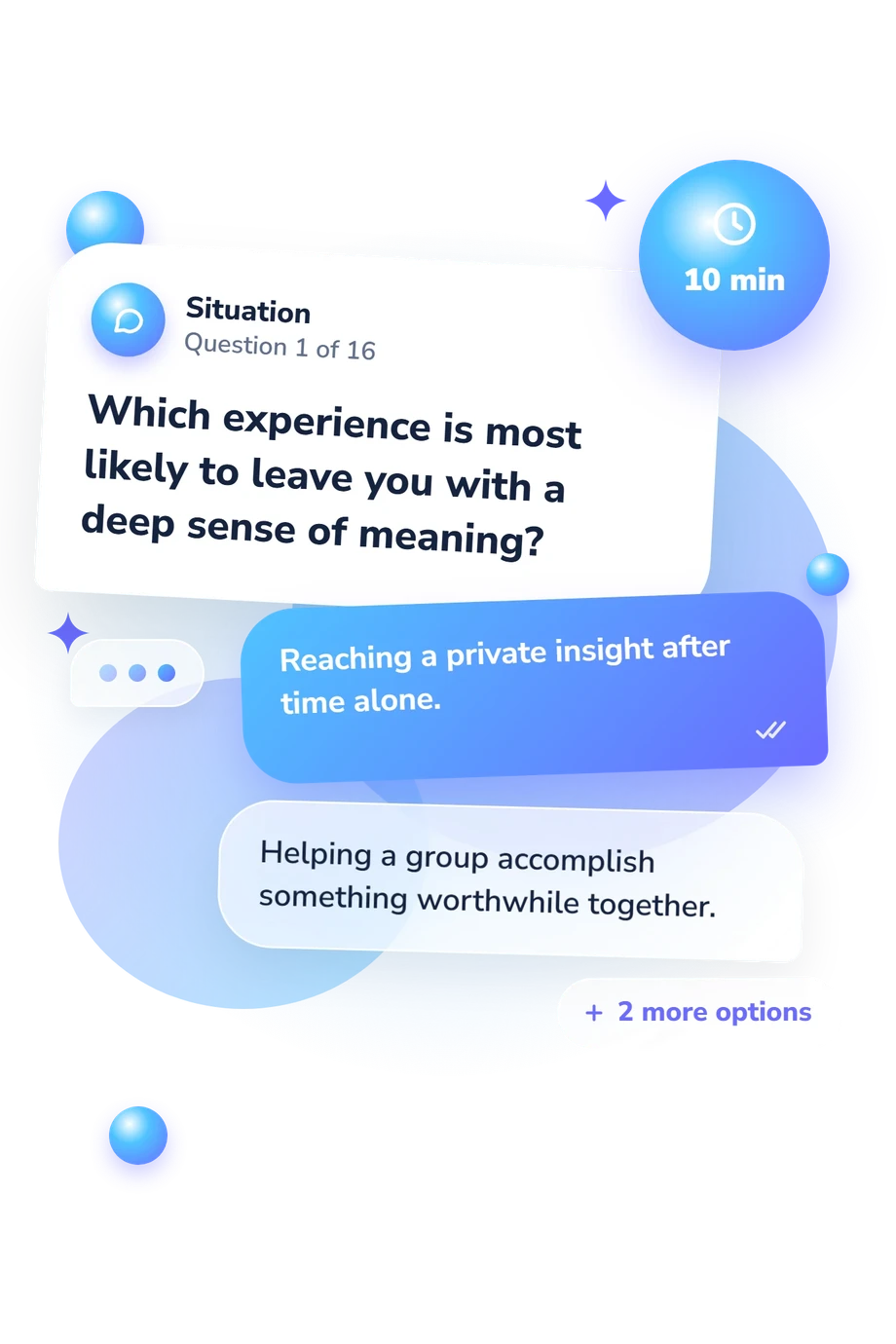
- Reaching a private insight after time alone.
- Helping a group accomplish something worthwhile together.
- Feeling mutual warmth and belonging with people I trust.
- Knowing my presence helped someone feel understood or less alone.
- Questions that keep opening into deeper questions.
- Direct experiences that shift how I see ordinary life.
- Wisdom shared through a trusted community.
- Rituals whose familiarity creates a sense of continuity.
- Keeping the evening for solitary rest or reflection.
- Stopping by a larger event briefly, without taking on a role.
- Spending unhurried time with one person I care about.
- Bringing a few people together in a warm, welcoming setting.
Soul Type Quiz - Description and methodology of the test
For readers who want to examine how personal priorities appear in everyday choices, this soul type quiz offers a reflective profile of meaning-making. Someone using the what kind of soul do i have quiz can compare their instincts across solitude, relationships, commitments, and uncertainty. These comparisons help you distinguish the four dimensions in your own responses. The result is a current pattern, not a permanent identity.
What This Assessment Explores
Questions about solitude, shared projects, spiritual grounding, care, tradition, and uncertainty show how meaning is approached in lived situations. This questionnaire about spiritual meaning is intended for self-reflection and helps connect choices in daily situations with broader routes to purpose.
Four dimensions organize the profile:
- The Creator (0-12) reflects imagination and original expression: Practical Interpreter (0-4), Adaptive Maker (5-8), or Visionary Creator (9-12).
- The Guardian (0-12) reflects stewardship and continuity: Flexible Free Spirit (0-4), Steady Steward (5-8), or Devoted Guardian (9-12).
- The Nurturer (0-12) reflects compassionate connection: Independent Heart (0-4), Caring Connector (5-8), or Heart-Centered Nurturer (9-12).
- The Seeker (0-12) reflects inquiry and open-ended exploration: Rooted Perspective (0-4), Curious Explorer (5-8), or Questing Seeker (9-12).
Together, the dimensions show which routes to purpose are most active in the respondent’s present outlook.
Methodology and Evidence Base
Each prompt presents a recognizable situation and four response options. The respondent chooses the option that best matches a usual inclination, making the format closer to guided self-report than to a knowledge test. Answer choices represent different routes to meaning, and the result presents four dimension scores with descriptive bands; weighting of individual options is unspecified.
The method is conceptually consistent with SoMe, which treats meaning as multidimensional and connected with well-being. Spiritual significance also sits alongside the Spiritual Meaning Scale by Mascaro, Rosen, and Morey, while its distinction between an existing sense of meaning and active searching can be read with the Meaning in Life Questionnaire by Steger, Frazier, Kaler, and Oishi. This questionnaire is conceptually consistent with those instruments, not an adaptation or standardized administration of them.
For anyone using it as a meaning and purpose quiz, the bands are descriptive prompts rather than validated population norms or clinical cutoffs. Scores can reflect current circumstances, self-awareness, and interpretation of each scenario, so the profile is most useful as a snapshot for further reflection.
- Schnell, T. (2009). The Sources of Meaning and Meaning in Life Questionnaire (SoMe): Relations to demographics and well-being. The Journal of Positive Psychology, 4(6), 483-499. 10.1080/17439760903271074
- Mascaro, N., Rosen, D. H., & Morey, L. C. (2004). The development, construct validity, and clinical utility of the Spiritual Meaning Scale. Personality and Individual Differences, 37(4), 845-860. 10.1016/j.paid.2003.12.011
- Steger, M. F., Frazier, P. A., Kaler, M., & Oishi, S. (2006). The Meaning in Life Questionnaire: Assessing the presence of and search for meaning in life. Journal of Counseling Psychology, 53(1), 80-93. 10.1037/0022-0167.53.1.80
Updated: