
Soccer Grid Quiz
How the Scales are Structured
Who Usually Takes This Test?
See How You Compare
Below is a preview of how scores are typically distributed across each scale.
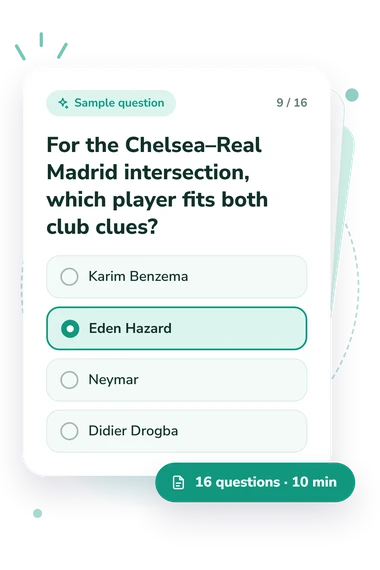
Example Questions From the Test
- José Mourinho
- Carlo Ancelotti
- Pep Guardiola
- Jürgen Klopp
- Steven Gerrard
- Luis Suárez
- David Villa
- Xavi
- Ruud Gullit
- Dennis Bergkamp
- Andrea Pirlo
- Arjen Robben
Soccer Grid Quiz - Description and methodology of the test
Fans seeking to benchmark football recall can use the soccer grid quiz to see how confidently connections come to mind. It suits supporters wanting a profile to guide review. The format primarily assesses football knowledge rather than physical ability, although its time limit can make pace relevant. As a soccer knowledge test, it can reveal where football memory is secure and which links deserve a closer look.
What This Assessment Explores
Each item asks the respondent to identify a footballer or manager who satisfies two clues, such as a club intersection, a national-team link, or a trophy combined with a former team. The options test recognition of senior careers and notable achievements, so the result reflects connected football knowledge rather than isolated name recall.
The test reports a Soccer Grid Knowledge score from 0-16. Its football grid quiz format assesses knowledge across clubs, national teams, trophies, and career paths. Its bands are:
- Foundation (0-6) shows recognition of some major names, while cross-club and country links remain difficult.
- Developing (7-12) indicates many accurate connections, with less familiar historical links still needing practice.
- Strong (13-16) reflects broad, reliable knowledge across the categories in the grid.
Methodology and Evidence Base
Behind the format is a multiple-choice grid task: each cell has one intended answer, and the respondent selects from four options. Methodologically, it is a cognitive knowledge task rather than a personality inventory. One point is awarded for every correct answer, and the result is an unofficial trivia classification, not an affiliation with any club, league, or governing body.
Its evidence base is conceptually consistent with research by Morris et al. (1981) examining football knowledge. This questionnaire is not presented as an adaptation of that published research. Williams et al. (1993) connect soccer knowledge with recognition demands in performance, while Haugaasen and Jordet (2012) place football expertise in a broader cognitive and developmental context. Together, these sources support the broader relevance of football knowledge and expertise, not this online test's exact career-linking design, norms, or scores.
Viewed as a football trivia quiz, the result is a snapshot of recall under the selected names and pairings. Familiarity with particular leagues, generations, countries, or competitions may affect performance. The displayed bands describe this result only, not overall football expertise.
- Morris, P. E., Gruneberg, M. M., Sykes, R. N., & Merrick, A. (1981). Football knowledge and the acquisition of new results. British Journal of Psychology, 72(4), 479-483. 10.1111/j.2044-8295.1981.tb01777.x
- Williams, M., Davids, K., Burwitz, L., & Williams, J. (1993). Cognitive knowledge and soccer performance. Perceptual and Motor Skills, 76(2), 579-593. 10.2466/pms.1993.76.2.579
- Haugaasen, M., & Jordet, G. (2012). Developing football expertise: a football-specific research review. International Review of Sport and Exercise Psychology, 5(2), 177-201. 10.1080/1750984X.2012.677951