
Snake Quiz
How the Scales are Structured
Who Usually Takes This Test?
See How You Compare
Below is a preview of how scores are typically distributed across each scale.
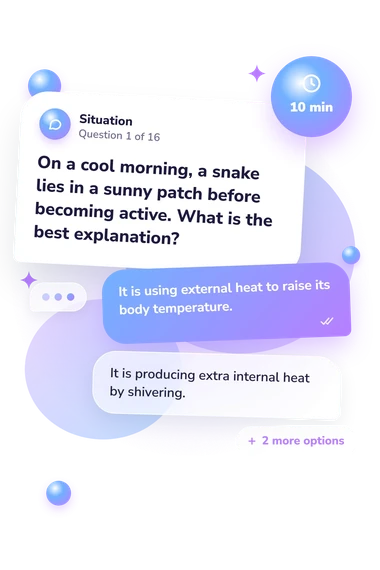
Example Questions From the Test
- It is using external heat to raise its body temperature.
- It is producing extra internal heat by shivering.
- It needs sunlight to activate its venom.
- It is absorbing energy directly through its scales as food.
- Cooling its mouth through evaporation
- Sending a visible warning signal to nearby prey
- Testing whether the ground can support its weight
- Sampling chemical cues that may help it follow the trail
- Some species lay eggs, while others give birth to live young.
- Every snake species lays hard-shelled eggs in a nest.
- All snakes carry developing young in external pouches.
- Snakes reproduce only once during their lives.
Snake Quiz - Description and methodology of the test
Curious learners, beginning naturalists, and anyone reviewing reptile biology can use this snake biology quiz to check factual understanding rather than personal opinion. This snake quiz connects visible traits with anatomy, behavior, movement, reproduction, ecology, and survival adaptations. The result summarizes performance across the covered topics and places it in one quiz-specific band. It supports focused self-reflection and helps direct review of missed content.
What This Assessment Measures
Items focus on natural-history knowledge rather than fear, preference, or handling confidence. They ask readers to reason about thermoregulation, shedding, senses, locomotion, feeding, reproduction, seasonal inactivity, food webs, and venom. The scope makes this a snake knowledge quiz linking adaptations with ecology.
Four areas organize the content:
- Anatomy and physiology show how eyes, lungs, skull joints, and heat-sensitive pits support survival.
- Behavior and senses explain defensive displays, tongue-flicking, chemical investigation, and environmental responses.
- Ecology and life history connect snakes with prey, habitats, reproduction, and seasonal conditions.
- Movement and feeding cover locomotion, constriction, swallowing, and related adaptations.
Together, these themes produce Snake Knowledge: 0-16. Foundation Builder (0-6) indicates basics to develop; Developing Naturalist (7-12) reflects broad working knowledge; Snake Savvy (13-16) reflects strong accuracy across covered topics. These bands describe this quiz only, not professional expertise or wild-snake handling skill.
Methodology and Scientific Basis
This fixed-choice format is best read as a structured learning check. Each item offers one best answer among four options, and the total summarizes performance across tested content. It rewards evidence-based explanations rather than reactions.
Vaughn et al. (2022) provide context for human-wildlife responses and the relationship between knowledge and tolerance. The biology content is consistent with Seigel, Collins, and Novak (1987) and Vitt and Caldwell (2013), which cover snake ecology, anatomy, physiology, behavior, and adaptations. This questionnaire is conceptually consistent with those works, not an adaptation of their studies.
Hooykaas et al. (2022) distinguish species identification from deeper knowledge of habitat, diet, and behavior, offering context for separating identification skill from broader natural-history knowledge.
One score is reported for the questionnaire, so the result provides a learning check rather than separate subscores for anatomy, behavior, or ecology. The displayed bands apply to this quiz only and do not establish professional expertise or skill in identifying or handling wild snakes. Results can guide further reading about the anatomy, behavior, ecology, movement, and adaptations represented in the questions, making the assessment a focused snake biology test.
- Vaughn, Audrey K., Lincoln R. Larson, M. Nils Peterson, and Lara B. Pacifici. 2022. Factors associated with human tolerance of snakes in the southeastern United States. Frontiers in Conservation Science 3:1016514. 10.3389/fcosc.2022.1016514
- Seigel, Richard A., Joseph T. Collins, and Susan S. Novak, editors. 1987. Snakes: Ecology and Evolutionary Biology. New York: Macmillan Publishing Company.
- Vitt, Laurie J., and Janalee P. Caldwell. 2013. Herpetology: An Introductory Biology of Amphibians and Reptiles. 4th ed. Amsterdam: Elsevier.
- Hooykaas, Michiel Jan Dirk, Menno Schilthuizen, Casper Johannes Albers, and Ionica Smeets. 2022. Species identification skills predict in-depth knowledge about species. PLOS ONE 17(4):e0266972. 10.1371/journal.pone.0266972