
Should I Get a Nose Job Quiz
How the Scales are Structured
Who Usually Takes This Test?
See How You Compare
Below is a preview of how scores are typically distributed across each scale.
Example Questions From the Test
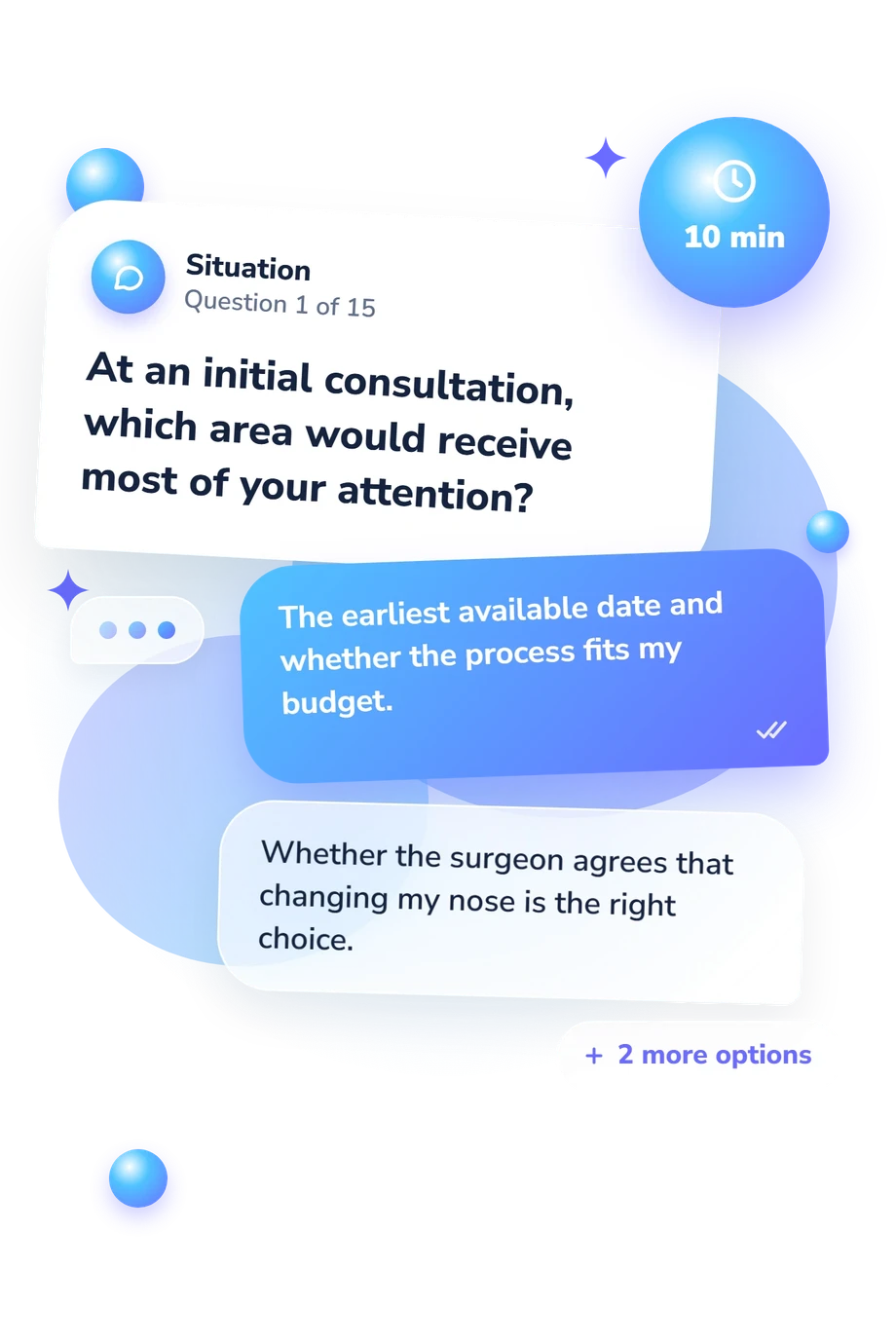
- The earliest available date and whether the process fits my budget.
- Whether the surgeon agrees that changing my nose is the right choice.
- Before-and-after examples and whether the surgeon understands my aesthetic goal.
- Qualifications, relevant experience, approach, risks, follow-up, and management of complications.
- I have compared surgery with doing nothing and reviewed the limits and risks of other options.
- I have thought seriously about both proceeding and leaving my nose unchanged.
- I have mostly treated temporary or nonsurgical procedures as equivalent substitutes.
- I have assumed surgery is the only meaningful response to my concern.
- A specific change, though I am still deciding how much difference I would want.
- Relief from criticism or greater security in a relationship.
- A realistic improvement that may not change my confidence or life overall.
- A major boost in confidence, dating, work, or social acceptance.
Should I Get a Nose Job Quiz - Description and methodology of the test
People weighing elective nasal surgery may use this quiz to consider whether they should get rhinoplasty when pulled between a personal concern, outside influence, and hopes for a wider life change. The Should I Get a Nose Job Quiz examines those motives with practical constraints: recovery, support, and cost. The Do I Need a Nose Job Quiz result distinguishes a settled preference from pressure or incomplete preparation.
What This Assessment Explores
The questionnaire explores approaches to elective rhinoplasty, not simply desire for change. Scenarios cover priorities, alternatives, motivation, expectations, consent, recovery, finances, and support.
People considering a Should I Get Rhinoplasty Quiz can identify decisions needing more thought. It is for those considering nasal surgery and does not assume surgery is appropriate.
Results fall into three domains:
- Informed Decision-Making: 0-15 shows attention to risks, alternatives, questions, and uncertainty; More info needed (0-5), Building understanding (6-10), and Informed foundation (11-15) are displayed.
- Motivation and Expectations: 0-15 reflects whether motivations are self-directed and realistic while capturing outside pressure, appearance-related distress, and hopes that surgery will produce sweeping life changes; Pause and explore (0-5), Mixed foundation (6-10), and Grounded outlook (11-15) are displayed.
- Recovery Preparation: 0-15 reflects planning for support, time, costs, and recovery; Major gaps (0-5), Partial plan (6-10), and Plan in place (11-15) are displayed.
Methodology and Scientific Basis
This structured self-report questionnaire presents a consultation, decision, expectation, or recovery situation with four response choices. Options contrast rushed or incomplete preparation with information-gathering, realistic expectations, practical planning, and readiness to reconsider. Responses contribute to three domain totals, and the results are presented with unvalidated reflective bands.
Its content is conceptually consistent with the rhinoplasty-expectations scale, especially its focus on expectations around aesthetic nasal surgery, but this questionnaire is not an adaptation of that scale. Appearance-related preoccupation connects with research by Lekakis and colleagues, while attention to individualized risks, function, recovery, and provider discussion aligns with clinical priorities described by Ishii and colleagues.
For someone considering surgery, this rhinoplasty decision quiz can organize questions for a qualified surgeon and expose assumptions or logistical gaps before deciding. The displayed bands are reflective groupings, not clinical cutoffs. Current feelings, self-awareness, and honest self-report can affect responses, so scores cannot establish candidacy or predict healing; individual risks, alternatives, breathing concerns, and expected outcomes require discussion with a qualified surgical team.
- Mohsen Naraghi and Mohammad Atari. Development and Validation of the Expectations of Aesthetic Rhinoplasty Scale. Archives of Plastic Surgery. 2016;43(4):365-370. 10.5999/aps.2016.43.4.365
- Garyfalia Lekakis, Valerie A. Picavet, Loes Gabriels, Jente Grietens, and Peter W. Hellings. Body Dysmorphic Disorder in aesthetic rhinoplasty: Validating a new screening tool. The Laryngoscope. 2016;126(8):1739-1745. 10.1002/lary.25963
- Lisa E. Ishii, Travis T. Tollefson, Gregory J. Basura, Richard M. Rosenfeld, Peter J. Abramson, Scott R. Chaiet, Kara S. Davis, Karl Doghramji, Edward H. Farrior, Sandra A. Finestone, Stacey L. Ishman, Robert X. Murphy Jr., John G. Park, Michael Setzen, Deborah J. Strike, Sandra A. Walsh, Jeremy P. Warner, and Lorraine C. Nnacheta. Clinical Practice Guideline: Improving Nasal Form and Function after Rhinoplasty. Otolaryngology-Head and Neck Surgery. 2017;156(S2):S1-S30. 10.1177/0194599816683153
Updated: