
Shakespeare Biography Quiz
How the Scales are Structured
Who Usually Takes This Test?
See How You Compare
Below is a preview of how scores are typically distributed across each scale.
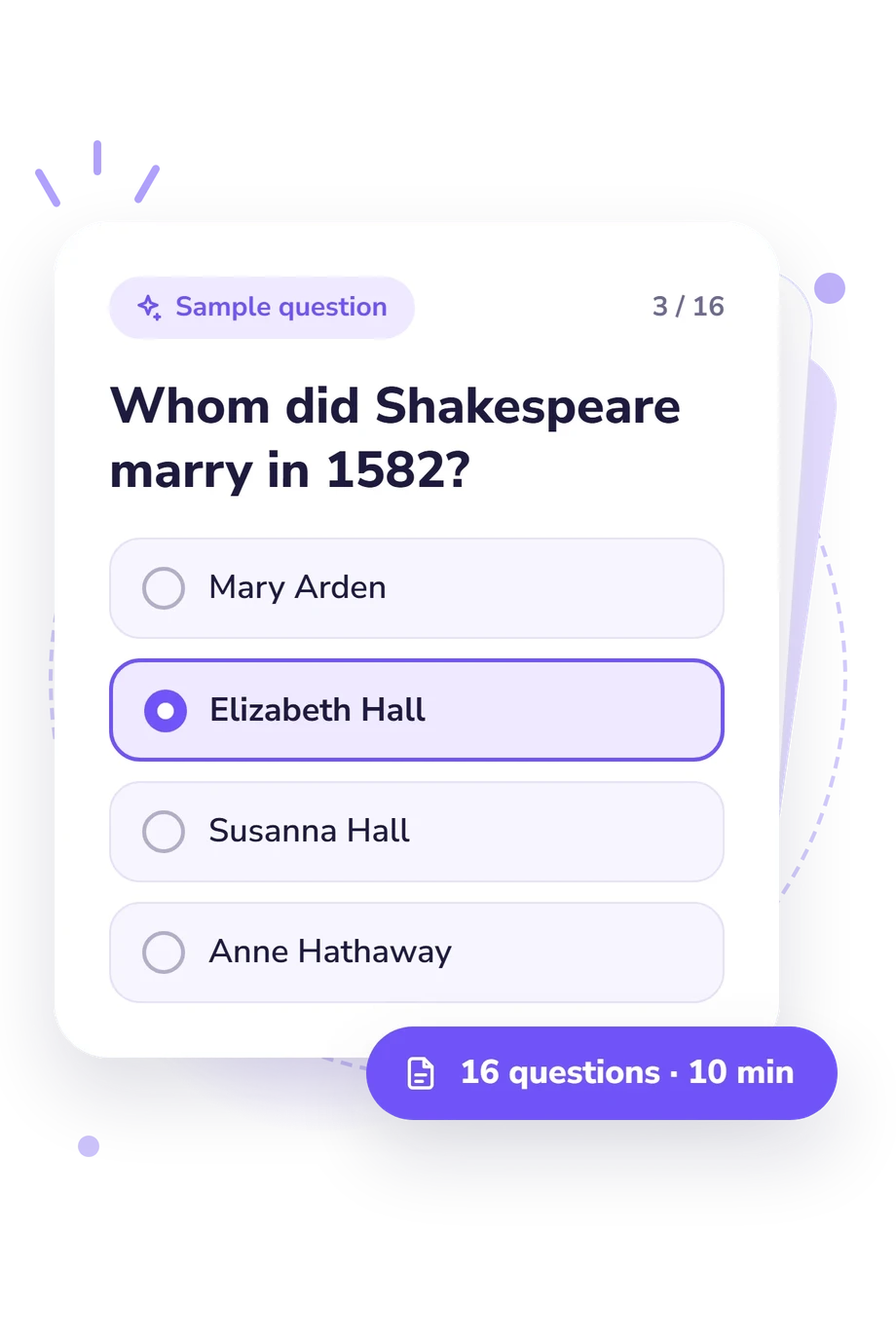
Example Questions From the Test
- Richard Shakespeare and Mary Sidney
- John Shakespeare and Mary Arden
- John Shakespeare and Elizabeth Hall
- Henry Shakespeare and Anne Whateley
- Mary Arden
- Elizabeth Hall
- Susanna Hall
- Anne Hathaway
- Canterbury
- Stratford-upon-Avon
- Oxford
- York
Shakespeare Biography Quiz - Description and methodology of the test
People who want to check their grasp of Shakespeare’s documented life can use the Shakespeare Biography Quiz as a focused historical exercise. The assessment suits general readers, students, and theatre enthusiasts seeking a William Shakespeare quiz that distinguishes established evidence from popular assumptions. The total score summarizes overall performance in a knowledge band, with questions spanning family, work, business connections, chronology, and legacy.
What This Assessment Explores
Documented events and surviving records help distinguish firm biographical evidence from unsupported claims. The historical focus makes it a Shakespeare life quiz covering chronology, performance history, family history, and the limits of historical knowledge.
These thematic groups show what your answers cover:
- Family and early life connect parents, schooling, marriage, birth evidence, and burial with the historical record.
- Career and company ties measure Shakespeare’s roles, theatrical partnerships, and business interests.
- Chronology and documentary evidence test judgment about dates, gaps, and historical claims.
- Publications, property, and legacy examine printed works, Stratford connections, heraldic evidence, and remembrance.
The displayed scale is Shakespeare Biography Knowledge, 0-16. Each correct answer earns one point; bands are Foundations to build (0-6), Developing knowledge (7-12), and Strong knowledge (13-16).
Methodology and Historical Evidence
Each prompt presents a fact or situation followed by four choices. Some items ask you to judge wording rather than recall a name, such as separating a baptism record from a proven birth date or assessing an absolute claim about Shakespeare’s later theatrical links. The format rewards factual recognition and careful reading.
Scoring is direct: each correct choice adds one point, and the displayed bands are the questionnaire’s raw-score categories for these biographical questions.
The method is documentary and theatre-historical rather than psychological. Schoenbaum (1987) and Bearman (2016) are factual and documentary reference works on Shakespeare’s life and surviving records. Gurr and Ichikawa (2000) supply context for acting companies, playhouses, and theatrical practice, while Hinman (1996) supports the First Folio. These sources support the content; the questionnaire is not a reproduced standardized psychological instrument.
In practical terms, the Shakespeare biography test summarizes performance on selected biographical facts as an overall learning level. Interpretation depends on current knowledge, wording, and self-selection, while uneven historical evidence means the result is a learning profile rather than a complete account of Shakespearean knowledge.
- Schoenbaum, Samuel. William Shakespeare: A Compact Documentary Life. Revised edition. Oxford University Press, 1987.
- Bearman, Robert. “Life Documents.” In The Cambridge Guide to the Worlds of Shakespeare, edited by Bruce R. Smith, pp. 839-845. Cambridge University Press, 2016. 10.1017/9781316137062.108
- Gurr, Andrew, and Mariko Ichikawa. Staging in Shakespeare’s Theatres. Oxford Shakespeare Topics. Oxford University Press, 2000. 10.1093/oso/9780198711599.001.0001
- Hinman, Charlton, prepared by. The Norton Facsimile of the First Folio of Shakespeare. 2nd ed., with an introduction by Peter W. M. Blayney. W. W. Norton, 1996.
Updated: