
Psychological Well-Being Scale Test
How the Scales are Structured
Who Usually Takes This Test?
See How You Compare
Below is a preview of how scores are typically distributed across each scale.
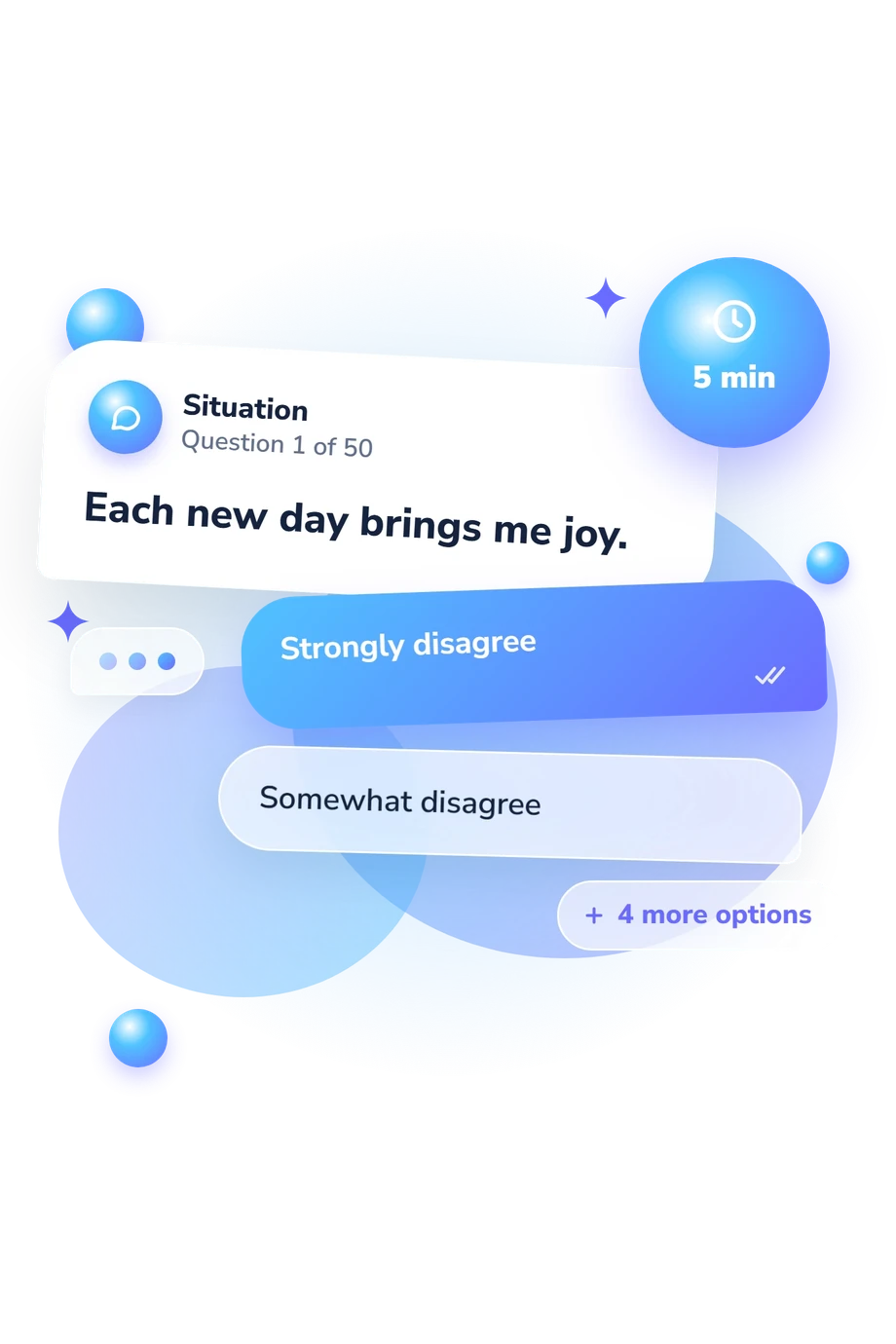
Example Questions From the Test
- Strongly disagree
- Somewhat disagree
- Disagree in some ways
- Agree in some ways
- Somewhat agree
- Strongly agree
- Completely disagree
- Somewhat disagree
- Disagree in some respects
- Agree in some respects
- Somewhat agree
- Completely agree
- Completely disagree
- Mostly disagree
- Disagree to some extent
- Agree to some extent
- Mostly agree
- Completely agree
Psychological Well-Being Scale Test - Description and methodology of the test
For readers who want a structured view of their current well-being, the Psychological Well-Being Scale Test examines how personal experience can be understood across several domains. People reflecting on growth and current attitudes can use this psychological well-being assessment to examine their own experience and guide reflection across domains. The result helps readers compare domain scores and consider which aspects of well-being feel more established or need closer attention.
What This Assessment Explores
Rather than a single mood, this psychological well-being test treats well-being as multidimensional. Statements address purpose, freedom, self-knowledge, self-regulation, and growth. The profile highlights areas and themes.
Five dimensions plus one overall score:
- Values and Meaning (5-30) measures values and meaning; Low 5-20, Moderate 21-27, High 28-30.
- Reflective (5-30) measures engagement, freedom, and growth; Low 5-18, Moderate 19-27, High 28-30.
- Conative (5-30) measures motivation, volition, and self-regulation; Lower self-regulation 5-19, Moderate self-regulation 20-26, High self-regulation 27-30.
- Cognitive (5-30) measures self-awareness and capacities; Low 5-18, Moderate 19-26, High 27-30.
- Affective (5-30) measures self-esteem, self-acceptance, satisfaction, and optimism; Low 5-18, Moderate 19-26, High 27-30.
- Psychological Well-Being (25-150) measures well-being, life satisfaction, harmony, and resources; Low 25-99, High 100-150.
Methodology and Evidence Base
Each statement uses a six-point agreement scale, from strong disagreement to strong agreement, although wording varies slightly. Respondents report attitudes directly, so scores reflect current self-perception rather than observed behavior or an interview.
The questionnaire is conceptually consistent with the Scale of Psychological Well-Being of Students (Samohvalova et al., 2022), which organizes well-being through value, reflective, conative, cognitive, and affective components. Ryff’s 1989 work provides broader conceptual context by treating well-being as broader than temporary happiness and connecting it with positive functioning and personal development. This online self-report is separate from the published instrument, so its validation findings should not automatically be transferred to it.
As a psychological well-being questionnaire, the items invite self-observation. The questionnaire reports domain scores and an overall score, with higher values indicating more of the quality defined by each scale. The displayed bands are interpretive ranges for this questionnaire, not universal clinical cutoffs. Results can be influenced by honesty, self-awareness, recent stress, and changing circumstances. They support reflection, but cannot by themselves explain a score or establish a diagnosis.
- Samohvalova A.G., Shipova N.S., Tikhomirova E.V., Vishnevskaya O.N. (2022). Scale for assessing the psychological well-being of students: verification and validation. Vestnik of Kostroma State University. Series: Pedagogy. Psychology. Sociokinetics, 28(1), 76-83. 10.34216/2073-1426-2022-28-1-76-83
- Samohvalova A.G., Tikhomirova E.V., Vishnevskaya O.N., Shipova N.S., Asriyan E.V. (2021). The structural-functional model of contemporary students' psychological well-being. Russian Psychological Journal, 18(4), 47-63. 10.21702/rpj.2021.4.4
- Ryff C.D. (1989). Happiness is everything, or is it? Explorations on the meaning of psychological well-being. Journal of Personality and Social Psychology, 57(6), 1069-1081. 10.1037/0022-3514.57.6.1069
Updated: