
Freudly+971 508685814hello@freudly.ai
Freudly
well-being

Adolescent Psychological Well-Being Manifestations Questionnaire Test
Take the online Adolescent Psychological Well-Being Manifestations Questionnaire Test - AI psychologist FreudlyYou can take Adolescent Psychological Well-Being Manifestations Questionnaire Testhere. Online version of a simple and accurate psychological test with interpretation.en
Understand an early teen’s mood, self-worth, and overall comfort in just 5 minutes. A quick 24-item snapshot that helps pinpoint strengths and areas needing support.
Start Online Test
Questions: 245 minutes
08:30
October 2, 2025
October 2, 2025
Material has been updated
October 2, 2025
Material has been published
14,376 views
1,479 completions
1,200 likes
Verified by Daniel Hall
Psychologist with 25 years of experience
Share
Scale Explorer

How the Scales are Structured

example score
9/20
Happiness (H)
Measures an adolescent’s subjective happiness, life satisfaction, and overall positive emotional tone.
Low
Moderate
High
49: Low | 1015: Moderate | 1620: High
A score of 9 falls in the Low range, suggesting reduced feelings of happiness and life satisfaction at the moment compared with higher scores.
example score
10/20
Self-Management (SM)
Assesses how well an adolescent regulates behavior, emotions, and everyday situations through self-regulation skills.
Low self-regulation
Moderate self-regulation
High self-regulation
49: Low self-regulation | 1014: Moderate self-regulation | 1520: High self-regulation
A score of 10 indicates a moderate level of self-regulation, suggesting the adolescent can manage themselves in some situations but may be inconsistent under stress or changing demands.
example score
13/20
Self-Esteem (SE)
Assesses an adolescent’s self-confidence, self-attitude, and perceived personal strengths and abilities.
Low
Moderate
High
49: Low | 1015: Moderate | 1620: High
A score of 13 falls in the Moderate range, suggesting generally adequate self-esteem with some areas of self-doubt or variability in confidence.
example score
8/20
Social Interaction (SI)
This scale measures how actively a teenager engages in social situations and builds relationships within a group.
Low
Moderate
High
49: Low | 1015: Moderate | 1620: High
A score of 8 indicates a low level of social interaction, suggesting the teenager is less involved in group activities and may find it harder to initiate or maintain contacts.
example score
13/20
Emotional Equilibrium (EE)
Measures inner harmony, emotional balance, and resilience to everyday stress in adolescents.
Low inner peace
Moderate inner peace
High inner peace
49: Low inner peace | 1015: Moderate inner peace | 1620: High inner peace
A score of 13 falls in the Moderate inner peace range, suggesting generally stable emotional balance with occasional stress-related fluctuations.
example score
9/20
Sociability (S)
Measures how open and willing a teenager is to communicate and engage with others.
Low sociability
Moderate sociability
High sociability
49: Low sociability | 1015: Moderate sociability | 1620: High sociability
A score of 9 falls in the low sociability range, suggesting limited openness to interaction and a lower inclination to initiate communication compared with peers.
example score
81/120
Psychological Well-Being (PWB)
Assesses the adolescent’s overall psychological well-being as an integrated indicator of psycho-emotional harmony across the questionnaire’s domains.
Low
Moderate
High
2455: Low | 5688: Moderate | 89120: High
A score of 81 falls in the Moderate range, suggesting generally stable psychological comfort with some areas that may be less consistent.
Start Online Test
just completed the test
DATA-BASED USER COHORTS

Who Usually Takes This Test?

School-age adolescents
46%OF USERS
Teens who want to understand their mood, self-worth, and overall life satisfaction during a challenging school period.
Parents seeking clarity
31%OF USERS
Parents who notice changes in their child’s behavior or emotions and want a clearer picture of their well-being.
School psychologists and counselors
23%OF USERS
Specialists who need a quick screening tool to spot students who may need additional support or preventive help.
BASED ON AGGREGATED, ANONYMIZED DATA FROM TENS OF THOUSANDS OF FREUDLY USERS.
Benchmarking

See How You Compare

Once you complete the test, your results are compared with real-world data from people in your country.
Below is a preview of how scores are typically distributed across each scale.
Happiness (H)
Happiness (H)
Average
11.7
Normal range
9.713.6
min.
4
max.
20
This curve shows how scores are typically distributed.
Once you complete the test, your result will appear on the scale so you can see how you compare.
Management (M)
Management (M)
Average
9.9
Normal range
7.612.2
min.
4
max.
20
This curve shows how scores are typically distributed.
Once you complete the test, your result will appear on the scale so you can see how you compare.
Self-esteem (S)
Self-esteem (S)
Average
11
Normal range
8.613.4
min.
4
max.
20
This curve shows how scores are typically distributed.
Once you complete the test, your result will appear on the scale so you can see how you compare.
Social interaction (Si)
Average
10.6
Normal range
8.612.6
min.
4
max.
20
This curve shows how scores are typically distributed.
Once you complete the test, your result will appear on the scale so you can see how you compare.
Inner peace (Ip)
Inner peace (Ip)
Average
13.7
Normal range
11.316.1
min.
4
max.
20
This curve shows how scores are typically distributed.
Once you complete the test, your result will appear on the scale so you can see how you compare.
Sociability (S)
Sociability (S)
Average
13.2
Normal range
10.216.2
min.
4
max.
20
This curve shows how scores are typically distributed.
Once you complete the test, your result will appear on the scale so you can see how you compare.
Psychological Well-being (PW)
Average
92.1
Normal range
78.1106.2
min.
24
max.
120
This curve shows how scores are typically distributed.
Once you complete the test, your result will appear on the scale so you can see how you compare.
Featured On
SAMPLE QUESTIONS

Example Questions From the Test

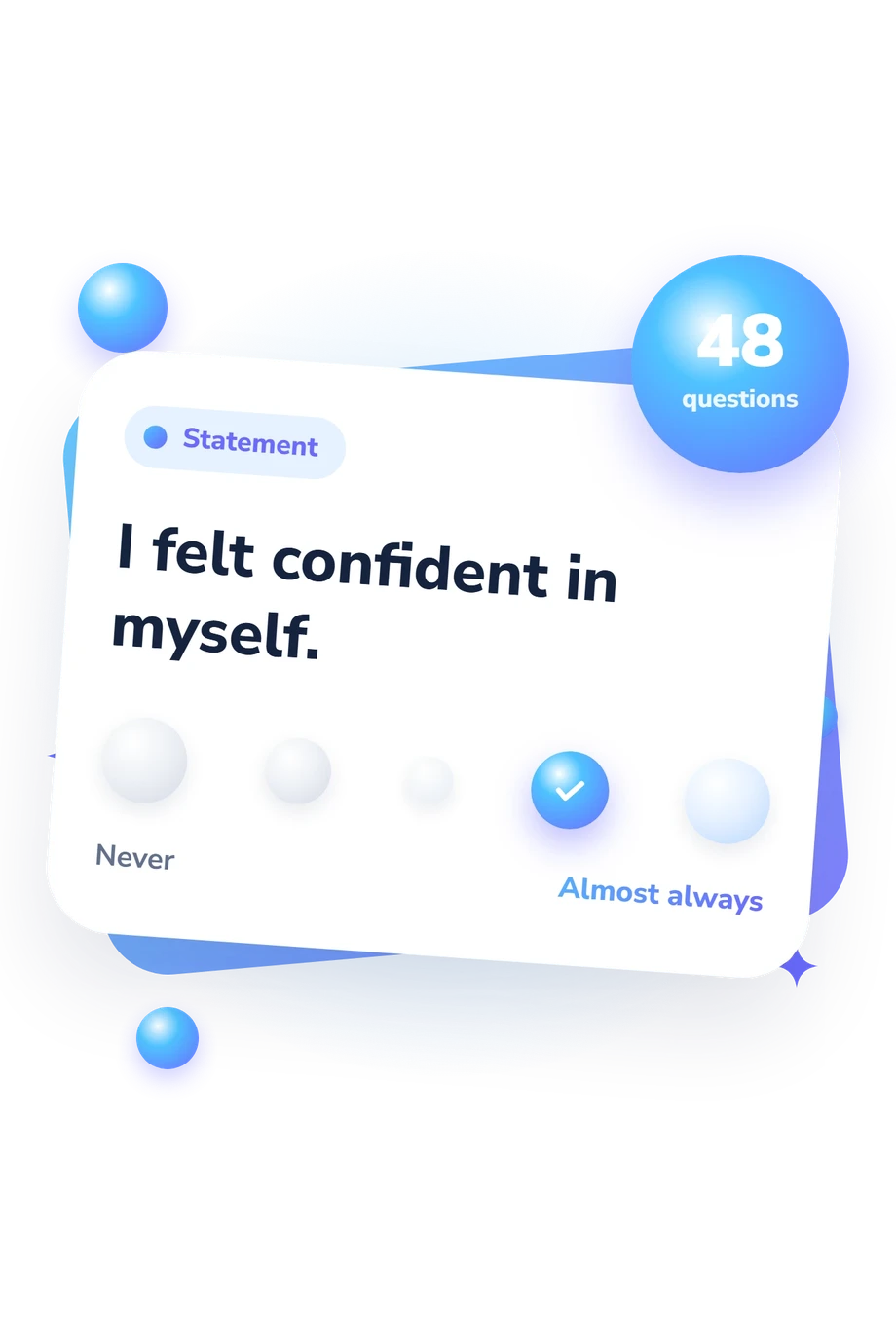
Please answer the questions about your condition over the past month. Read each statement carefully and indicate how often you have experienced each of the following states during the past month.
    • Never
    • Rarely
    • Sometimes
    • Often
    • Almost always
    • Never
    • Rarely
    • Sometimes
    • Often
    • Almost always
    • Never
    • Rarely
    • Sometimes
    • Often
    • Almost always
WHAT THE TEST MEASURES
About This Assessment
Questionnaire on Manifestations of Psychological Well-Being in Adolescents Test

Adolescent Psychological Well-Being Manifestations Questionnaire Test - Symptoms and Signs

well-being

In clinical or school settings, it can be helpful to obtain a brief, structured picture of an adolescent’s subjective adjustment and psychological comfort. The Adolescent Psychological Well-Being Manifestations Questionnaire is a self-report measure designed to assess perceived well-being manifestations in early to mid adolescence.

The measure includes 24 items and typically requires about 5 minutes to complete. Items sample everyday indicators of psychological well-being (e.g., general emotional tone, perceived self-worth, and satisfaction with life and functioning), supporting a rapid screening-level summary to inform follow-up discussion, monitoring, or further assessment.

The Adolescent Psychological Well-Being Manifestations Questionnaire is intended for use as one component of a broader evaluation and should be interpreted in the context of developmental stage, presenting concerns, and collateral information.

Author: Carol D. Ryff, Ed Diener
Literature: Steinberg, L. Adolescence. McGraw-Hill Education. 2017.; Masse, R., Poulin, C., Dassa, C., Lambert, J., Belair, S., & Battaglini, A. The structure of mental health: Higher-order confirmatory factor analyses of psychological distress and well-being measures. Social Indicators Research. 1998.
Popular tests
Comments
Leave a Comment