
Romeo and Juliet Act 3 Quiz
How the Scales are Structured
Who Usually Takes This Test?
See How You Compare
Below is a preview of how scores are typically distributed across each scale.
Example Questions From the Test
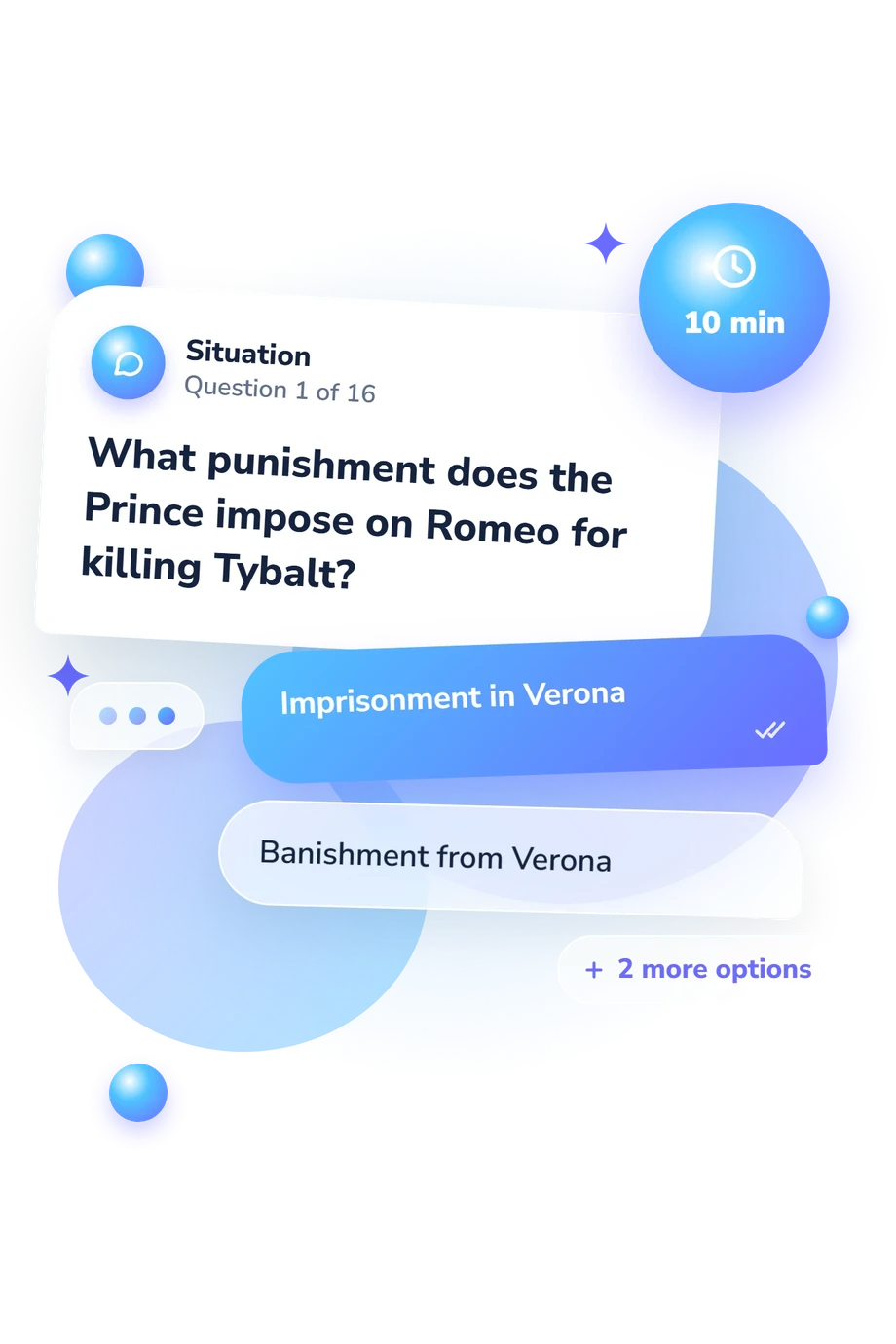
- Imprisonment in Verona
- Banishment from Verona
- Immediate execution
- Service in the city watch
- As a clever attempt to make Tybalt confess publicly
- As dishonorable submission that Mercutio must answer himself
- As proof that Romeo has secretly joined the Capulets
- As obedience to a direct command from the Prince
- Romeo takes Mercutio’s sword away, leaving him defenseless.
- Romeo calls the watch, distracting Mercutio from the fight.
- Tybalt wounds Mercutio under Romeo’s arm while Romeo intervenes.
- Mercutio trips while trying to push Romeo out of danger.
Romeo and Juliet Act 3 Quiz - Description and methodology of the test
Students, teachers, and readers revising Shakespeare can use the Romeo and Juliet Act 3 Quiz to connect plot, language, and dramatic interpretation. It suits anyone who wants to check understanding after reading or discussion, especially when scene order, character motivation, or the act’s tragic turn remains uncertain. Taking this Romeo and Juliet quiz 3 helps direct review toward the conflict’s causes and consequences.
What This Assessment Explores
Act 3 places private love against public violence, exile, family pressure, and an unwanted marriage. The questions connect plot events with motives, language, imagery, and tragic effects rather than testing recall alone. The questions help readers examine Act 3 literature through plot, motivation, language, imagery, and dramatic meaning.
The displayed scale is Romeo and Juliet Act 3 Knowledge (0-16): Foundation to revisit (0-6), Developing command (7-12), and Strong command (13-16). The questions cover these thematic areas within that single overall knowledge result:
- Plot and sequence are tested through the duel, Mercutio’s death, banishment, and wedding plan.
- Character motives are explored through how Romeo, Juliet, the Nurse, and Capulet connect private feeling to action.
- Language and quotation are examined in their scene and dramatic context.
- Dramatic effect and theme are considered through foreshadowing, imagery, conflict, and tragedy.
Methodology and Literary Evidence
Each item presents a question with four answer choices. Prompts ask the reader to identify an event, motive, quotation, sequence, or dramatic effect, combining factual recall with introductory literary interpretation. In this Romeo and Juliet study quiz, four-choice questions assess recognition of scene order, dialogue, events, and interpretation without requiring extended written analysis.
The questionnaire returns one overall knowledge result; no additional per-option weighting or scoring formula is stated.
The questionnaire is conceptually consistent with Romeo and Juliet (Mowat and Werstine, 2011), which supplies the scenes, language, and sequence assessed. Snyder (1979) helps frame the movement from comic energy toward tragedy, while Appelbaum (1997) addresses masculine pressure and retaliatory violence within the feud. These sources support literary interpretation; the online questionnaire is not an adaptation of either work.
No reliability, validity, or norm data are provided for this quiz. Results can shift with memory, attention, prior teaching, and the reader’s interpretation of a line, so they are best used to select scenes for closer review before discussion or written analysis.
- Shakespeare, William. Romeo and Juliet. Edited by Barbara A. Mowat and Paul Werstine. New York: Simon & Schuster, 2011.
- Snyder, Susan. The Comic Matrix of Shakespeare's Tragedies: Romeo and Juliet, Hamlet, Othello, and King Lear. Princeton: Princeton University Press, 1979. DOI 10.1515/9780691196626.
- Appelbaum, Robert. “Standing to the Wall”: The Pressures of Masculinity in Romeo and Juliet. Shakespeare Quarterly, 48(3), 1997, 251-272. DOI 10.2307/2871016.
Updated: