
Psychology Research Methods Quiz
How the Scales are Structured
Who Usually Takes This Test?
See How You Compare
Below is a preview of how scores are typically distributed across each scale.
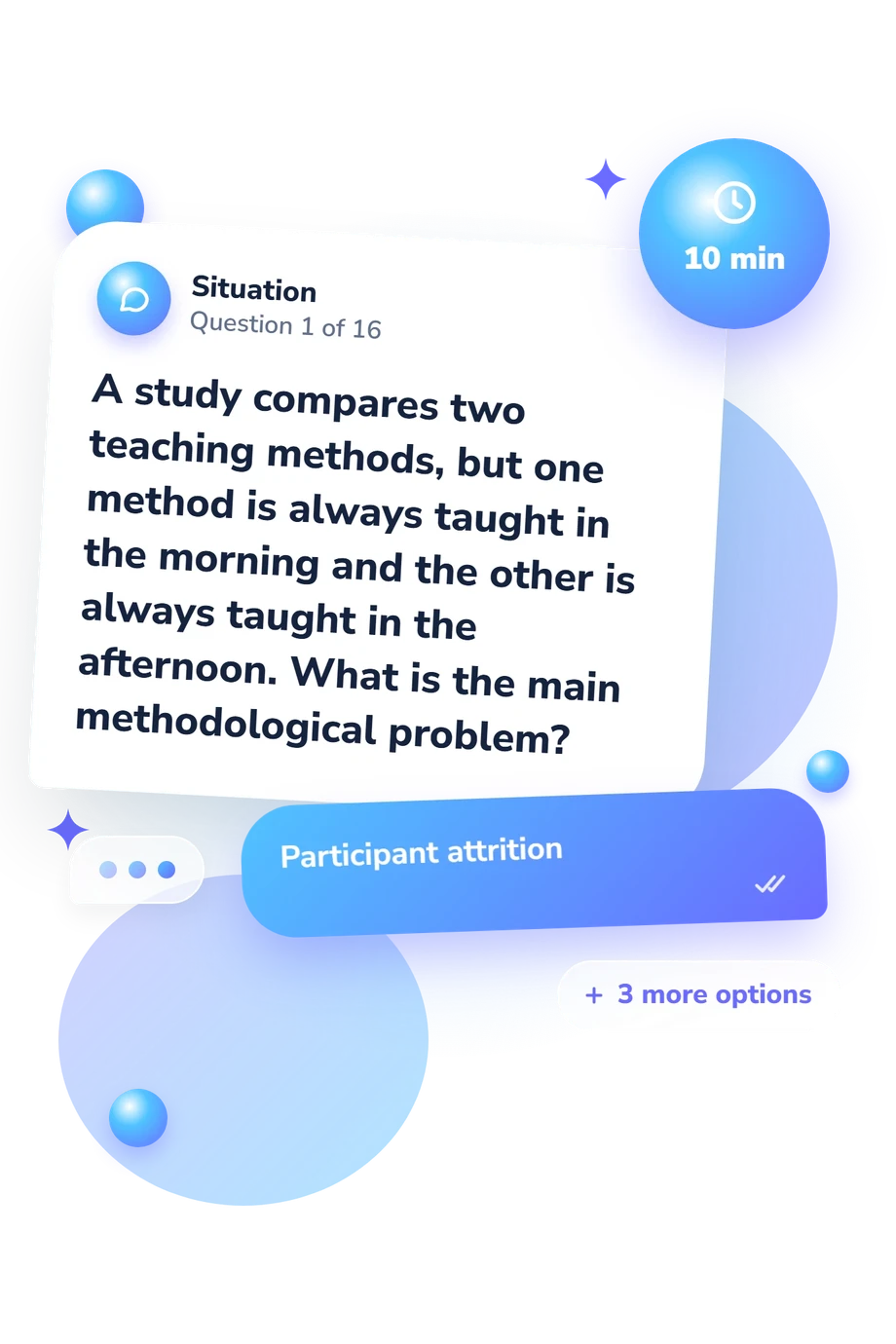
Example Questions From the Test
- Opportunity sampling
- Increasing inter-rater reliability
- Counterbalancing the order of conditions
- Matching participants by age
- An operational definition of stress
- A theory explaining the causes of stress
- A representative sample of stressful experiences
- A control condition for stress
- Failing to reject a null hypothesis that is actually false
- Rejecting a null hypothesis that is actually true
- Using a sample that does not represent the target population
- Measuring the dependent variable inconsistently
Psychology Research Methods Quiz - Description and methodology of the test
Students, educators, and curious readers can use this psychology research methods quiz to gauge their grasp of research design and evidence. Readers reviewing research methods in psychology can use the quiz when they want a concise check of the subject. Its overall performance band can help them decide whether to advance to more complex material or revisit foundational methods.
What This Assessment Measures
Respondents use research scenarios to recognize sound choices in psychological research. It suits learners reviewing design, measurement, ethics, and statistics; the knowledge result summarizes overall performance rather than separate strengths and weaknesses.
The scenarios ask what a design permits, what a measure captures, and which conclusion exceeds the evidence, making this psychology research methods assessment useful for learners.
The question areas cover:
- Study design shows how assignment, conditions, order, and sampling affect studies.
- Measurement tests whether definitions, variables, reliability, and validity fit the construct.
- Research ethics covers consent, withdrawal, debriefing, and responsible deception.
- Evidence interpretation and statistical reasoning distinguish correlation from causation and replication from a single finding while testing statistical interpretation.
Performance is summarized as Psychology Research Methods Knowledge: 0-16, with Foundations to build (0-6), Developing knowledge (7-12), and Strong knowledge (13-16). These bands describe quiz performance, not credentials.
Methodology and Evidence Base
Each item presents a short research scenario or definition with several answer choices. The respondent selects the option that best identifies a design feature, ethical response, measurement property, or statistical conclusion. This response format tests conceptual discrimination rather than personal opinion.
Conceptually, the content is consistent with the PRIC and its related validation study, but this online questionnaire is not that published instrument. Ethical scenarios reflect the American Psychological Association code, including consent, withdrawal, and debriefing after deception. The interview item uses thematic analysis as described by the Braun and Clarke framework.
Evidence for that published instrument does not automatically establish validity or norms for this online questionnaire. For someone using this psychology research methods test, the result indicates overall performance, while performance may be affected by prior coursework, wording familiarity, guessing, and concentration. The bands are not population norms or evidence of professional qualification.
- Veilleux, Jennifer C., and Kate M. Chapman. (2017). Development of a Research Methods and Statistics Concept Inventory. Teaching of Psychology, 44(3), 203-211. 10.1177/0098628317711287
- Veilleux, Jennifer C., and Kate M. Chapman. (2017). Validation of the Psychological Research Inventory of Concepts: An Index of Research and Statistical Literacy. Teaching of Psychology, 44(3), 212-221. 10.1177/0098628317711302
- American Psychological Association. (2017). Ethical Principles of Psychologists and Code of Conduct (2002, amended effective June 1, 2010, and January 1, 2017). American Psychological Association.
- Braun, Virginia, and Victoria Clarke. (2006). Using thematic analysis in psychology. Qualitative Research in Psychology, 3(2), 77-101. 10.1191/1478088706qp063oa
Updated: