
PSR Quiz
How the Scales are Structured
Who Usually Takes This Test?
See How You Compare
Below is a preview of how scores are typically distributed across each scale.
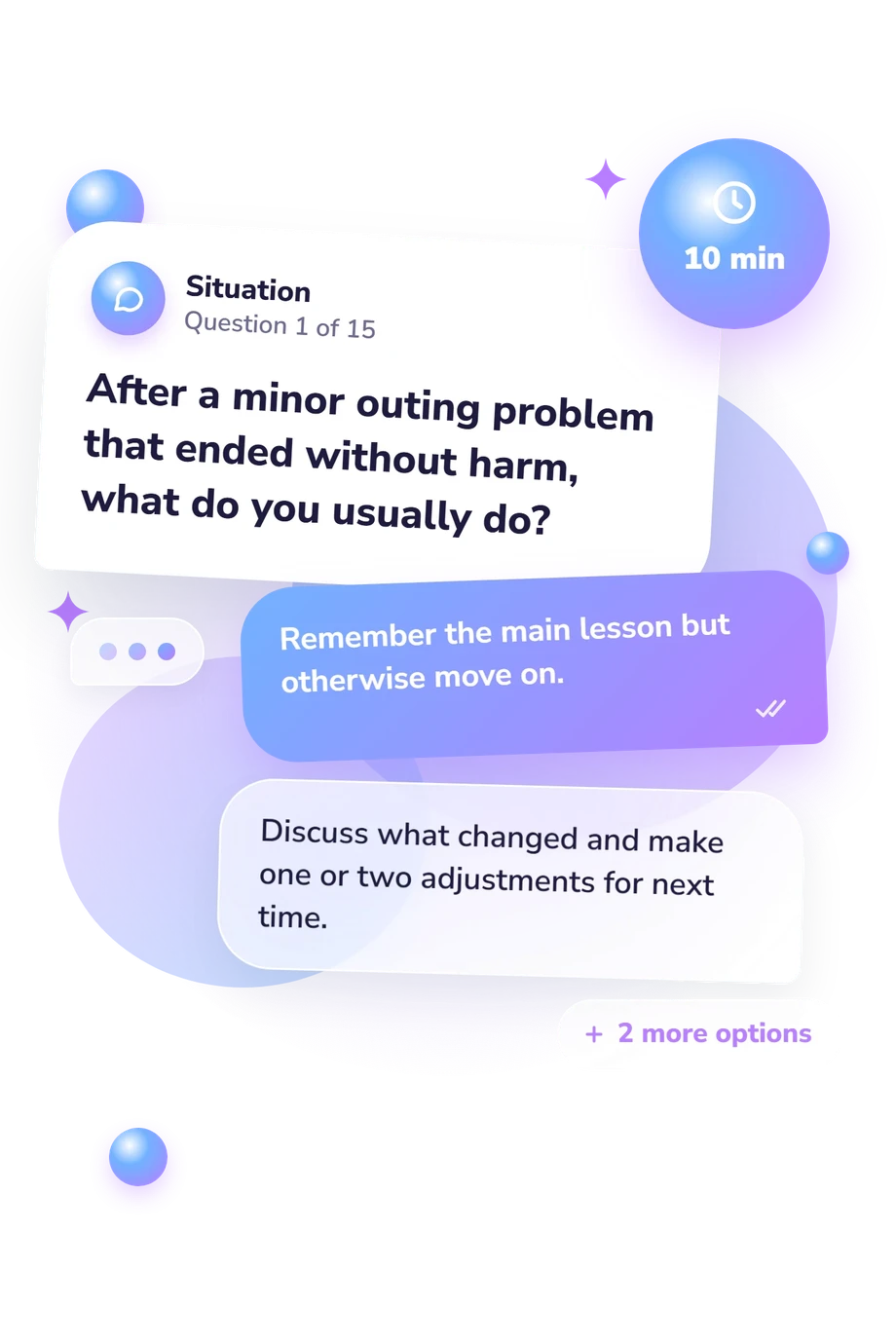
Example Questions From the Test
- Remember the main lesson but otherwise move on.
- Discuss what changed and make one or two adjustments for next time.
- Treat it as a one-off unless the same problem happens again.
- Review the early warning signs, decisions, and specific changes needed before another outing.
- Ask each person for the evidence, constraints, and consequences behind their choice.
- Support the option that seems easiest for the group to accept.
- Summarize the shared goal and propose a quick comparison of the two options.
- Step back until one person persuades the other.
- Start with the most likely needs and add comfort items if space remains.
- Pack from memory, focusing on items I have used on previous trips.
- Prioritize water, shelter, communication, first aid, and realistic backups for the conditions.
- Choose a compact set that keeps the bag light and easy to carry.
PSR Quiz - Description and methodology of the test
People who want a clearer picture of how they prepare for changing conditions can use this questionnaire to examine practical readiness rather than imagine a single ideal response. The psr quiz connects everyday planning with decisions made under uncertainty. For self-reflection, it functions as a discovery quiz for personal survival readiness, turning broad concerns into concrete areas to review. It suits readers considering travel, household disruption, teamwork, and personal limits.
What This Assessment Measures
Readiness here means more than owning supplies or knowing a route. The scenarios examine changing plans, conflicting information, limited resources, group disagreement, and unfamiliar tasks. A personal survival readiness test highlights habits in preparation, communication, prioritization, and decision-making for readers reflecting on travel, household disruption, and shared responsibilities.
The result separates these themes into three dimensions:
- Adaptation and Coordination (0-15) shows plan revision and teamwork: Familiar-pattern response (0-5) favors stable roles; Flexible contributor (6-10) usually adjusts; Adaptive coordinator (11-15) coordinates while revising plans.
- Essentials Management (0-15) shows how you maintain and allocate supplies: Informal preparation (0-5) may leave access or upkeep uneven; Working foundation (6-10) covers several needs; Organized capability (11-15) uses clear priorities.
- Situation Assessment (0-15) shows how you evaluate changing conditions: Developing awareness (0-5) may rely on familiar plans; Functional assessment (6-10) notices key factors; Deliberate assessment (11-15) weighs alternatives before acting.
Methodology and Evidence Base
Each scenario in this self-report presents a practical situation involving route changes, supplies, group coordination, information gaps, or unfamiliar tasks. Four response choices move from familiar or delayed reactions toward checking conditions, setting thresholds, communicating limits, and revising a plan. The selections are combined into three scores and reported as descriptive bands rather than pass/fail grades.
The content is conceptually consistent with the Household Emergency Preparedness Instrument (Heagele et al., 2023), which treats preparedness as practical, multidimensional capacities. It also aligns conceptually with the development work of Heagele et al. (2022) and the systematic review by Osman and Altıntaş (2023). This emergency preparedness questionnaire is not presented as an adaptation of those instruments; the sources support comparison of themes, not validation or norms for this online version.
Because the questionnaire has no established standardization or validation, scores may shift with current stress, recent experience, self-awareness, and the tendency to give socially desirable answers. Read the profile as a structured reflection on likely habits, while official warnings and emergency assistance take priority when conditions are genuinely dangerous.
- Heagele, T. N., Adams, L. M., McNeill, C. C., & Alfred, D. M. (2023). Validation and Revision of the Household Emergency Preparedness Instrument (HEPI) by a Pilot Study in the City University of New York. Disaster Medicine and Public Health Preparedness, 17, e126. 10.1017/dmp.2022.35
- Heagele, T. N., McNeill, C. C., Adams, L. M., & Alfred, D. M. (2022). Household Emergency Preparedness Instrument Development: A Delphi Study. Disaster Medicine and Public Health Preparedness, 16(2), 570-582. 10.1017/dmp.2020.292
- Osman, M., & Altıntaş, K. H. (2023). Domains and Psychometric Properties of Scales Measuring Disaster Preparedness among General Population: A Systematic Literature Review. Prehospital and Disaster Medicine, 38(5), 636-644. 10.1017/S1049023X23006386
Updated: