
Physical Therapy Quiz
How the Scales are Structured
Who Usually Takes This Test?
See How You Compare
Below is a preview of how scores are typically distributed across each scale.
Example Questions From the Test
- Objective
- Subjective
- Assessment
- Plan
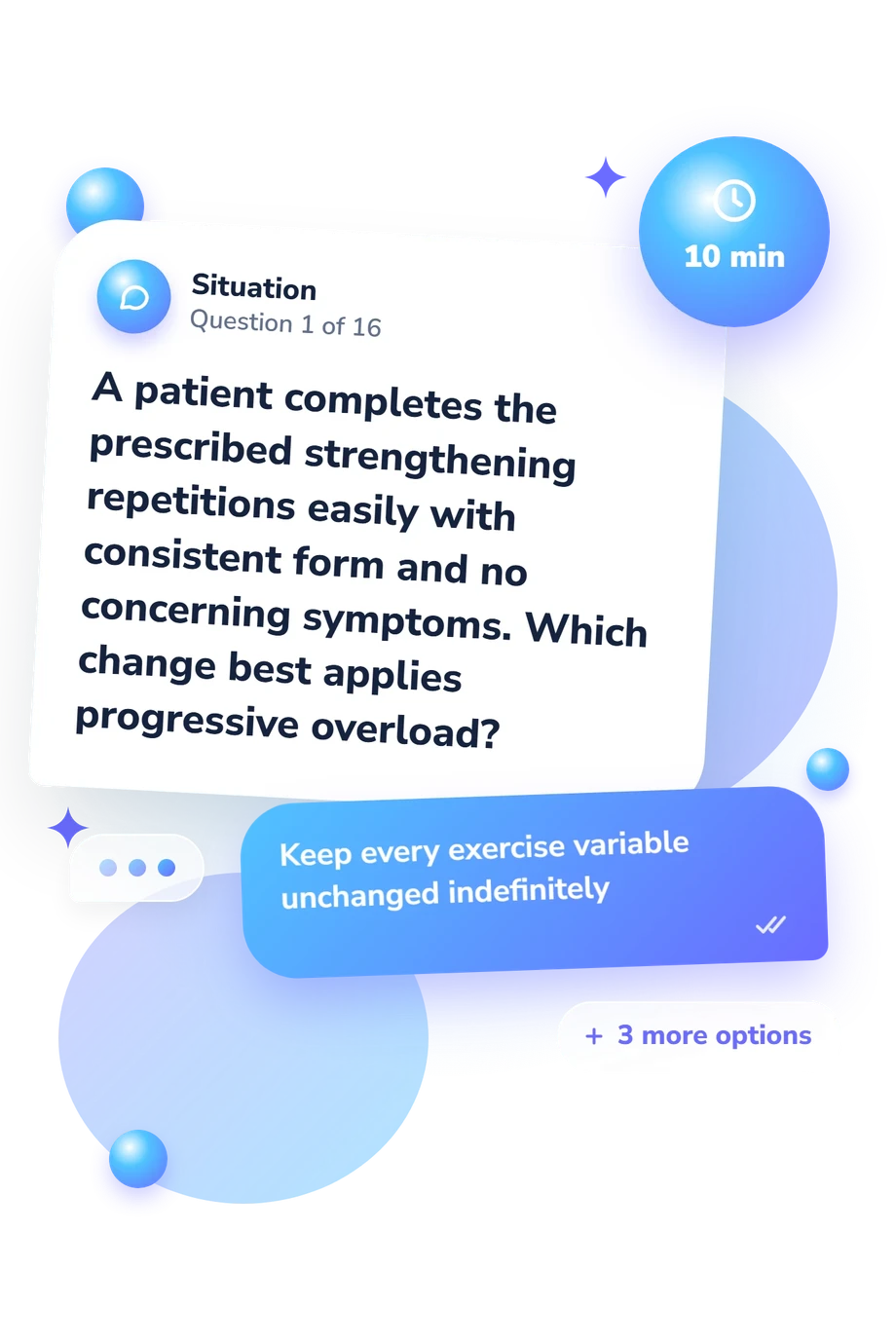
- Keep every exercise variable unchanged indefinitely
- Increase the resistance by a manageable amount while continuing to monitor technique and response
- Replace strengthening with passive movement only
- Double the resistance immediately and continue even if form deteriorates
- Tightening the quadriceps while keeping the knee still
- Slowly straightening the elbow while lowering a weight
- Actively moving the knee repeatedly through its available range
- Bending the elbow while lifting a dumbbell
Physical Therapy Quiz - Description and methodology of the test
People deciding whether to take an educational assessment can use this physical therapy quiz to check their readiness for further study and identify the next useful revision step. For learners preparing to study physical therapy, this physical therapist quiz provides a focused way to decide what deserves another look. The result turns uncertainty into a practical starting point for self-directed review.
What This Assessment Explores
The questionnaire samples foundational knowledge rather than personal symptom history. Its scenarios cover documentation, progressive overload, physical therapy's purpose, measurement quality, balance, gait, range of motion, muscle contraction, consent, acute warning signs, transfers, cane use, kinetic-chain exercise, and manual muscle testing. It functions as a physical therapy knowledge test for readers seeking a broad review of rehabilitation concepts.
The result organizes performance on one educational dimension. The displayed Physical Therapy Knowledge scale runs from 0 to 16 and uses these bands:
- Foundational Gaps (0-6) indicates that core terminology, measurement, exercise, gait, and safety principles need review.
- Developing Knowledge (7-12) shows that many essentials are understood, with targeted revision still useful.
- Strong Foundation (13-16) reflects command of tested concepts and points learners toward finer distinctions or applications.
These labels help learners choose what to revisit rather than reduce rehabilitation to one number.
Methodology and Evidence Base
Each item presents a short clinical or educational situation with four answer choices. The best response depends on recognizing and applying a principle, such as distinguishing subjective from objective documentation, choosing a safe first response to light-headedness, or identifying validity, reliability, and movement terminology. The total reflects performance across the items; the bands describe this questionnaire rather than published professional norms.
Childs et al. (2005) examined physical therapists’ knowledge in musculoskeletal management. Tilson (2010) and Torres-Narváez et al. (2018) offer related comparison points concerning evidence-based practice and physical therapy competencies, but they do not validate this quiz, whose items focus more narrowly on foundational concepts. This format supports physical therapy study by turning missed principles into a focused revision plan.
Self-administered responses and brief scenarios leave scores sensitive to guessing, wording, and current familiarity; a high result cannot prove clinical competence or guide individual treatment.
- Childs JD, Whitman JM, Sizer PS, Pugia ML, Flynn TW, Delitto A. A description of physical therapists' knowledge in managing musculoskeletal conditions. BMC Musculoskeletal Disorders. 2005;6:32. 10.1186/1471-2474-6-32
- Tilson JK. Validation of the modified Fresno Test: assessing physical therapists' evidence based practice knowledge and skills. BMC Medical Education. 2010;10:38. 10.1186/1472-6920-10-38
- Torres-Narváez MR, Vargas-Pinilla OC, Rodríguez-Grande EI. Validity and reproducibility of a tool for assessing clinical competencies in physical therapy students. BMC Medical Education. 2018;18(1):280. 10.1186/s12909-018-1377-x
Updated: