
Freudly+971 508685814hello@freudly.ai
Freudly
alexithymia

Perth Alexithymia Questionnaire (PAQ) Test
Take the online Perth Alexithymia Questionnaire (PAQ) Test - AI psychologist FreudlyYou can take Perth Alexithymia Questionnaire (PAQ) Test here. Online version of a simple and accurate psychological test with interpretation.en
Understand how well you identify and describe your emotions in about 5 minutes. A 24 item check of positive and negative feelings that supports clearer communication and better treatment planning.
Start Online Test
Questions: 245 minutes
08:30
October 2, 2025
October 2, 2025
Material has been updated
October 2, 2025
Material has been published
28,977 views
3,037 completions
2,297 likes
Verified by Daniel Hall
Psychologist with 25 years of experience
Share
Scale Explorer

How the Scales are Structured

example score
129/168
Overall Alexithymia (OA)
Measures overall difficulty identifying, evaluating, and expressing both negative and positive emotions.
Lower alexithymia
Moderate alexithymia
Higher alexithymia
2471: Lower alexithymia | 72119: Moderate alexithymia | 120168: Higher alexithymia
A score of 129 falls in the Higher alexithymia range, indicating pronounced difficulty attending to, making sense of, and putting words to emotional experiences.
example score
10/56
Negative-Difficulty Identifying Feelings (N-DIF) (NDIFD)
Measures how difficult it is to identify, understand, and distinguish your own negative emotions.
Low difficulty
Moderate difficulty
High difficulty
018: Low difficulty | 1937: Moderate difficulty | 3856: High difficulty
A score of 10 suggests low difficulty identifying and differentiating negative feelings, with generally clear awareness of negative emotional states.
example score
30/56
Positive Difficulty Identifying Feelings (P-DIF) (PDIFD)
Measures how difficult it is to identify, understand, and differentiate your own positive emotions.
Low difficulty
Moderate difficulty
High difficulty
018: Low difficulty | 1937: Moderate difficulty | 3856: High difficulty
A score of 30 indicates a moderate level of difficulty recognizing and clearly distinguishing positive feelings.
example score
28/56
Negative-Difficulty Describing Feelings (N-DDF) (NDDFD)
Measures difficulty describing and verbally expressing one’s own negative emotions.
Low difficulty
Moderate difficulty
High difficulty
018: Low difficulty | 1937: Moderate difficulty | 3856: High difficulty
A score of 28 falls in the Moderate difficulty range, suggesting some challenges putting negative feelings into words while still being able to describe them at times.
example score
28/56
Positive Difficulty Describing Feelings (P-DDF) (PDDFD)
Measures how difficult it is for a person to describe and communicate their own positive emotions in words.
Low difficulty
Moderate difficulty
High difficulty
018: Low difficulty | 1937: Moderate difficulty | 3856: High difficulty
A score of 28 indicates a moderate level of difficulty putting positive feelings into words and conveying them clearly.
example score
16/56
Externally Oriented Thinking (G-EOT) (EOTE)
Measures the tendency to focus attention away from one’s own emotions and toward external events or practical details.
Low externally-oriented thinking
Moderate externally-oriented thinking
High externally-oriented thinking
823: Low externally-oriented thinking | 2439: Moderate externally-oriented thinking | 4056: High externally-oriented thinking
A score of 16 falls in the low range, suggesting you are relatively likely to notice and reflect on your emotions rather than consistently focusing outward.
example score
40/56
Difficulty Identifying Feelings (G-DIF) (DIFD)
Measures how difficult it is to identify, understand, and differentiate your own emotions (both negative and positive).
Low
Moderate
High
018: Low | 1937: Moderate | 3856: High
A score of 40 falls in the High range, suggesting pronounced difficulty recognizing and distinguishing your feelings across positive and negative emotions.
example score
35/56
Difficulty Describing Feelings (G-DDF) (DDFD)
Assesses how difficult it is to put one’s emotions into words, for both negative and positive feelings.
Low difficulty
Moderate difficulty
High difficulty
018: Low difficulty | 1937: Moderate difficulty | 3856: High difficulty
A score of 35 falls in the Moderate difficulty range, suggesting noticeable but not extreme challenges describing and expressing emotions in words.
example score
22/56
Negative Difficulty Appraising Feelings (N-DAF) (NDAFD)
Measures how difficult it is to identify and describe your own negative emotions.
Low difficulty
Moderate difficulty
High difficulty
018: Low difficulty | 1937: Moderate difficulty | 3856: High difficulty
A score of 22 falls in the Moderate difficulty range, suggesting some challenges recognizing and putting negative feelings into words.
example score
49/56
Positive Difficulty Appraising Feelings (P-DAF) (PDAFD)
Assesses how difficult it is to identify and describe one’s own positive emotions.
Low difficulty
Moderate difficulty
High difficulty
018: Low difficulty | 1937: Moderate difficulty | 3856: High difficulty
A score of 49 falls in the High difficulty range, suggesting notable challenges recognizing and putting positive feelings into words.
example score
52/112
Difficulty Appraising Feelings (G-DAF) (DAFD)
Assesses overall difficulty identifying and describing both negative and positive feelings.
Low difficulty
Moderate difficulty
High difficulty
1647: Low difficulty | 4879: Moderate difficulty | 80112: High difficulty
A score of 52 falls in the Moderate difficulty range, suggesting noticeable but not severe challenges recognizing and expressing feelings overall.
Start Online Test
just completed the test
DATA-BASED USER COHORTS

Who Usually Takes This Test?

People who feel emotionally stuck
41%OF USERS
They often sense something is wrong but struggle to name or explain what they feel, especially under stress.
Therapy and counseling clients
34%OF USERS
They take it to clarify patterns in identifying and describing emotions so treatment goals can be more targeted.
Students and research participants
25%OF USERS
They complete it as part of a study or screening to measure emotional awareness for both positive and negative feelings.
BASED ON AGGREGATED, ANONYMIZED DATA FROM TENS OF THOUSANDS OF FREUDLY USERS.
Benchmarking

See How You Compare

Once you complete the test, your results are compared with real-world data from people in your country.
Below is a preview of how scores are typically distributed across each scale.
Overall Level of Alexithymia (OLoA)
Average
127.3
Normal range
108146.6
min.
24
max.
168
This curve shows how scores are typically distributed.
Once you complete the test, your result will appear on the scale so you can see how you compare.
Identification of Negative Feelings (N-DIF) (IoNF()
Average
26.7
Normal range
17.735.7
min.
0
max.
56
This curve shows how scores are typically distributed.
Once you complete the test, your result will appear on the scale so you can see how you compare.
Identification of Positive Feelings (P-DIF) (IoPF()
Average
31.6
Normal range
24.139
min.
0
max.
56
This curve shows how scores are typically distributed.
Once you complete the test, your result will appear on the scale so you can see how you compare.
Description of Negative Feelings (N-DDF) (DoNF()
Average
23.8
Normal range
13.733.9
min.
0
max.
56
This curve shows how scores are typically distributed.
Once you complete the test, your result will appear on the scale so you can see how you compare.
Description of Positive Feelings (P-DDF) (DoPF()
Average
36.9
Normal range
2944.8
min.
0
max.
56
This curve shows how scores are typically distributed.
Once you complete the test, your result will appear on the scale so you can see how you compare.
Externally-Oriented Thinking (G-EOT) (ET()
Average
37.5
Normal range
31.643.3
min.
8
max.
56
This curve shows how scores are typically distributed.
Once you complete the test, your result will appear on the scale so you can see how you compare.
Difficulties with Identification (G-DIF) (DwI()
Average
32.4
Normal range
23.441.5
min.
0
max.
56
This curve shows how scores are typically distributed.
Once you complete the test, your result will appear on the scale so you can see how you compare.
Difficulties with Description (G-DDF) (DwD()
Average
26
Normal range
15.536.4
min.
0
max.
56
This curve shows how scores are typically distributed.
Once you complete the test, your result will appear on the scale so you can see how you compare.
Assessment of Negative Feelings (N-DAF) (AoNF()
Average
33.1
Normal range
24.841.4
min.
0
max.
56
This curve shows how scores are typically distributed.
Once you complete the test, your result will appear on the scale so you can see how you compare.
Assessment of Positive Feelings (P-DAF) (AoPF()
Average
38.9
Normal range
31.746.1
min.
0
max.
56
This curve shows how scores are typically distributed.
Once you complete the test, your result will appear on the scale so you can see how you compare.
Assessment of All Feelings (G-DAF) (AoAF()
Average
66
Normal range
48.583.4
min.
16
max.
112
This curve shows how scores are typically distributed.
Once you complete the test, your result will appear on the scale so you can see how you compare.
Featured On
SAMPLE QUESTIONS

Example Questions From the Test

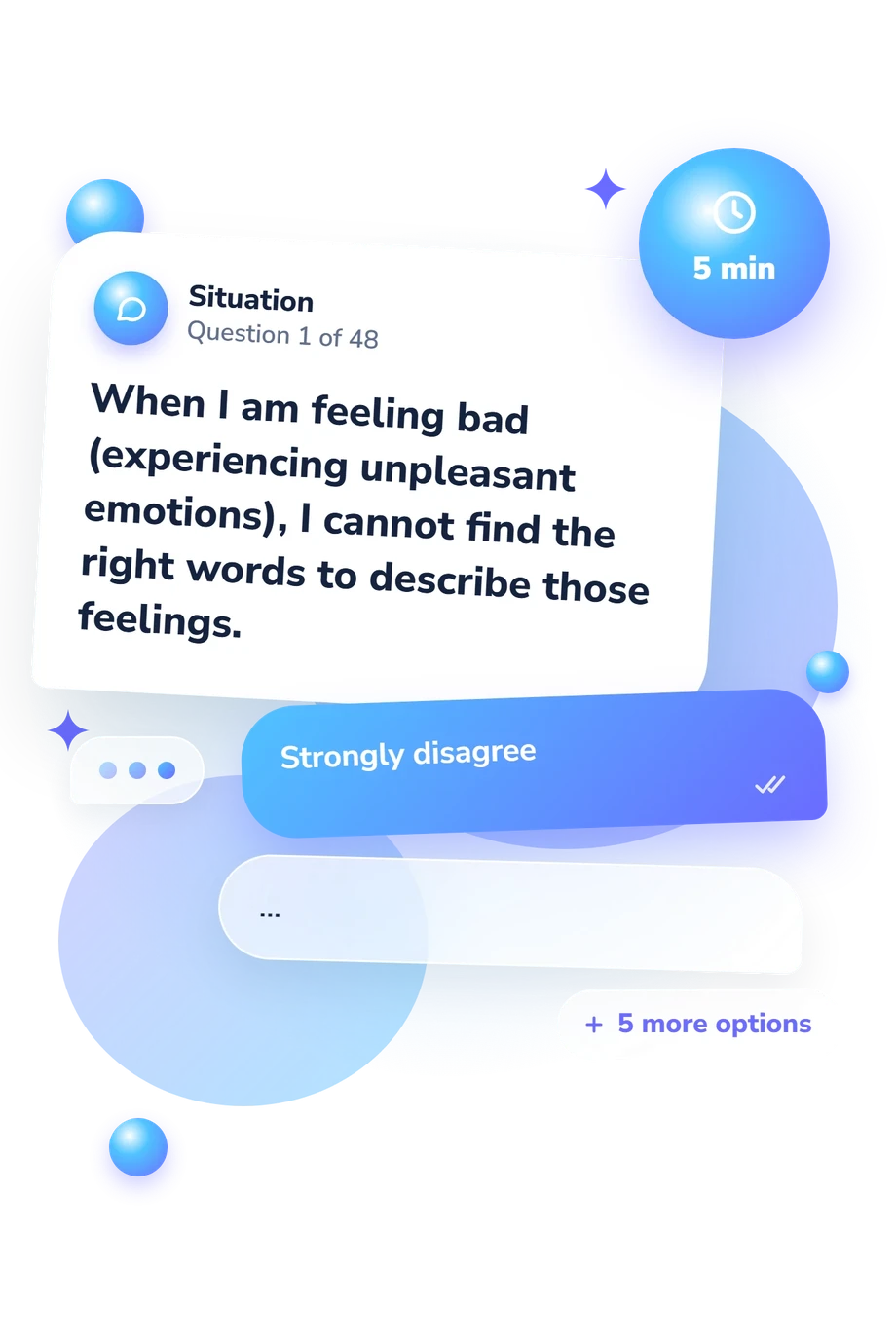
This questionnaire is designed to assess how emotions are perceived and experienced. Please rate the following statements according to the extent to which you agree or disagree that each statement is true for you. Some statements refer to negative or unpleasant emotions, such as sadness, anger, or fear. Other statements refer to positive or pleasant emotions, such as happiness, amusement, or joyful excitement.
    • Strongly disagree
    • ...
    • ...
    • Neither agree nor disagree
    • ...
    • ...
    • Strongly agree
    • Strongly disagree
    • ...
    • ...
    • Neither agree nor disagree
    • ...
    • ...
    • Strongly agree
    • Strongly disagree
    • ...
    • ...
    • Neither agree nor disagree
    • ...
    • ...
    • Strongly agree
WHAT THE TEST MEASURES
About This Assessment
Perth Alexithymia Questionnaire, PAQ Test

Perth Alexithymia Questionnaire (PAQ) Test - Symptoms and Signs

alexithymia
autism

This measure assesses individual differences in alexithymia, including difficulties identifying and describing one’s own emotions across positive and negative affect. The Perth Alexithymia Questionnaire (PAQ) is a self-report instrument developed by James N. D. Parker, David Preece, and Graeme J. Taylor.

The instrument contains 24 items and typically requires about 5 minutes to complete. It is intended for use in clinical and research settings to support screening and characterization of emotion awareness and expression; results are generally interpreted in conjunction with other assessment data and clinical judgment.

The Perth Alexithymia Questionnaire (PAQ) yields information relevant to key components of alexithymia, such as difficulty identifying feelings, difficulty describing feelings, and related features of emotional processing.

Author: David Preece, Graeme J. Taylor, James N. D. Parker
Literature: Taylor, G. J., Bagby, R. M., & Parker, J. D. A. Disorders of affect regulation: Alexithymia in medical and psychiatric illness. Cambridge University Press. 1997.; Preece, D., Becerra, R., Robinson, K., Dandy, J., & Allan, A. The psychometric assessment of alexithymia: Development and validation of the Perth Alexithymia Questionnaire. Personality and Individual Differences. 2018.; Bagby, R. M., Parker, J. D. A., & Taylor, G. J. The twenty-item Toronto Alexithymia Scale—I. Item selection and cross-validation of the factor structure. Journal of Psychosomatic Research. 1994.; Preece, D., Mehta, A., Petrova, K., Sikka, P., Bjureberg, J., Chen, W., Becerra, R., Allan, A., Robinson, K., & Gross, J. J. The Perth Alexithymia Questionnaire-Short Form (PAQ-S): A 6-item measure of alexithymia. Journal of Affective Disorders. 2023.
Popular tests
Comments
Leave a Comment