
Socio-Psychological Self-Assessment of the Team Test
How the Scales are Structured
Who Usually Takes This Test?
See How You Compare
Below is a preview of how scores are typically distributed across each scale.
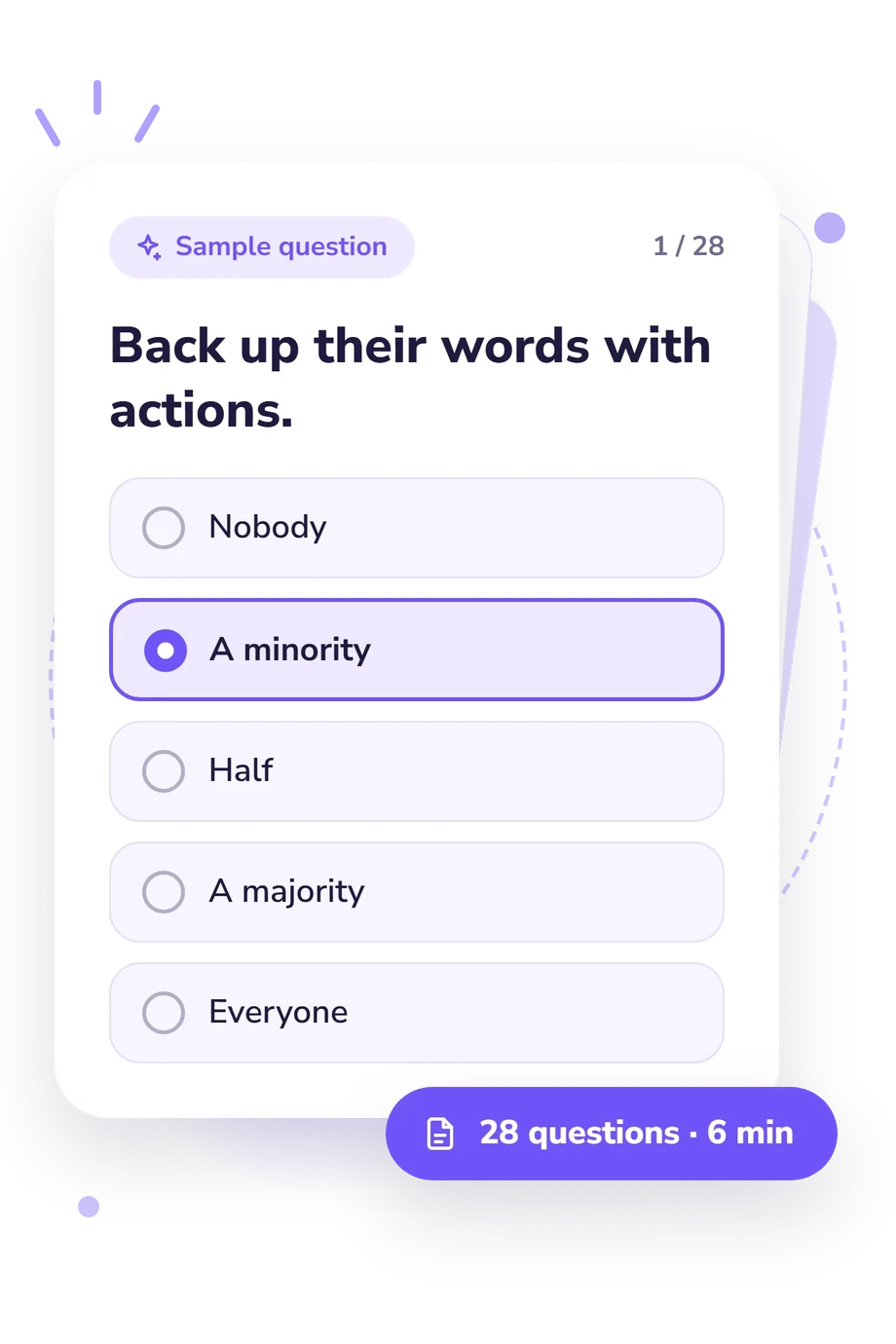
Example Questions From the Test
- Nobody
- A minority
- Half
- A majority
- Everyone
- No one
- A minority
- Half
- A majority
- Everyone
- No one
- A minority
- Half
- A majority
- Everyone
Socio-Psychological Self-Assessment of the Team Test - Description and methodology of the test
Designed for people who want to understand how a group functions from the inside, this Socio-Psychological Self-Assessment of the Team Test offers a structured view of how members perceive conformity to shared socio-psychological standards. As a team self-assessment, it suits respondents reflecting on a class or established group. Its result describes one group-level tendency, drawing on cooperation, shared responsibility, support, fairness, and coordination rather than assigning a personality label.
What This Assessment Explores
The questionnaire examines cooperation, shared responsibility, respect, support for newcomers, and responses to collective success or difficulty. These behaviors contribute to one group-level tendency: conformity to shared socio-psychological standards.
Rather than measuring private traits or clinical symptoms, this team behavior assessment focuses on everyday conduct and perceived cohesion or difficulties.
Other items cover decisions, discipline, fairness, shared property, and coordination under pressure. The result draws on these aspects:
- Group Prototypicality (M) is scored 0-4 and measures perceived conformity to socio-psychological standards: Low 0-1.9, Medium 2-3, High 3.1-4. High indicates cohesion and positive perception; Medium suggests some problems; Low indicates pronounced team difficulties.
- Cooperation and shared responsibility show whether members decide together and accept group duties.
- Support and inclusion show responses to setbacks, newcomers, and others’ achievements.
- Fairness and coordination show respect, consistent standards, discipline, and organized action.
Methodology and Scientific Basis
Each item asks the respondent how many members display a stated behavior. Five ordered choices move from nobody or a minority to most or everyone, so the format measures perceived prevalence rather than agreement with an abstract statement.
Scoring is aggregate: M is defined as the mean across participants’ responses, producing a group-level result rather than separate ratings for individual members. As a team dynamics assessment, it describes shared perception rather than ranking people.
The questionnaire is conceptually consistent with Nemov’s socio-psychological self-attestation work, but it is not presented as that published instrument or as a validated adaptation.
Nemov’s work is the closest conceptual comparison for the group-behavior themes. Likert’s work is relevant only to ordered response categories, while Klychkovskyi’s study provides context for socio-psychological climate. None of these sources establishes the displayed scale, the M calculation, or population norms for this online version.
Self-report can be influenced by current tensions, social desirability, and incomplete knowledge of other members, so the result is best used as a structured starting point for reflection and discussion.
- Stepanov, E. N. (ed.), Baiborodova, L. V., Andreev, A. A., and Petrova, S. M. Educational Process: Studying Effectiveness: Methodological Recommendations. Moscow: Sfera, 2001. 128 pp. ISBN 5-89144-153-5.
- Nemov, R. S. Psychology: Book 3: Experimental Educational Psychology and Psychodiagnostics. Moscow: Prosveshchenie and Vlados, 1995. 507 pp. ISBN 5-09-007343-0.
- Klychkovskyi, Serhii Oleksiiovych. Research of Features of the Socio-Psychological Climate of the Enterprise in a Crisis Period. Scientific Bulletin of Kherson State University. Series Psychological Sciences, no. 2 (2019): 119-127. DOI 10.32999/ksu2312-3206/2019-2-17.
- Likert, Rensis. A Technique for the Measurement of Attitudes. Archives of Psychology, no. 140 (1932): 1-55.
Updated: