
Attachment Style Test
How the Scales are Structured
Who Usually Takes This Test?
See How You Compare
Below is a preview of how scores are typically distributed across each scale.
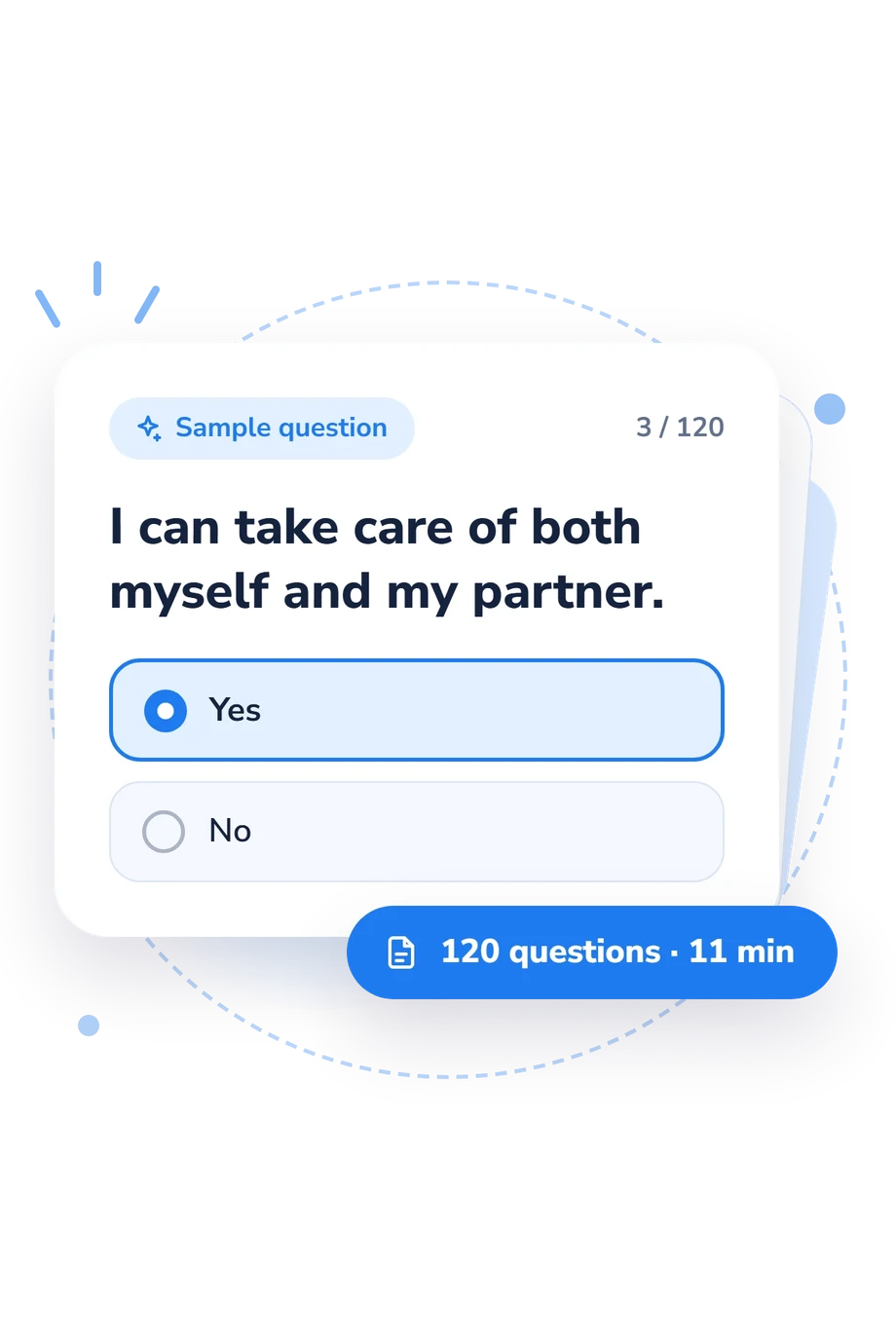
Example Questions From the Test
- Yes
- No
- Yes
- No
- Yes
- No
Attachment Style Test - Description and methodology of the test
People who want to understand how they respond to closeness, reassurance, conflict, and personal space may find the Attachment Style Test a useful starting point. It is intended for people reflecting on romantic or close relationships, especially when they notice recurring reactions but cannot easily name the pattern. As an attachment style quiz, it turns those observations into a structured profile rather than a single personality label.
What This Assessment Explores
The questions examine emotional availability, closeness, boundaries, vulnerability, conflict, reassurance, and independence in relationships. They also address reading a partner’s mood, expressing needs, responding to criticism, and feeling safe with intimacy. This profile helps readers notice recurring relationship attachment patterns without treating one result as a fixed identity.
The result is organized around four displayed dimensions:
- Secure (0-15) measures trust, openness, safety, and confidence in relationships; bands are Low secure (0-5), Moderate secure (6-10), and High secure (11-15).
- Anxious (0-15) reflects fear of rejection or loneliness, self-sacrifice, and reassurance-seeking; bands are Low (0-5), Moderate (6-10), and High (11-15).
- Anxious-Avoidant (0-15) captures wanting closeness while withdrawing, with suspiciousness or feeling intimacy is unsafe; bands are Low (0-5), Moderate (6-10), and High (11-15).
- Dismissive-Avoidant (0-15) measures distancing, difficulty engaging, and discomfort with vulnerability; bands are Low (0-5), Moderate (6-10), and High (11-15).
Methodology and Scientific Basis
Each item is a brief self-report statement with a Yes/No response. Answers are combined into separate scale totals, so the profile is best read across its dimensions rather than from one response. Results show which tendencies are more or less pronounced.
Gibson’s 2020 book provides theoretical context, while the four-part structure is consistent with Bartholomew and Horowitz’s 1991 four-category model. Hazan and Shaver’s 1987 work linked romantic relationships with attachment processes, and Bowlby’s theory describes how expectations of care and safety can shape closeness. As an attachment style assessment, this questionnaire is conceptually consistent with those attachment models, but is not presented as a validated adaptation or diagnostic instrument.
Because the online format provides no population norms, reliability estimates, or clinical cutoffs, a score shows the tendency most visible in this profile. Read the four totals together: one scale does not by itself define the whole attachment pattern. Responses can shift with current relationship circumstances, mood, self-awareness, and willingness to answer honestly, so the result works best as a reflection prompt when difficulties persist.
- Gibson, Thais. Attachment Theory: A Guide to Strengthening the Relationships in Your Life. Rockridge Press, 2020. ISBN 978-1-64611-545-7.
- Bartholomew, Kim, and Leonard M. Horowitz. "Attachment Styles Among Young Adults: A Test of a Four-Category Model." Journal of Personality and Social Psychology, 61(2), 226-244, 1991. 10.1037/0022-3514.61.2.226.
- Hazan, Cindy, and Phillip R. Shaver. "Romantic Love Conceptualized as an Attachment Process." Journal of Personality and Social Psychology, 52(3), 511-524, 1987. 10.1037/0022-3514.52.3.511.
- Bowlby, John. Attachment and Loss: Volume 1, Attachment. 2nd ed. Basic Books, 1982. ISBN 978-0-465-00543-7.
Updated: