
Emotional and Moral Development Test
How the Scales are Structured
Who Usually Takes This Test?
See How You Compare
Below is a preview of how scores are typically distributed across each scale.
Example Questions From the Test
- When you have prepared your homework very well and have performed well (answered) in front of the teacher and the whole class.
- When you put on expensive, new, fashionable, stylish, nice sneakers and go out wearing them with friends.
- Giving your mother a flower (or a bouquet of flowers).
- Going with friends to an amusement park for fun, having a good time together, and then drinking a can of cola and eating a slice of pizza.
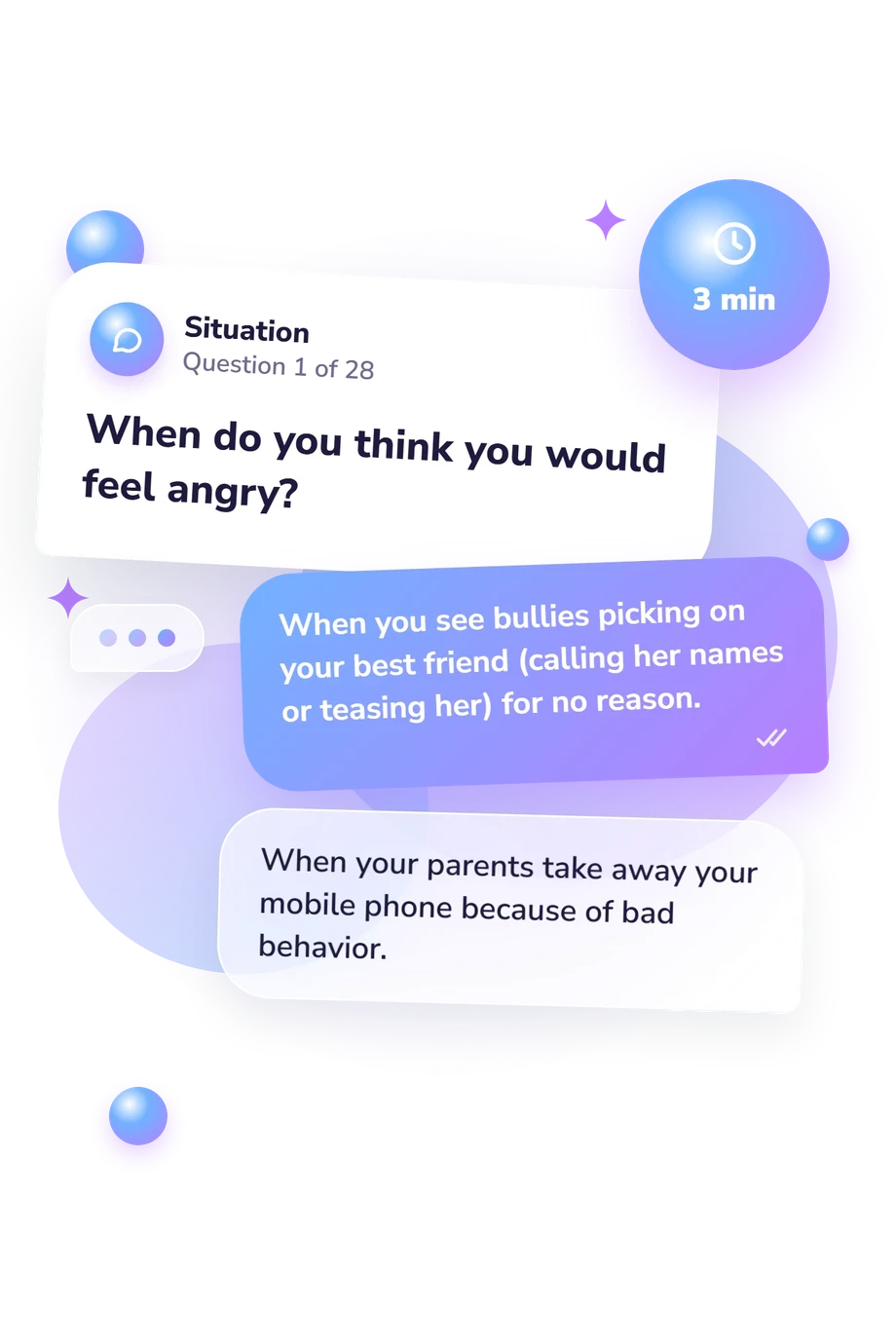
- When you saw your best friend being picked on (called names, teased) for no reason by bullies.
- When your parents took away your mobile phone because of bad behavior.
Emotional and Moral Development Test - Description and methodology of the test
People who want to examine how emotions connect with values can use the Emotional and Moral Development Test as a structured self-reflection exercise. As a moral development questionnaire, this test contrasts responses centred on empathy, relationships, and ethical meaning with responses focused on possessions, status, or personal reward. The result offers a compact profile of these orientations.
What This Assessment Explores
The items connect familiar emotions with values in everyday situations, contrasting empathy, fairness, family connection, and concern for others with possessions, status, and personal reward. This emotional development questionnaire links emotional concepts to moral meaning and external benefits.
The result assesses material and spiritual value orientations:
- Material Values (M), 0-14, show priority given to possessions, objects, external rewards, and material needs; bands are Low material focus (0-4), Moderate material focus (5-9), and High material focus (10-14).
- Spiritual Values, 0-14, show attention to cultural, ethical, aesthetic, and moral meaning; higher scores indicate greater emphasis on empathy, moral judgment, and conscious awareness of emotions; bands are Low spiritual orientation (0-4), Moderate spiritual orientation (5-9), and High spiritual orientation (10-14).
A stronger material orientation can coincide with less attention to empathy and moral norms, while spiritual orientation suggests greater emphasis on them.
Methodology and Scientific Basis
Each prompt presents an emotion or everyday situation with two contrasting choices. The alternatives pair empathy, relationships, fairness, and ethical concern with consumption, prestige, punishment, or personal gain. Respondents choose the meaning that fits their view; the format compares orientations rather than emotional intensity.
The displayed scoring presents two totals and places each in its stated band. It does not specify how many points an option contributes, so that rule cannot be inferred from the ranges. The closest published basis is Radchenko’s 2021 test questionnaire. This online questionnaire is a separate, conceptually consistent questionnaire rather than a direct adaptation of that instrument; it also aligns conceptually with Kohlberg’s stage theory of moral reasoning and Hoffman’s work on empathy and moral development.
Viewed as a moral values assessment, the result is an orientation profile rather than a fixed developmental verdict. The bands are descriptive and are not norm-referenced developmental levels or clinical cutoffs; self-report answers may shift with mood, experience, social desirability, and interpretation of a scenario, so the profile cannot by itself explain a person’s moral life.
- Radchenko, Violetta A. (2021). “A New and Relevant Psychodiagnostic Method of Research in the Study of the Personality of Students, Students with OOP, and Students with HIA-A: Test Questionnaire to Determine the Level of Emotional and Moral Development, Based on the Predominance of Material and Non-Material (Spiritual) Value Needs and Guidelines.” In Effective Practices of Modern Defectology: Current State and Trends, pp. 155-163. Moscow: Moscow Region State University. ISBN 978-5-7017-3257-3.
- Kohlberg, Lawrence. (1969). “Stage and Sequence: The Cognitive-Developmental Approach to Socialization.” In David A. Goslin (Ed.), Handbook of Socialization Theory and Research, pp. 347-480. Chicago, IL: Rand McNally.
- Hoffman, Martin L. (2000). Empathy and Moral Development: Implications for Caring and Justice. Cambridge: Cambridge University Press. 10.1017/CBO9780511805851
Updated: