
Leadership Qualities Assessment Test
How the Scales are Structured
Who Usually Takes This Test?
See How You Compare
Below is a preview of how scores are typically distributed across each scale.
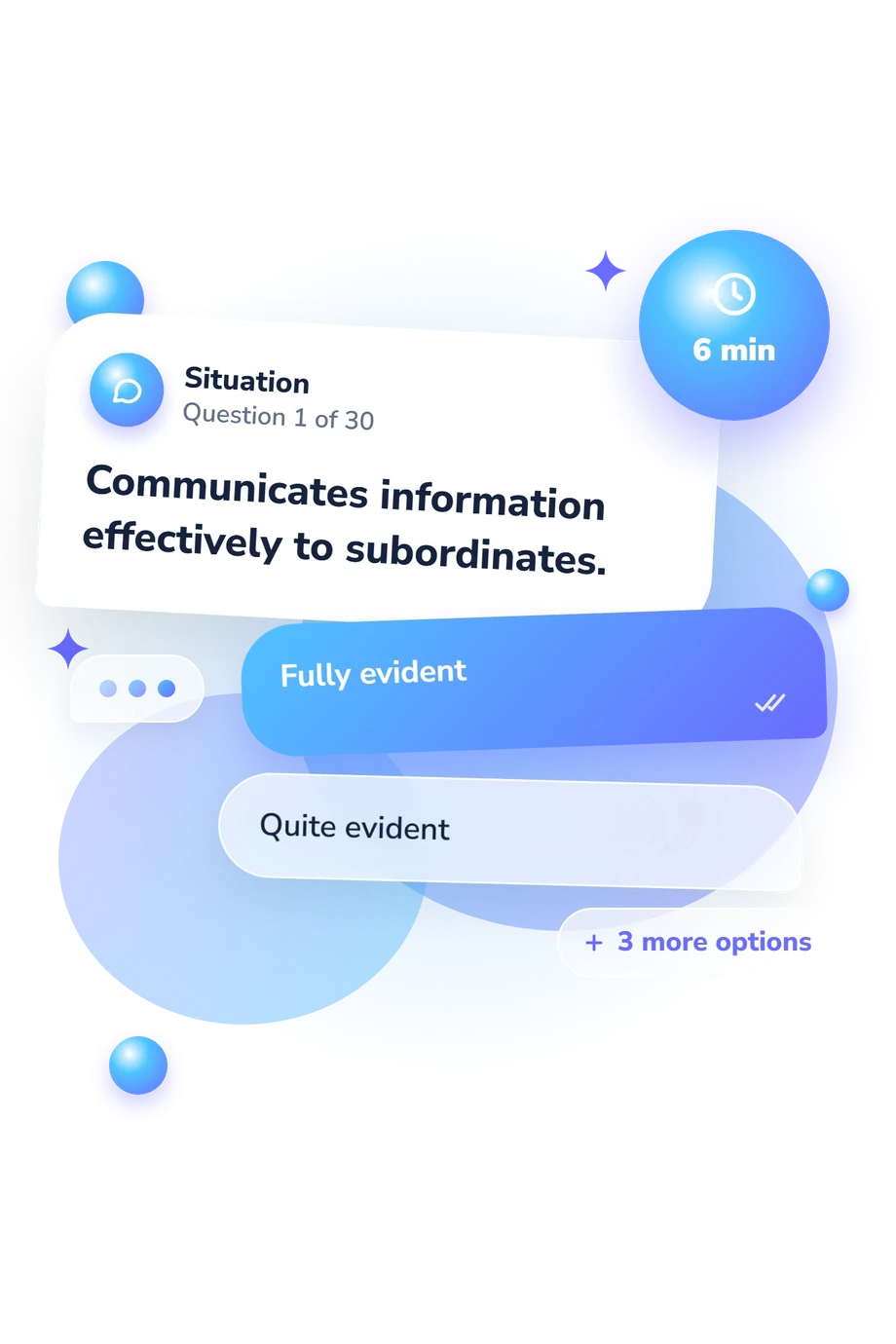
Example Questions From the Test
- Fully evident
- Quite evident
- Moderately evident
- Poorly evident
- Practically absent
- Fully expressed
- Fairly well expressed
- Moderately expressed
- Poorly expressed
- Virtually absent
- Fully developed
- Fairly well developed
- Moderately developed
- Poorly developed
- Practically absent
Leadership Qualities Assessment Test - Description and methodology of the test
Managers, team leads, and employees preparing for greater responsibility can use this assessment to examine behaviors that shape everyday leadership. The Leadership Qualities Assessment Test turns self-ratings into a profile of communication, decision-making, motivation, authority, and consideration for others. As a leadership assessment, it can help identify strengths and practical areas for reflection at work.
What This Assessment Measures
Questions cover communication, listening, support, teamwork, responsibility, risk, and employee involvement. Supervisors and people reviewing management habits can use it as a leadership skills test.
Five scales organize the result:
- Subordinate Motivation (6-30) measures the ability to inspire employees toward shared goals: Low 6-11; Moderate 12-21; High 22-30.
- Decision-Making (6-30) measures timely, well-reasoned decisions: Developing 6-11; Adequate 12-21; Strong 22-30.
- Use of Power (6-30) measures authority for organizational goals: Low use of power 6-11; Balanced use of power 12-21; High use of power 22-30, with balance indicating no excessive pressure.
- Consideration for Others (6-30) measures attention to employees’ interests, needs, and feelings, supporting trust and teamwork: Low focus on people 6-11; Balanced focus on people 12-21; Strong focus on people 22-30.
- Communication Domain (6-30) measures effective communication, contact-building, and relationship maintenance: Needs development 6-11; Adequate 12-21; Strong 22-30.
Methodology and Evidence Base
Each statement asks respondents to rate how evident a leadership behavior is, using five ordered choices that move from fully present, developed, or expressed to poorly evident or absent. The questionnaire reports a separate result for each scale and places it in the corresponding displayed band. These categories describe the profile.
The online questionnaire is conceptually consistent with the managerial-potential approach discussed by Travin, Magura, and Kurbatova (2005), especially its attention to directing work, employee involvement, responsibility, and interpersonal influence. It should not be read as the published instrument itself. Its wider leadership framing is compatible with Bass’s 1985 and 1990 work on performance beyond expectations and transformational leadership, while Yukl’s 2006 synthesis adds context for managerial effectiveness.
This assessment is most useful when answers reflect typical behavior across ordinary work situations. The questionnaire is presented as a structured online self-report profile; its displayed categories are descriptive bands. Self-perception and current team context can influence responses, so use the resulting leadership profile to identify areas for reflection and practice rather than as a standalone judgment of leadership effectiveness.
- Travin, V. V., Magura, M. I., & Kurbatova, M. B. (2005). Development of Managerial Potential: Module I. Educational and Practical Manual (2nd ed.). Moscow: Delo. ISBN 5-7749-0362-1.
- Bass, B. M. (1985). Leadership and Performance Beyond Expectations. New York: Free Press. ISBN 0-02-901810-2.
- Yukl, G. (2006). Leadership in Organizations (6th ed.). Upper Saddle River, NJ: Pearson Prentice Hall. ISBN 0-13-814268-8.
- Bass, B. M. (1990). From Transactional to Transformational Leadership: Learning to Share the Vision. Organizational Dynamics, 18(3), 19-31. 10.1016/0090-2616(90)90061-S
Updated: