
Romantic Partner Attachment Style Questionnaire Test
How the Scales are Structured
Who Usually Takes This Test?
See How You Compare
Below is a preview of how scores are typically distributed across each scale.
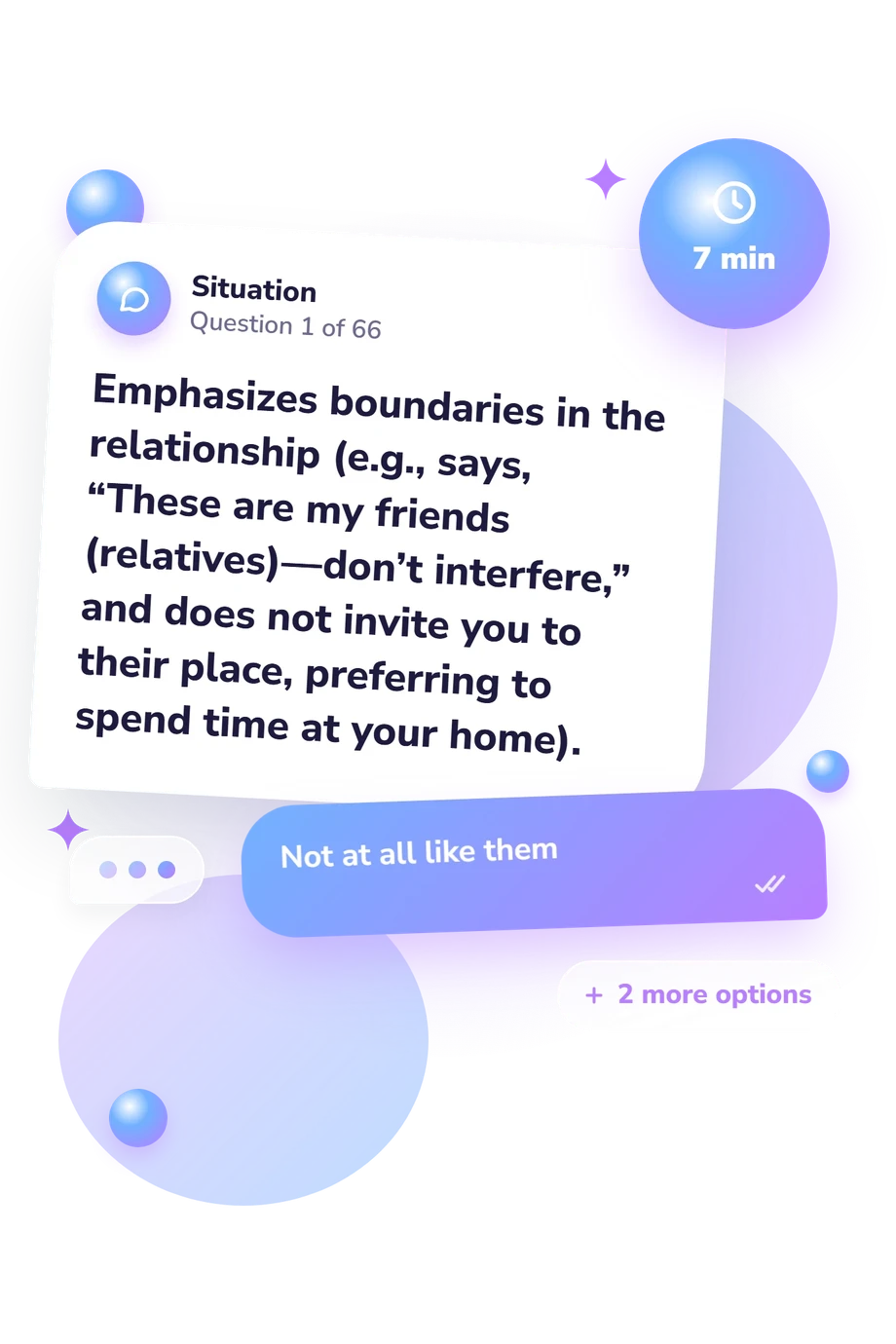
Example Questions From the Test
- Not at all like her
- Somewhat like her
- Very much like her
- Not at all like her
- Somewhat like her
- Very much like her
- Not at all like her
- Somewhat like her
- Very much like her
Romantic Partner Attachment Style Questionnaire Test - Description and methodology of the test
People assessing a loved one's relationship behavior may use this partner attachment questionnaire to organize observations before deciding what to discuss or reflect on. The Romantic Partner Attachment Style Questionnaire Test presents a profile across separate Anxious, Secure, and Avoidant scales, showing how these tendencies appear in observed behavior rather than assigning a single category. This can help the respondent choose which relationship questions deserve closer attention.
What This Assessment Explores
This assessment examines attachment-related behavior observed in situations involving intimacy, uncertainty, conflict, reassurance, and independence. The descriptions cover openness, disagreement, shared decisions, boundaries, commitment, and closeness. This questionnaire organizes one respondent's observations of a loved one's attachment style rather than assessing both partners together.
The result profile contains three displayed scales:
- Anxious (11-33) measures concern about separation and a need for reassurance; its bands are Low 11-17, Moderate 18-22, and High 23-33.
- Secure (11-33) measures comfort with intimacy, openness, cooperation, and supportive stability; its bands are Low reliability 11-17, Moderate reliability 18-22, and High reliability 23-33.
- Avoidant (11-33) measures independence, emotional distance, and reluctance to discuss feelings; its bands are Low avoidant 11-17, Moderate avoidant 18-22, and High avoidant 23-33.
A result may show multiple tendencies when behavior changes across situations. Use the profile to notice patterns and questions worth discussing.
Methodology and Scientific Basis
Items cover distance, reassurance, openness, compromise, boundaries, and disagreement. The described items ask you to rate each behavior as 1 - Not at all like her, 2 - Somewhat like her, or 3 - Very much like her. Three scale scores are displayed; the questionnaire does not document how responses are assigned, weighted, or combined.
Its conceptual framework is adult attachment research. The questionnaire is conceptually consistent with Partner Attachment Style Questionnaire (Levine & Heller, 2010), and it relates to Hazan and Shaver’s account of romantic love as an attachment process and Brennan, Clark, and Shaver’s work on adult romantic attachment measurement. These sources support distinguishing comfort with closeness, anxiety about abandonment, and distancing from intimacy; they do not establish this online version as a validated adaptation.
This romantic attachment questionnaire is best interpreted alongside the situations described and your knowledge of the person. Recent conflict, selective attention, incomplete information, or a wish to protect or criticize the partner can influence ratings. The bands organize reflection, but they are not established population norms. Honest, context-aware responses make the profile useful.
- Levine, A., & Heller, R. (2010). Attached: The New Science of Adult Attachment and How It Can Help You Find-and Keep-Love. Jeremy P. Tarcher/Penguin.
- Hazan, C., & Shaver, P. R. (1987). Romantic love conceptualized as an attachment process. Journal of Personality and Social Psychology, 52(3), 511-524. 10.1037/0022-3514.52.3.511
- Brennan, K. A., Clark, C. L., & Shaver, P. R. (1998). Self-report measurement of adult romantic attachment: An integrative overview. In J. A. Simpson & W. S. Rholes (Eds.), Attachment theory and close relationships (pp. 46-76). Guilford Press.
Updated: