
Freudly+971 508685814hello@freudly.ai
Freudly
role conflict

Intrapersonal Conflict Level Assessment Test
Take the online Intrapersonal Conflict Level Assessment Test - AI psychologist FreudlyYou can take Intrapersonal Conflict Level Assessment Test here. Online version of a simple and accurate psychological test with interpretation.en
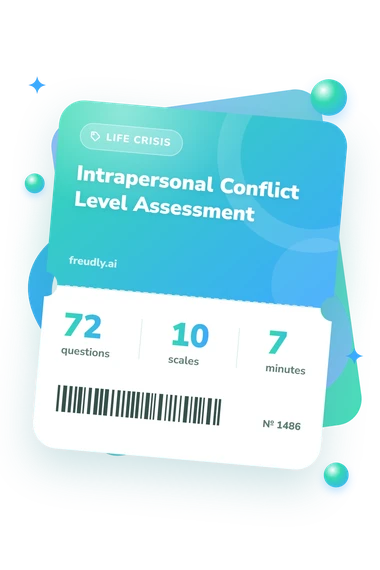
With 36 questions and a typical completion time of about seven minutes, the Intrapersonal Conflict Level Assessment Test explores tensions between motives, duties, aspirations, and everyday demands. Your result can highlight recurring areas of inner strain and support focused self-reflection about choices, emotions, and adaptation.
Questions: 367 minutes
Intrapersonal Conflict Level Assessment: test ticket with numbers
October 2, 2025October 2, 2025Material has been updatedOctober 2, 2025Material has been published
21,925 views
1,822 completions
1,600 likes
Daniel HallPsychologist · Test reviewer
1,600 likes
Scale Explorer

How the Scales are Structured

Self-EsteemSE
Measures the intensity of intrapersonal conflict tied to self-evaluation and the gap between personal aspirations and perceived capabilities.
example score23/54
23/54Moderate conflictexample score
0 – 18Low conflict
19 – 36Moderate conflict
37 – 54High conflict
A score of 23 falls in the Moderate conflict range, suggesting occasional tension between how you evaluate yourself and what you expect from yourself.
Musts and ShouldsMaS
Measures the intensity of inner tension linked to perceived duties, demands, and social norms versus personal desires.
example score25/54
25/54Moderateexample score
0 – 18Low
19 – 36Moderate
37 – 54High
A score of 25 falls in the Moderate range, suggesting a noticeable but manageable degree of conflict between “should” obligations and personal wants.
MotivationM
Measures the intensity of internal conflicts arising from competing motives, desires, and goals.
example score12/54
12/54Low conflictexample score
0 – 18Low conflict
19 – 36Moderate conflict
37 – 54High conflict
A score of 12 falls in the Low conflict range, suggesting relatively few pronounced contradictions between current motives and goals.
Inadequate Self-Esteem ConflictISEC
Measures the extent of internal tension arising from a mismatch between self-evaluation, aspirations, and perceived capabilities.
example score3/18
3/18Low conflictexample score
0 – 5Low conflict
6 – 11Moderate conflict
12 – 18High conflict
A score of 3 falls in the Low conflict range, suggesting relatively little tension from discrepancies between self-assessment, goals, and perceived abilities.
Adaptation ConflictAC
Measures the degree to which environmental demands feel mismatched with one’s perceived ability to adapt socially or professionally.
example score14/18
14/18Highexample score
0 – 6Low
7 – 12Moderate
13 – 18High
A score of 14 falls in the High range, suggesting notable tension around adjusting to external demands and feeling stretched by situational requirements.
Role ConflictRC
Role Conflict measures tension arising from difficulty balancing or fulfilling multiple important social roles.
example score10/18
10/18Moderateexample score
0 – 5Low
6 – 12Moderate
13 – 18High
A score of 10 falls in the Moderate range, suggesting noticeable but manageable strain when juggling different role expectations.
Unfulfilled Desire ConflictUDC
Measures the degree of internal tension arising from a gap between desired goals and perceived ability to fulfill them.
example score4/18
4/18Lowexample score
0 – 6Low
7 – 12Moderate
13 – 18High
A score of 4 falls in the Low range, suggesting that unfulfilled wishes are currently a minor source of internal tension and dissatisfaction.
Moral ConflictMC
Measures the degree of inner tension arising from clashes between personal values, ethical principles, and perceived social norms.
example score6/18
6/18Lowexample score
0 – 6Low
7 – 12Moderate
13 – 18High
A score of 6 falls in the Low range, suggesting moral contradictions are present but generally create limited doubt or internal resistance in everyday situations.
Motivational ConflictMC
Measures the degree of internal tension arising from competing motives, needs, and goals.
example score4/18
4/18Lowexample score
0 – 6Low
7 – 12Moderate
13 – 18High
A score of 4 falls in the Low range, suggesting relatively little conflict between competing goals or desires at this time.
Overall Level of Intrapersonal ConflictOLoIC
Measures the overall intensity of internal contradictions, doubts, and associated emotional tension.
example score85/108
85/108Highexample score
0 – 50Low
51 – 72Moderate
73 – 108High
A score of 85 falls in the High range, suggesting pronounced intrapersonal conflict with frequent internal contradictions and elevated emotional strain.
just completed the test
DATA-BASED USER COHORTS

Who Usually Takes This Test?

Stressed decision-makers
41%OF USERS
People who feel torn between competing goals or desires and want to understand why choices trigger anxiety or guilt.
Role and identity shifters
34%OF USERS
Those juggling multiple roles (partner, parent, leader, student) who sense inner tension about expectations and who they “should” be.
Helpers guiding clients
25%OF USERS
Psychologists, coaches, and counselors who need a quick snapshot of a client’s main internal conflict zones to plan next steps.
BASED ON AGGREGATED, ANONYMIZED DATA FROM TENS OF THOUSANDS OF FREUDLY USERS.
Benchmarking

See How You Compare

Once you complete the test, your results are compared with real-world data from people in your country.
Below is a preview of how scores are typically distributed across each scale.
Shaded area — where most people score
Dot — the average
You — your score lands on each curve after the test— your score, after the test
Self-esteemS
You?
Average20
Typical rangeTypical10.4 – 29.5
Possible0 – 54
EntitlementE
You?
Average18.4
Typical rangeTypical10.1 – 26.7
Possible0 – 54
MotivationM
You?
Average15.2
Typical rangeTypical6.8 – 23.6
Possible0 – 54
Conflict of Inadequate Self-EsteemCoIS
You?
Average11.6
Typical rangeTypical8.8 – 14.4
Possible0 – 18
Adaptation ConflictAC
You?
Average5.6
Typical rangeTypical3 – 8.2
Possible0 – 18
Role ConflictRC
You?
Average9.9
Typical rangeTypical7.6 – 12.1
Possible0 – 18
Conflict of Unfulfilled DesireCoUD
You?
Average5.4
Typical rangeTypical2.7 – 8
Possible0 – 18
Moral conflictMc
You?
Average11.4
Typical rangeTypical8.6 – 14.2
Possible0 – 18
Motivational ConflictMC
You?
Average8.9
Typical rangeTypical5.9 – 12
Possible0 – 18
Overall Level of Intrapersonal Conflict, KvKOLoICK
You?
Average41.8
Typical rangeTypical22.8 – 60.8
Possible0 – 108
Featured On
SAMPLE QUESTIONS

Example Questions From the Test

Please read the questions and choice scenarios listed below carefully. Indicate how you typically respond when faced with this type of choice. Select the response option that best describes your usual reaction.
    • Not feel upset
    • Feel slightly upset
    • Feel upset
    • Feel desperate
    • Openly express my emotions
    • Other
    • Not feel upset
    • Feel slightly upset
    • Feel upset
    • Feel desperate
    • Openly express my emotions
    • Other
    • Not upset
    • Slightly upset
    • Upset
    • Desperate
    • Openly express my emotions
    • Other
WHAT THE TEST MEASURES

Intrapersonal Conflict Level Assessment Test - Description and methodology of the test

role conflict
life crisis

People who feel pulled between personal wishes, obligations, self-expectations, and practical limits may use the Intrapersonal Conflict Level Assessment Test to organize these experiences. This intrapersonal conflict assessment is intended for people seeking a structured view of recurring inner tension, emotional reactions, and difficult choices. The profile points to areas for closer reflection rather than reducing experience to one label.

What This Assessment Explores

Results form an intrapersonal conflict profile from disappointment, restraint, commitments, rules, roles, values, and blocked wishes. The dimensions and bands are:

  • Self-Esteem (0-54) covers aspiration/capability conflict: Low conflict 0-18/Moderate conflict 19-36/High conflict 37-54; Musts and Shoulds (0-54) covers duty/desire tension: Low 0-18/Moderate 19-36/High 37-54.
  • Motivation (0-54) covers competing motives/goals: Low conflict 0-18/Moderate conflict 19-36/High conflict 37-54; Inadequate Self-Esteem Conflict (0-18) covers aspiration/capability discrepancy: Low conflict 0-5/Moderate conflict 6-11/High conflict 12-18.
  • Adaptation Conflict (0-18) covers demands/capacity imbalance: Low 0-6, Moderate 7-12, High 13-18; Role Conflict (0-18) covers role integration: Low 0-5, Moderate 6-12, High 13-18.
  • Unfulfilled Desire Conflict (0-18), Moral Conflict (0-18), and Motivational Conflict (0-18) cover blocked wishes, value/norm conflict, and competing needs: Low 0-6, Moderate 7-12, High 13-18.
  • Overall Level of Intrapersonal Conflict (0-108) reflects contradictions, doubts, and distress: Low 0-50, Moderate 51-72, High 73-108; moderate also indicates self-reflection, resilience, and flexible adaptation.

Methodology and Scientific Basis

An intrapersonal conflict questionnaire uses self-report responses to brief situations, not factual knowledge questions. Options move from no upset or worry through slight distress to desperation; some permit open emotional expression or Other. The format records reactions when desires meet duties, health, rules, relationships, work, or conduct.

Scoring aggregates broad domains and subscales, then places each result in its stated band. Higher scores indicate greater conflict on the named scale. Ranges do not reveal how many points each answer contributes. Shipilov’s Intrapersonal Conflict Test is the closest named reference; this questionnaire is conceptually consistent with its conflictology framework, not a direct adaptation.

Fantalova’s model clarifies tensions between values and opportunities, while Letyagina’s study supplies an applied comparison involving upbringing and acceptance of deviant behavior. These sources support construct-level interpretation, not claims that this version shares their samples, norms, reliability, or validation.

The online version provides bands, but its standardization, reliability estimates, and clinical cutoffs are not established by these sources. Current stress, recall, and willingness to disclose can influence scores, so the profile is best read as structured reflection on present experience.

Author: Leon Festinger
Literature:
  • Antsupov, Anatoly Ya., and Anatoly I. Shipilov. Conflictology: A Textbook for Universities. 5th revised and expanded ed. Saint Petersburg: Piter, 2014. ISBN 978-5-496-00113-7.
  • Letyagina, S. K. “Features of the Relationship of Intrapersonal Conflict with Family Upbringing Styles and Acceptability of Deviant Behavior among Law Students.” Human Capital, no. 8 (152), 2021, pp. 112-118. 10.25629/HC.2021.08.12.
  • Fantalova, Elena B. Values and Internal Conflicts: Theory, Methodology, Diagnostics. Saarbrucken: LAP Lambert Academic Publishing, 2012.
Popular tests
Comments
Leave a Comment