
Basic Meaning Attitudes Test
How the Scales are Structured
Who Usually Takes This Test?
See How You Compare
Below is a preview of how scores are typically distributed across each scale.
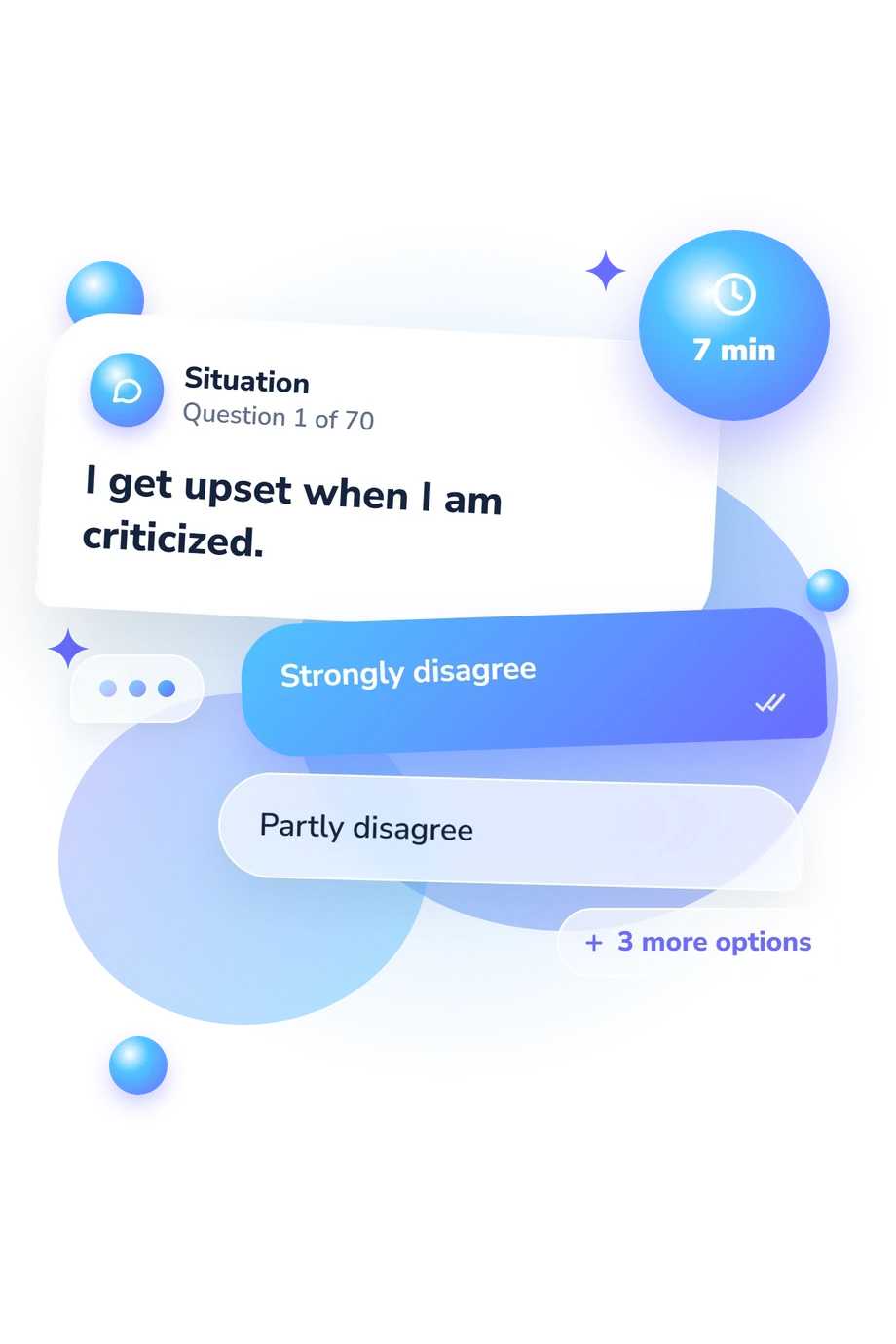
Example Questions From the Test
- Strongly disagree
- Somewhat disagree
- Neutral
- Somewhat agree
- Strongly agree
- Strongly disagree
- Somewhat disagree
- Neutral
- Somewhat agree
- Strongly agree
- Strongly disagree
- Somewhat disagree
- Neutral
- Somewhat agree
- Strongly agree
Basic Meaning Attitudes Test - Description and methodology of the test
People who want to examine the assumptions shaping their reactions to responsibility, approval, achievement, and close relationships may find the Basic Meaning Attitudes Test useful. This assessment can show whether these beliefs lean toward autonomy, obligation, perfectionism, dependence, or external control. The result offers a profile of recurring attitudes for structured self-reflection in everyday decisions, relationships, and responses to setbacks.
What This Assessment Explores
Questions in this attitudes assessment cover responsibility, standards, achievement, dependence, and reactions to criticism or obstacles. Its scales are:
- Responsibility for Self (0-10) shows overestimating personal control or shifting responsibility to external circumstances: Over-control 0-4, Balanced 5-6, Externalizing 7-10.
- Responsibility for Others (0-10) shows responsibility for others: Low 0-3, Balanced 4-6, High 7-10.
- Demandingness Toward Others (0-10) shows demands on others: Low demandingness 0-3, Moderate demandingness 4-6, High demandingness 7-10.
- Self-Demandingness (0-10) shows self-demands: Low self-demand 0-3, Balanced self-demand 4-6, High self-demand 7-10.
- Achievement-Contingent Self-Worth (0-10) shows achievement-based self-worth: Low 0-3, Balanced 4-7, High 8-10.
- Emotional Dependence (0-10) shows reliance on support: Low 0-3, Moderate 4-6, High 7-10.
- Verbal Dependence (0-10) shows how self-respect depends on other people's opinions: Low 0-2, Moderate 3-6, High 7-10.
Methodology and Scientific Basis
Each item in this self-report questionnaire is a self-report statement answered on a five-point scale from strong or complete disagreement through a neutral midpoint to strong or complete agreement. The format asks how closely each belief fits. Results are reported across the seven displayed dimensions, but the questionnaire does not specify how individual responses are converted into scale scores, including item weights or a conversion rule.
The questionnaire is conceptually consistent with the Semantic Basic Attitudes Questionnaire described by Ishkov and Miloradova, but it is not presented as a standardized administration of that instrument. The 2007 patent describes the original assessment method, and Karasaeva’s 2013 study examines the SBA in two samples. Beck et al.’s 1991 study of the Dysfunctional Attitude Scale is a related study of dysfunctional attitudes, but it does not validate this questionnaire.
A meaning attitudes profile is read as patterns across domains: displayed bands are interpretive categories, not clinical norms, and this online version has no population norms, reliability estimates, or clinical validation; responses may shift with stress, self-awareness, or the wish to appear favorable.
- Ishkov, Alexander D., and Nadezhda G. Miloradova. Method for Diagnosing Basic Semantic Attitudes of a Person. Russian Patent RU 2303467, published July 27, 2007.
- Ishkov, Alexander D., and Nadezhda G. Miloradova. Psychological Attitudes and Their Diagnosis Using the Semantic Basic Attitudes Questionnaire (SBA). Economics and Entrepreneurship, no. 6-3 (59), 2015, pp. 569-574.
- Karasaeva, Aliya M. Social-Psychological Study of Semantic Attitudes Using Two Samples and the SBA Questionnaire. Vestnik of Tver State University. Series: Pedagogy and Psychology, no. 4, 2013, pp. 117-122. ISSN 1999-4133.
- Beck, Aaron T., Gary Brown, Robert A. Steer, and Arlene Weissman. Factor Analysis of the Dysfunctional Attitude Scale in a Clinical Population. Psychological Assessment, vol. 3, no. 3, 1991, pp. 478-483. 10.1037/1040-3590.3.3.478.
Updated: