
Marital Satisfaction Test
How the Scales are Structured
Who Usually Takes This Test?
See How You Compare
Below is a preview of how scores are typically distributed across each scale.
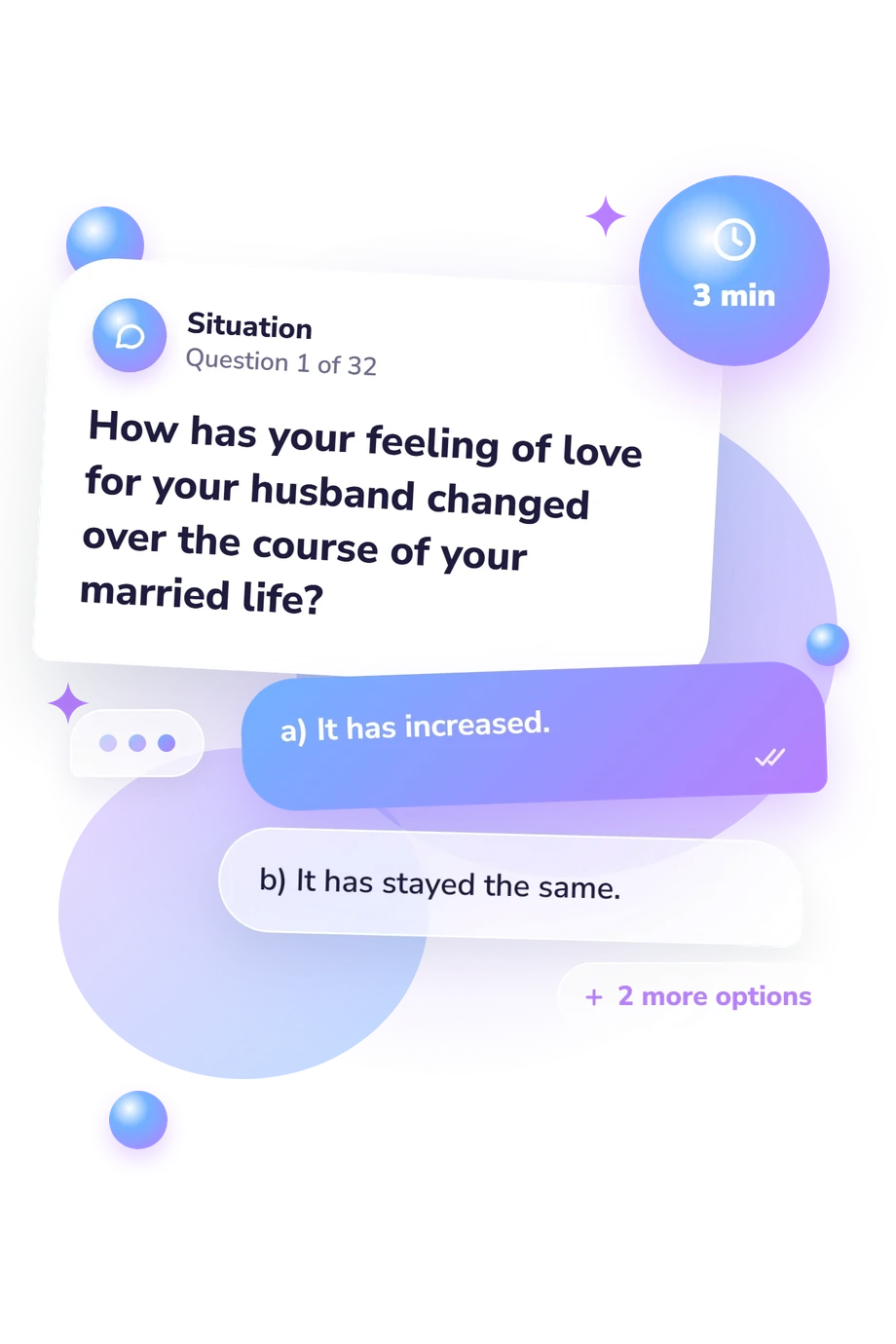
Example Questions From the Test
- It has grown stronger.
- It has stayed the same.
- It has decreased.
- It has disappeared.
- Not get married at all.
- Choose a completely different person.
- Prefer someone similar to your spouse.
- Choose your current spouse again.
- No.
- Rather no than yes.
- Rather yes than no.
- Yes.
Marital Satisfaction Test - Description and methodology of the test
People reflecting on the quality of a marriage may find the Marital Satisfaction Test a structured way to examine satisfaction from one partner’s perspective. This marriage satisfaction questionnaire is intended for someone who wants to understand their own view of the marriage. The result highlights a general level of satisfaction for further reflection.
What This Assessment Explores
The questionnaire examines how a respondent experiences marriage as an emotional and practical relationship. Items address love, tenderness, comfort at home, willingness to return home, thoughts of divorce, and overall appraisal. Item wording frames the respondent as evaluating a marriage with a wife; this marital relationship assessment reflects one partner’s perspective, not both spouses.
The main themes are:
- Emotional connection shows how love, affection, calm, and closeness are experienced.
- Shared decisions show agreement about friends, relatives, household responsibilities, and spending.
- Conflict and distance indicate irritation, serious disagreements, withdrawal, and separation thoughts.
- Commitment and appraisal show whether the respondent would choose the same spouse again and how successful the marriage feels.
The result is reported as Marital Satisfaction (0-48), with Low satisfaction (0-18), Moderate satisfaction (19-39), and High satisfaction (40-48). Higher scores indicate greater satisfaction; lower scores suggest marital difficulties or dissatisfaction.
Methodology and Evidence Base
Each question presents four ordered response choices, moving between favorable and unfavorable experiences or lower and higher frequency. The respondent selects the option that best matches the relationship, so the format captures household situations and broad judgments without requiring a narrative answer.
Responses are combined into a single marriage satisfaction scale. Higher totals represent greater satisfaction, but the exact points assigned to choices are not stated; the displayed ranges should not be used to reconstruct an item-level scoring key.
The closest source is the 1987 work by Aleshina, Gozman, and Dubovskaya; this is a separate online questionnaire conceptually consistent with that instrument, not a verbatim reproduction or standardized adaptation. Aleshina’s 1985 dissertation adds context on satisfaction and interpersonal perception, while the items here apply that subject through judgments about affection, agreement, conflict, home comfort, and the future of the marriage.
As a self-report tool, it can be influenced by current mood, recent conflict, memory, and candor. No population norms are stated, so the bands describe the questionnaire’s categories rather than clinical thresholds; interpret the score in context.
- Aleshina, Yu. E., Gozman, L. Ya., & Dubovskaya, E. M. (1987). Socio-Psychological Methods for Studying Marital Relationships: Special Practicum in Social Psychology. Moscow: Moscow University Press.
- Aleshina, Yu. E. (1985). Satisfaction with Marriage and Interpersonal Perception in Married Couples with Different Lengths of Shared Life. PhD dissertation, Lomonosov Moscow State University, Moscow.
- Sychev, O. A. (2016). Russian Version of Relationship Assessment Scale. Psychology. Journal of the Higher School of Economics, 13(2), 386-409. 10.17323/1813-8918-2016-2-386-409
Updated: