
Freudly+971 508685814hello@freudly.ai
Freudly
self-regulation

Self-Regulation Ability Scale Test
Take the online Self-Regulation Ability Scale Test - AI psychologist FreudlyYou can take Self-Regulation Ability Scale Testhere. Online version of a simple and accurate psychological test with interpretation.en
Understand how you manage emotions and actions under pressure in about 6 minutes. Get a clear view of flexibility, composure, and creative problem solving for real-world challenges.
Start Online Test
Questions: 486 minutes
08:30
October 2, 2025
October 2, 2025
Material has been updated
October 2, 2025
Material has been published
20,040 views
1,132 completions
949 likes
Verified by Daniel Hall
Psychologist with 25 years of experience
Share
Scale Explorer

How the Scales are Structured

example score
2/6
Correction (C)
Correction measures how effectively a person adjusts their actions and behavior based on self-monitoring results to improve outcomes.
Limited correction
Situational correction
Consistent correction
02: Limited correction | 34: Situational correction | 56: Consistent correction
A score of 2 indicates limited correction, meaning adjustments based on feedback tend to be infrequent or require clearer cues to implement.
example score
4/6
Self-Control (SC)
Self-Control measures how well a person monitors their actions against a plan, evaluates results, and adjusts behavior to stay on track.
Low
Moderate
High
02: Low | 34: Moderate | 56: High
A score of 4 indicates moderately developed self-control, with generally effective monitoring and correction of actions but occasional lapses under changing conditions.
example score
4/6
Decision Making (DM)
Measures how effectively a person turns plans into timely action by choosing and committing to an optimal start point.
Hesitant start
Developing decisiveness
Ready to act
02: Hesitant start | 34: Developing decisiveness | 56: Ready to act
A score of 4 suggests you generally move from planning to action with reasonable timing, though some situations may still require extra prompting to begin implementation.
example score
3/6
Quality Evaluation Criterion (QEC)
Measures how well a person defines and uses clear indicators to judge plan progress and adjust actions toward the intended outcome.
Limited criteria
Basic criteria
Strong criteria
02: Limited criteria | 34: Basic criteria | 56: Strong criteria
A score of 3 indicates a basic ability to set evaluation indicators for plan execution, with some need for clearer metrics to support timely adjustments.
example score
2/6
Planning (P)
Planning measures how well a person structures steps and selects methods to achieve goals.
Low
Moderate
High
02: Low | 34: Moderate | 56: High
A score of 2 indicates a low planning level, suggesting goals may be approached with limited step-by-step structure and less consistent selection of effective means.
example score
3/6
Goal Setting (GS)
Measures how well a person forms and prioritizes a coherent system of goals to guide planning and achievement.
Limited
Developing
Strong
02: Limited | 34: Developing | 56: Strong
A score of 3 suggests a developing capacity to set and prioritize goals, with some structure present but not yet consistently applied across situations.
example score
3/6
Forecasting (F)
Forecasting measures how well a person anticipates future events and consequences by analyzing past and present information.
Limited forecasting
Adequate forecasting
Strong forecasting
02: Limited forecasting | 34: Adequate forecasting | 56: Strong forecasting
A score of 3 suggests an adequate ability to anticipate likely outcomes, with some room to make predictions more consistent across situations.
example score
3/6
Contradiction Analysis (CA)
Measures how well a person identifies contradictions and likely causes of setbacks to form a coherent understanding of a situation for problem-solving.
Limited analysis
Developing analysis
Strong analysis
02: Limited analysis | 34: Developing analysis | 56: Strong analysis
A score of 3 suggests a developing ability to notice contradictions and begin mapping causes of difficulties, with room to make the situation model more precise.
example score
19/48
General Self-Regulation Ability (GSRA)
Measures the overall development of an integrated self-management system and the balance between rational control and emotional evaluation in regulating behavior.
Low
Moderate
High
021: Low | 2239: Moderate | 4048: High
A score of 19 falls in the Low range, suggesting a less developed self-management system with emotions tending to outweigh deliberate, rational regulation in challenging situations.
Start Online Test
just completed the test
DATA-BASED USER COHORTS

Who Usually Takes This Test?

Managers and team leads
41%OF USERS
They take it to gauge how well they stay calm, adapt fast, and make independent decisions when plans change.
Job candidates in fast-paced roles
34%OF USERS
They use it to show readiness for unpredictable tasks, self-direction, and flexible problem-solving at work.
Coaching and training clients
25%OF USERS
They take it to understand their self-control patterns under stress and identify where to build better habits and resilience.
BASED ON AGGREGATED, ANONYMIZED DATA FROM TENS OF THOUSANDS OF FREUDLY USERS.
Benchmarking

See How You Compare

Once you complete the test, your results are compared with real-world data from people in your country.
Below is a preview of how scores are typically distributed across each scale.
Correction (C)
Correction (C)
Average
1.8
Normal range
12.5
min.
0
max.
6
This curve shows how scores are typically distributed.
Once you complete the test, your result will appear on the scale so you can see how you compare.
Self-Control (S)
Self-Control (S)
Average
4.4
Normal range
3.65.3
min.
0
max.
6
This curve shows how scores are typically distributed.
Once you complete the test, your result will appear on the scale so you can see how you compare.
Decision Making (DM)
Average
1.5
Normal range
0.52.6
min.
0
max.
6
This curve shows how scores are typically distributed.
Once you complete the test, your result will appear on the scale so you can see how you compare.
Quality assessment criterion (Qac)
Average
3.3
Normal range
2.44.2
min.
0
max.
6
This curve shows how scores are typically distributed.
Once you complete the test, your result will appear on the scale so you can see how you compare.
Planning (P)
Planning (P)
Average
3.5
Normal range
2.54.5
min.
0
max.
6
This curve shows how scores are typically distributed.
Once you complete the test, your result will appear on the scale so you can see how you compare.
Goal Setting (GS)
Goal Setting (GS)
Average
2.8
Normal range
23.6
min.
0
max.
6
This curve shows how scores are typically distributed.
Once you complete the test, your result will appear on the scale so you can see how you compare.
Forecasting (F)
Forecasting (F)
Average
2.2
Normal range
13.3
min.
0
max.
6
This curve shows how scores are typically distributed.
Once you complete the test, your result will appear on the scale so you can see how you compare.
Contradiction Analysis (CA)
Average
3.8
Normal range
2.94.6
min.
0
max.
6
This curve shows how scores are typically distributed.
Once you complete the test, your result will appear on the scale so you can see how you compare.
General Self-Regulation Ability Scale (GSAS)
Average
24.9
Normal range
18.431.3
min.
0
max.
48
This curve shows how scores are typically distributed.
Once you complete the test, your result will appear on the scale so you can see how you compare.
Featured On
SAMPLE QUESTIONS

Example Questions From the Test

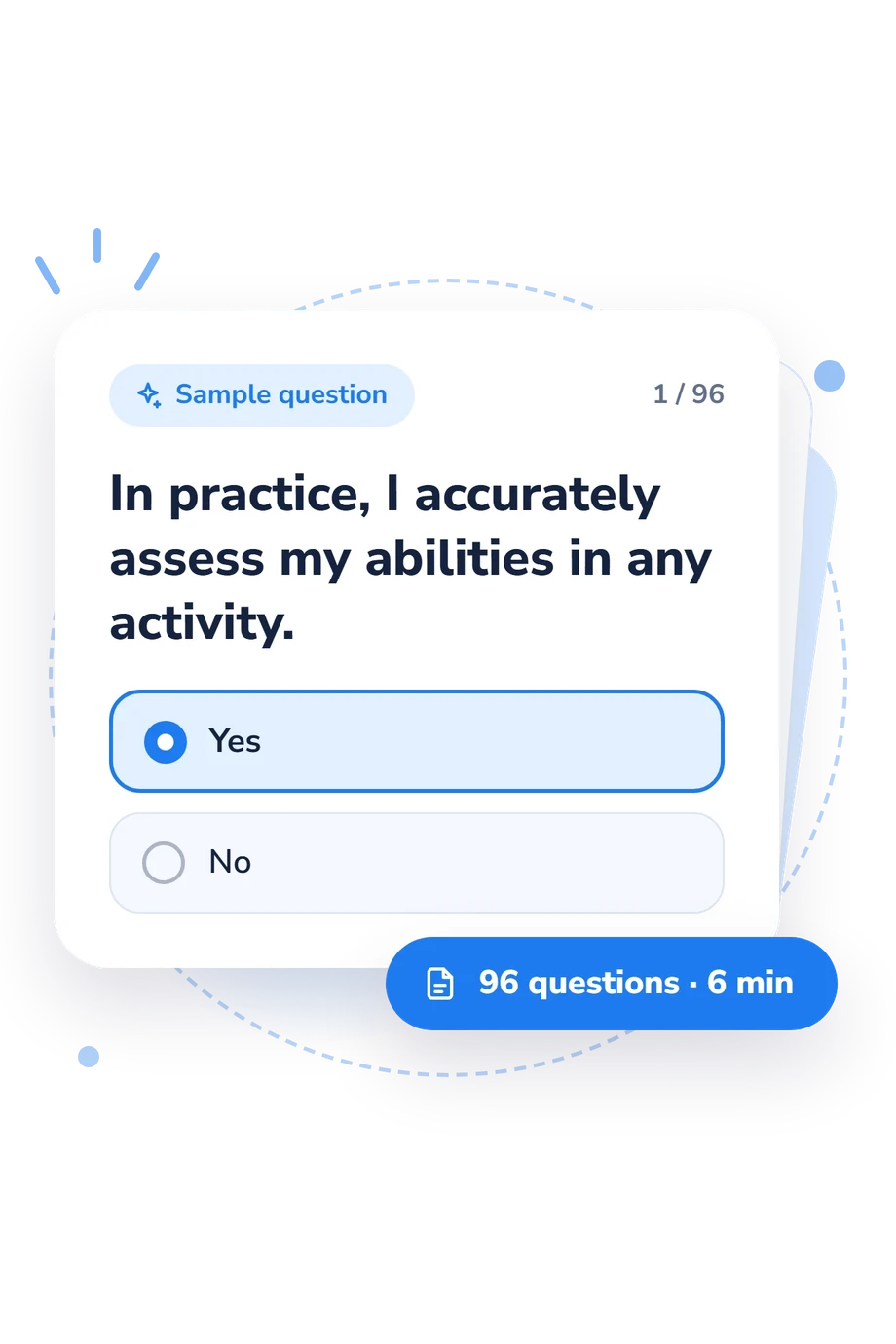
The proposed questionnaire makes it possible to assess self-control abilities across various situations. The questionnaire includes two groups of statements: I. Statements that require reference to personal experience. For example: 5. I constantly try to find an answer to the question: “What is good and what is bad?” If you do, in fact, often evaluate your actions and behavior and try to find an answer to this question, respond “Yes.” If you do this rarely, respond “No.” II. Statements that reflect your attitude toward commonly held opinions. For example: 28. Good luck favors those who do not plan in advance but rely on the natural course of events. If you agree with this view, respond “Yes.” If you do not agree, respond “No.”
    • Yes
    • No
    • Yes
    • No
    • Yes
    • No
WHAT THE TEST MEASURES
About This Assessment
Self-regulation ability, SRA Test

Self-Regulation Ability Scale Test - Symptoms and Signs

self-regulation

This questionnaire assesses perceived capacity to manage behavior, emotions, and goal-directed activity across changing demands. The Self-Regulation Ability Scale is intended to characterize how individuals monitor and adjust their responses, particularly when routine strategies are insufficient.

The instrument includes 48 items and typically takes about 6 minutes to complete. Respondents rate their typical reactions across a range of situations, yielding a profile of self-regulatory functioning that may inform clinical formulation, counseling goals, or broader psychological assessment.

The Self-Regulation Ability Scale was developed by Roy F. Baumeister and is generally interpreted as a self-report measure of adaptive self-control and flexible goal pursuit. Results should be considered alongside other clinical data and the individual’s context.

Author: Roy F. Baumeister
Literature: Baumeister, R. F., & Vohs, K. D. (Eds.). Handbook of self-regulation: Research, theory, and applications. Guilford Press. 2004.
Popular tests
Comments
Leave a Comment