
Love Test

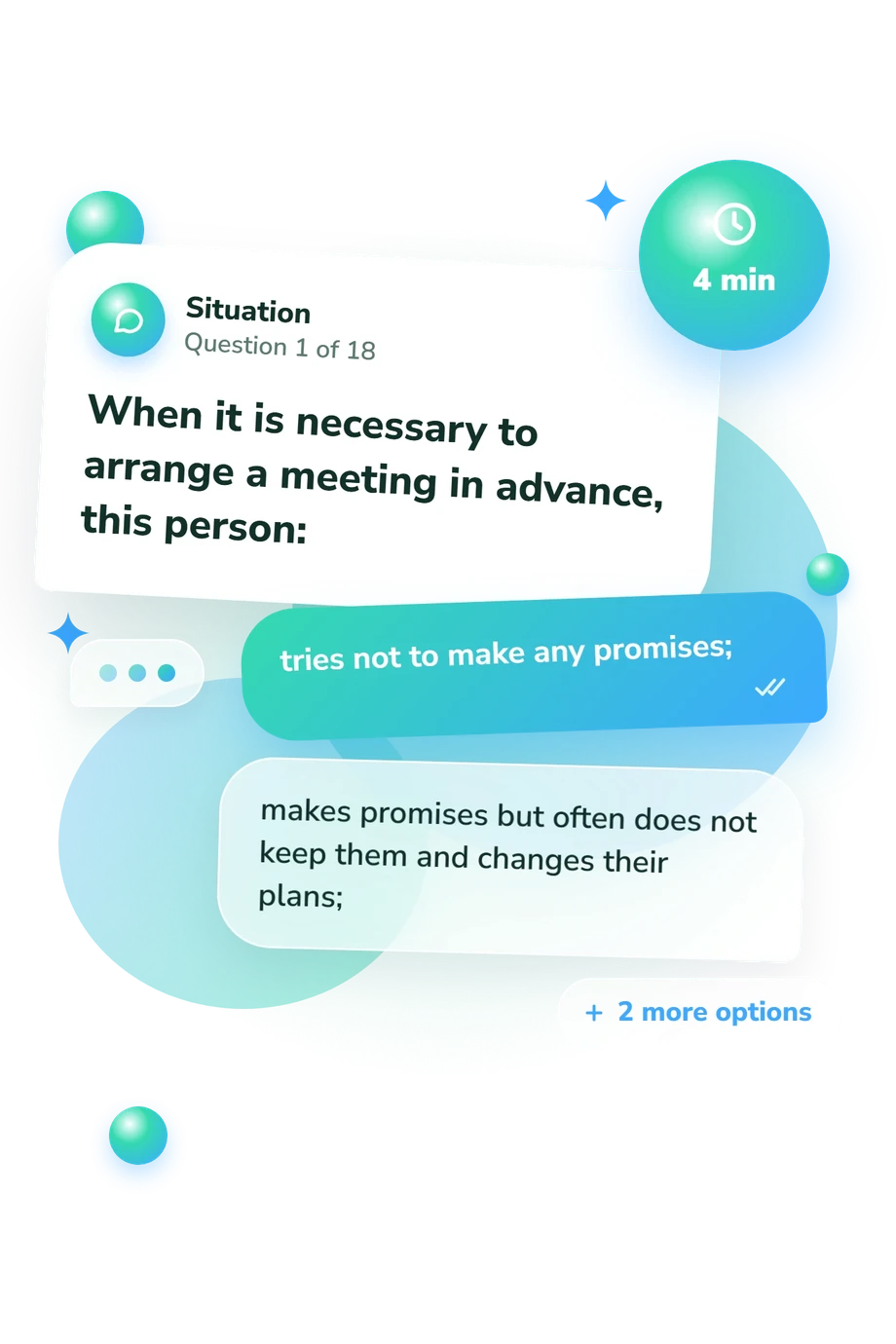
Learn your attachment style in love and friendship in about 4 minutes. Take this Love Test — an 18-item screen based on Rubin and Hazan & Shaver's research — to get clear, actionable insight into your relationship patterns and emotional needs.
Start Online Test
Questions184 minutes
Hi! My name is Freudly, i am an AI therapist, I will give you an interpretation of the test after you complete it.
08:30
October 2, 2025
October 2, 2025
Material has been updated
10,361 view
1,559 completions
836 likes
Verified by Daniel Hall
Psychologist with 25 years of experience
Share
Scale Explorer

How the Scales are Structured

example score
4/8
Secure (S)
Measures the degree of secure (reliable) attachment reflected in dependability, openness, and comfort with vulnerability in close relationships.
Low security
Moderate security
High security
02Low security35Moderate security68High security
A score of 4 suggests a moderate level of secure attachment, with some consistent capacity for openness and support alongside areas that may feel less steady under stress.
example score
2/8
Anxious (A)
Measures the tendency toward anxious attachment patterns such as fear of rejection, loneliness, and self-sacrificing behavior in close relationships.
Low
Moderate
High
02Low35Moderate68High
A score of 2 indicates low anxious attachment tendencies, suggesting relatively little fear of rejection or overcompensating behavior in relationships.
example score
5/8
Anxious-Avoidant (AA)
Measures the degree of ambivalence in close relationships, combining a desire for closeness with discomfort that leads to distancing and heightened insecurity.
Low
Moderate
High
02Low35Moderate68High
A score of 5 suggests a moderate anxious-avoidant pattern, where closeness may be strongly desired but is often mixed with doubt, overanalysis, and periods of pulling away.
example score
7/8
Dismissive-Avoidant (DA)
Measures the tendency to downplay closeness and rely on emotional or physical distance in relationships.
Low
Moderate
High
02Low35Moderate68High
A score of 7 falls in the High range, suggesting a strong pattern of keeping emotional distance and finding closeness feel unsafe or uncomfortable.
Start Online Test
just completed the test
DATA-BASED USER COHORTS

Who Usually Takes This Test?

Couples in a rough patch
41%OF USERS
Partners take it together to understand recurring conflicts, reassurance needs, and distancing patterns so they can communicate more clearly.
Self-growth seekers
34%OF USERS
People take it solo to identify their attachment tendencies and learn what helps them feel safe and connected in close relationships.
Therapy and coaching clients
25%OF USERS
Clients use it with a counselor to name patterns from past experiences and guide practical goals for healthier bonds.
BASED ON AGGREGATED, ANONYMIZED DATA FROM TENS OF THOUSANDS OF FREUDLY USERS.
Benchmarking

See How You Compare

Once you complete the test, your results are compared with real-world data from people in your country.
Below is a preview of how scores are typically distributed across each scale.
Safe (reliable) (S()
Average
4.5
Normal range
3.15.9
min.
0
max.
8
Majority
This curve shows how scores are typically distributed.
Once you complete the test, your result will appear on the scale so you can see how you compare.
Anxious (A)
Average
5.3
Normal range
3.96.7
min.
0
max.
8
Majority
This curve shows how scores are typically distributed.
Once you complete the test, your result will appear on the scale so you can see how you compare.
Anxious-avoidant (A)
Average
5.3
Normal range
3.96.7
min.
0
max.
8
Majority
This curve shows how scores are typically distributed.
Once you complete the test, your result will appear on the scale so you can see how you compare.
Avoidant-dismissive (A)
Average
6
Normal range
4.77.2
min.
0
max.
8
Majority
This curve shows how scores are typically distributed.
Once you complete the test, your result will appear on the scale so you can see how you compare.
Featured On
CLEAR ANSWERS TO COMMON QUESTIONS

Frequently Asked Questions

What does this Love Test measure?
It screens for attachment patterns in close relationships across four dimensions: secure, anxious, anxious-avoidant, and dismissive-avoidant. Results describe how you typically seek and respond to closeness, emotional vulnerability, and conflict in romantic relationships and close friendships — providing a structured profile of your relational tendencies.
How long does it take and how many items are included?
Estimated completion time is about 4 minutes. The questionnaire contains 18 items. Choose the option that best reflects your typical behavior across recent close relationships — avoid answering based on one unusual event or an idealized preference.
Can couples take this test together?
Yes — the Love Test can be completed individually or separately by two partners for comparison and discussion. Comparing attachment profiles is often one of the most clarifying steps for couples in conflict, as it reveals the underlying emotional needs and fears driving recurring patterns rather than focusing on surface-level disagreements.
What is the difference between the four attachment styles?
Secure attachment involves comfort with closeness and consistent emotional availability. Anxious attachment is characterized by fear of abandonment and strong need for reassurance. Anxious-avoidant combines desire for closeness with discomfort that leads to pulling away. Dismissive-avoidant involves downplaying the importance of intimacy and relying on emotional distance. Most people show a dominant style alongside secondary tendencies.
Is this Love Test a diagnostic tool?
No. This is a self-report screening measure intended to support self-reflection and clinical discussion — it does not establish a clinical diagnosis. Results provide descriptive indicators of attachment tendencies and are best interpreted alongside personal history, current relationship context, and, where relevant, clinical interview with a qualified professional.
Can attachment styles change?
Yes. Research consistently shows that attachment patterns — while often stable — are not fixed. Meaningful relationship experiences, therapy focused on attachment and relational patterns, and deliberate work on emotional regulation and communication can shift attachment style over time. This test for love and attachment is most valuable when used as a baseline to track growth and inform targeted personal development.
How should I use my Love Test results in counseling?
Your results provide a ready-made framework for discussing emotional needs, triggers, and protective strategies with your therapist or counselor. Share your profile at the start of a session to quickly orient the conversation around the attachment themes most relevant to your situation. Results do not replace a full clinical assessment but offer a useful, structured starting point for deeper relational work.
WHAT THE TEST MEASURES
About This Assessment
Love and Friendship Test

This measure is designed to support a brief self-report screening of interpersonal feelings, attitudes, and attachment patterns in close relationships. Grounded in Zick Rubin's foundational work on love and liking and Hazan and Shaver's attachment theory, the Love Test provides a structured profile of how you tend to connect, seek closeness, and respond to emotional vulnerability in both romantic and friendship contexts. It includes 18 items and typically takes about 4 minutes to complete.

Why Take a Love Test

The way we experience love and close friendship is not random — it is shaped by deeply ingrained attachment patterns that develop early in life and influence how we seek and maintain emotional connection as adults. These patterns determine how comfortable we feel with closeness, how we respond to conflict and perceived rejection, and what we need to feel secure in a relationship.

Most people are unaware of their own attachment tendencies until they see them reflected clearly in recurring relationship dynamics — the same arguments, the same distances, the same fears. A structured test for love and attachment provides a framework for recognizing these patterns before they cause damage, and for understanding what lies beneath them. This insight is directly actionable: knowing whether you lean toward secure, anxious, or avoidant attachment tells you specifically what to work on — in yourself and in how you communicate with a partner or close friend.

The Love Test is particularly useful for couples who want to understand each other's emotional needs more clearly, for individuals examining what makes intimacy feel safe or threatening, and for anyone preparing to discuss relationship patterns with a therapist or counselor.

What the Assessment Measures

The instrument yields scores across four attachment dimensions in close relationships:

  • Secure attachment — comfort with emotional intimacy, dependability, openness to vulnerability, and the ability to both give and receive support consistently
  • Anxious attachment — fear of rejection or abandonment, need for reassurance, and self-sacrificing behavior driven by worry about losing closeness
  • Anxious-avoidant attachment — a conflicted pattern combining strong desire for closeness with discomfort that leads to distancing, doubt, and emotional ambivalence
  • Dismissive-avoidant attachment — a tendency to downplay the importance of closeness, rely on emotional distance, and experience intimacy as threatening or uncomfortable

Results describe your dominant attachment pattern and the relative strength of each tendency — giving you a differentiated picture rather than a single label.

Who This Assessment Is For

This Love Test is appropriate for any adult who wants to better understand how they experience and express love and closeness in their relationships. It can be completed individually for self-reflection, or by two partners separately for comparison and discussion. Therapists and counselors use it as a structured conversation starter to identify attachment themes relevant to treatment goals and to clarify what clients need to feel safe and connected.

Clinical Validity and Use in Practice

This instrument draws on Rubin's pioneering research distinguishing love from liking, and on Hazan and Shaver's influential attachment framework — among the most widely cited bodies of work in relationship psychology. Results are best interpreted as descriptive indicators of relational tendencies rather than diagnostic conclusions. In clinical or counseling contexts, they provide a structured framework for discussing emotional needs, relationship history, and protective strategies — and should always be considered alongside clinical interview and relevant contextual information.

Author: Zick Rubin
Literature: Hazan, C., & Shaver, P. R. Romantic love conceptualized as an attachment process. Journal of Personality and Social Psychology. 1987.
Test Question Form
Popular tests
Narcissistic Personality Inventory (NPI)
This self-report measure is used to assess narcissism as a personality trai…
Start Test
Yale-Brown Obsessive Compulsive Scale (Y-BOCS)
This measure is used to rapidly quantify the current severity of obsessive…
Start Test
CRAFFT Screening Test (CRAFFT 2.1)
This brief screening measure is designed to identify potential alcohol and…
Start Test
Patient Health Questionnaire-9 (PHQ-9)
This measure is commonly used to quickly screen for the presence and severi…
Start Test
Maslach Burnout Inventory (MBI)
This self-report measure is used to assess occupational burnout symptoms in…
Start Test
Adolescent Anxiety Questionnaire
This measure is designed to support a brief appraisal of anxiety symptoms a…
Start Test
Emotional Creativity Inventory (ECI)
This self-report measure assesses individual differences in the originality…
Start Test
Horne–Ostberg Morningness–Eveningness Questionnaire (MEQ)
Circadian preferences influence typical patterns of alertness and sleep tim…
Start Test
Ambivalent Sexism Inventory (ASI)
This measure is designed to assess attitudes toward women, including both o…
Start Test
Internalized Misogyny Scale (IMS)
This measure is designed to assess internalized negative beliefs and stereo…
Start Test
Perceived Stress Scale (PSS-10)
This self-report measure assesses the degree to which individuals appraise…
Start Test
Impulsive Behavior Scale (SUPPS-P)
Impulsivity is a multidimensional construct that is often assessed with bri…
Start Test
Clinical Institute Withdrawal Assessment for Alcohol, Revised (CIWA-Ar)
This rating scale is used to rapidly assess the severity of alcohol withdra…
Start Test
Positive and Negative Affect Schedule (PANAS)
This measure provides a brief self-report assessment of current or typical…
Start Test
Light Triad Scale (LTS)
This self-report measure assesses prosocial personality tendencies and orie…
Start Test
Suicidal Ideation Scale
In clinical settings, the Suicidal Ideation Scale is used to structure an i…
Start Test
Body Dysmorphic Disorder Scale (BDD-D)
This brief self-report measure is designed to screen for and quantify distr…
Start Test
Beck Anxiety Inventory (BAI)
This measure is a brief self-report inventory used to screen for anxiety sy…
Start Test
Differential Test of Perfectionism
This instrument is used to screen for perfectionism-related attitudes and t…
Start Test
Locus of Control Scale
This measure assesses generalized expectancies regarding the degree to whic…
Start Test
New Apathy Scale
This brief self-report measure is used to screen for apathy-related symptom…
Start Test
Perth Alexithymia Questionnaire (PAQ)
This measure assesses individual differences in alexithymia, including diff…
Start Test
Social Intelligence Scale
This brief self-report measure is designed to support rapid screening of in…
Start Test
Fear Test
This measure is designed to evaluate individual differences in fear-related…
Start Test
Neuroticism Level Scale
The measure is intended for brief screening of an individual’s propensity t…
Start Test
Aggressiveness Indicators Screening Questionnaire
This screening tool is designed to quickly identify behavioral indicators a…
Start Test
Comments
Leave a Comment