
Attachment Style Test
How the Scales are Structured
Who Usually Takes This Test?
See How You Compare
Below is a preview of how scores are typically distributed across each scale.
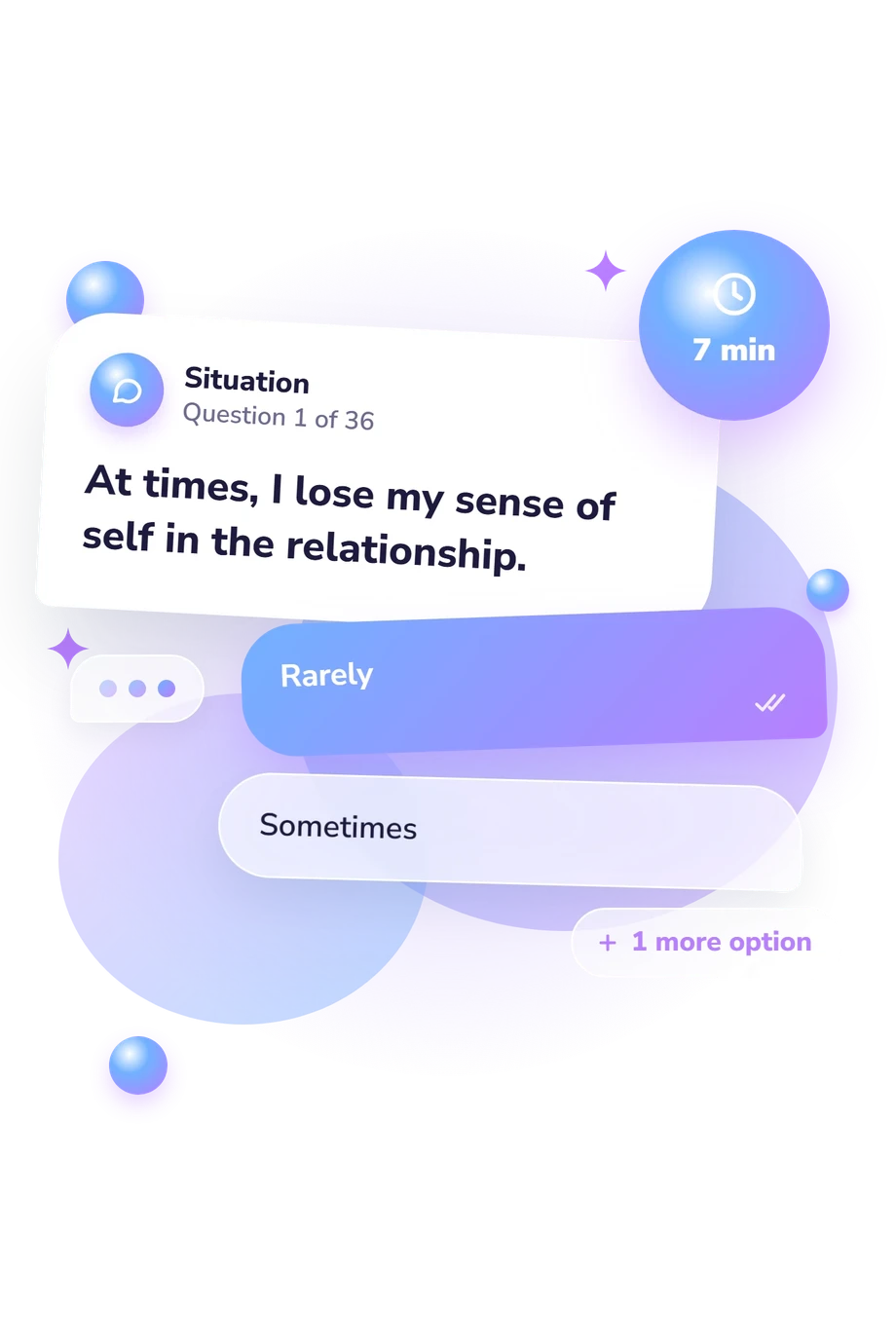
Example Questions From the Test
- Rarely
- Sometimes
- Often
- Rarely
- Sometimes
- Often
- Rarely
- Sometimes
- Often
Attachment Style Test - Description and methodology of the test
People considering an attachment style quiz can use this questionnaire to examine how they respond to closeness, independence, trust, and tension in an intimate relationship. The Attachment Style Test is intended for people who want a structured way to reflect on recurring relational patterns. Its result organizes those responses into interpretable tendencies rather than assigning a fixed identity.
What This Assessment Explores
The questionnaire examines how someone manages closeness, boundaries, trust, and conflict when a relationship feels uncertain or demanding, making it a relationship attachment test for everyday relational patterns. Items cover self-neglect, rejection sensitivity, reassurance seeking, privacy, anger, compromise, separation, and repair. The result describes attachment-related tendencies in everyday relationships rather than a complete personality profile or diagnosis.
The result is organized into four displayed dimensions:
- Avoidant Type (0-24) measures distancing and emotional restraint; Lower avoidant: 0-17; Higher avoidant: 18-24.
- Anxious Type (0-24) measures rejection sensitivity and reassurance-seeking; Low: 0-7; Moderate: 8-15; High: 16-24.
- Attachment Security Level (0-24) measures capacity for stable, supportive connection; Low security: 0-8; Moderate security: 9-17; High security: 18-24.
- Attachment Insecurity Level (0-24) measures difficulty coping with relational stress and trusting a partner; Low insecurity: 0-6; Moderate: 7-13; High: 14-24.
Methodology and Scientific Basis
This adult attachment test uses self-report. Its response format includes statements answered with Rarely, Sometimes, or Often, alongside paired alternatives indicating different preferences or reactions. Themes cover current relationship experiences, conflict habits, and earlier family impressions.
Responses yield four displayed scores. No standardised scoring, population norms, or validation evidence are stated, so the bands should be read descriptively rather than as validated thresholds. Read the profile across dimensions and in light of recent relationship circumstances, not as a permanent trait.
Hazan and Shaver (1987) supply the link between romantic relationships and attachment processes. Bartholomew and Horowitz (1991) offer a four-category model relevant to security, anxiety, and avoidance, while Collins and Read (1990) connect adult working models with relationship quality. The questionnaire is conceptually consistent with these sources, but is not established as a standardized reproduction or validated adaptation of any published instrument.
Memory, self-awareness, candid reporting, and current stress can shape answers. The result is most useful as structured reflection on recurring reactions and relationship needs; it cannot explain the causes of difficulty or predict how a relationship will develop.
- Hazan, C., & Shaver, P. R. (1987). Romantic love conceptualized as an attachment process. Journal of Personality and Social Psychology, 52(3), 511-524. 10.1037/0022-3514.52.3.511
- Bartholomew, K., & Horowitz, L. M. (1991). Attachment styles among young adults: A test of a four-category model. Journal of Personality and Social Psychology, 61(2), 226-244. 10.1037/0022-3514.61.2.226
- Collins, N. L., & Read, S. J. (1990). Adult attachment, working models, and relationship quality in dating couples. Journal of Personality and Social Psychology, 58(4), 644-663. 10.1037/0022-3514.58.4.644
Updated: