
Bodenhamer-Hall Test
How the Scales are Structured
Who Usually Takes This Test?
See How You Compare
Below is a preview of how scores are typically distributed across each scale.
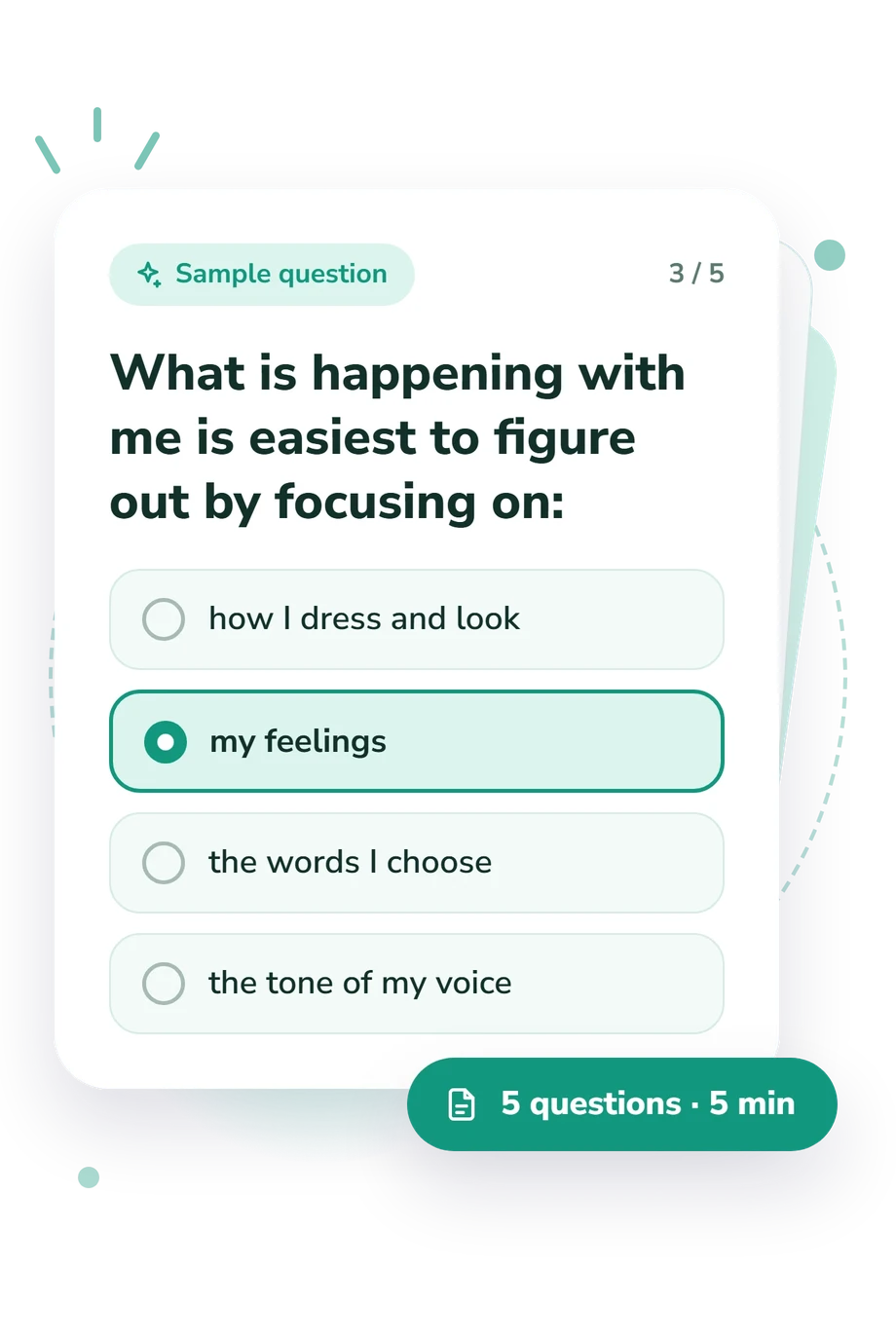
Example Questions From the Test
- the other person's tone of voice
- being able to see how the other person's reasoning is structured
- the logic of the other person's arguments
- being able to sense the other person's emotional state
- how I dress and look
- my feelings
- the words I choose
- the tone of my voice
- find the ideal volume level and adjust the stereo system settings
- phrase a question correctly about a topic that interests me
- choose the most comfortable furniture
- select a rich, appealing color combination
Bodenhamer-Hall Test - Description and methodology of the test
People who want to examine how they notice and organize information may find the Bodenhamer-Hall Test useful as a focused self-reflection exercise. The result helps a reader notice recurring patterns in whether decisions and self-observation draw on logical analysis and internal dialogue, imagery, sound, or bodily sensations, movement, and direct physical experience. As a Bodenhamer-Hall questionnaire, it offers a descriptive profile to read alongside everyday context.
What This Assessment Explores
The questions examine four ways of representing experience: logical analysis and internal dialogue, visual imagery, sounds and speech, and bodily sensations, movement, and direct physical experience. The situations involve decisions, conversation, self-observation, environmental attention, and practical preferences. Viewed as a representational systems test, it describes preference rather than ranking one mode as better.
The profile is organized as follows:
- Digital (5-20) reflects logical analysis and internal dialogue: Low digital 5-9; Moderate digital 10-15; High digital 16-20.
- Visual (5-20) reflects imagery and observed detail: Low visual 5-9; Moderate visual 10-15; High visual 16-20.
- Auditory (5-20) reflects speech, sound, and rhythm: Lower auditory focus 5-9; Moderate auditory focus 10-15; Higher auditory focus 16-20.
- Kinesthetic (5-20) reflects bodily sensations, movement, and direct physical experience: Lower 5-9; Moderate 10-15; Higher 16-20.
These results describe a pattern, not an absence of other abilities.
Methodology and Scientific Basis
First-person situations offer contrasting choices about logic, appearance, sound, speech, feelings, and bodily comfort. The prompts place these modalities in contexts such as decisions and conversations, not abstract trait ratings.
Responses are grouped into modality scores, creating a profile. Because the points assigned to each answer are unspecified, displayed bands should be read descriptively rather than used to infer a conversion rule. A stronger pattern in one area does not mean other processing styles are absent.
Conceptually, the questionnaire is consistent with the Representational System Preference Test (James, 1990) and Bodenhamer and Hall's representational-system model, but it is not an adaptation of either source. Sharpley's 1984 review calls for caution about preferred representational systems, while Cronbach and Meehl's construct-validity framework emphasizes checking whether scores represent the intended construct.
This online Bodenhamer-Hall assessment is an exploratory self-report profile with four displayed score bands; its available score is descriptive rather than a documented population comparison. Mood, context, wording, and self-awareness can influence responses; the result does not establish reliability, clinical significance, or diagnosis. It prompts reflection on taking in and organizing information.
- James, Tad. The Basic NLP Training Collection: 24 Audio Tapes & Manual. Honolulu, HI: Advanced Neuro Dynamics, 1990.
- Bodenhamer, Bob G., and L. Michael Hall. The User's Manual for the Brain: The Complete Manual for Neuro-Linguistic Programming Practitioner Certification. Carmarthen, Wales: Crown House Publishing, 1999.
- Sharpley, Christopher F. Predicate matching in NLP: A review of research on the preferred representational system. Journal of Counseling Psychology, 31(2), 238-248, 1984. 10.1037/0022-0167.31.2.238
- Cronbach, Lee J., and Paul E. Meehl. Construct validity in psychological tests. Psychological Bulletin, 52(4), 281-302, 1955. 10.1037/h0040957
Updated: