
Change Blindness Test
How the Scales are Structured
Who Usually Takes This Test?
See How You Compare
Below is a preview of how scores are typically distributed across each scale.
Example Questions From the Test
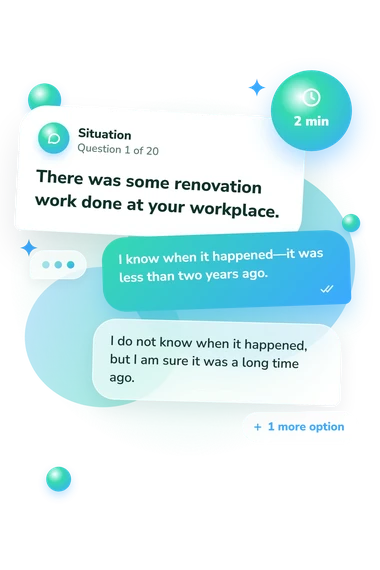
- I know when it was: less than two years ago.
- I do not know when it was, but it was definitely a long time ago.
- I do not have time to think about things that are not related to my work.
- I never allow myself to do this on principle.
- We are all human; I will quickly take care of my own matters and then get back to work.
- I have not thought about it, but for the money I am paid, I am not going to overexert myself at work either.
- Fine; it is not particularly important.
- Very neatly.
- You do not care what you wear or how you look.
Change Blindness Test - Description and methodology of the test
People examining overlooked details in professional settings may find the Change Blindness Test useful for structured self-reflection. It focuses on moments involving clients, visitors, appearance, cleanliness, and workplace boundaries, then turns responses into a total score reflecting the displayed level of this tendency in work-related situations. This change blindness assessment helps you question assumptions about what others notice.
What This Assessment Explores
The items present workplace situations from which the score reads the catalogue-defined tendency associated with workplace change blindness: missing obvious work-related details. They ask whether a person registers cues affecting visitors: disorder, neglected facilities, unsuitable clothing, eating areas, cigarette waste, and guest reception. Other scenarios examine whether personal matters displace attention to clients or responsibility for an overlooked detail is dismissed.
A higher result suggests that relevant cues may be missed more often; a lower result suggests stronger noticing in these situations. The displayed scale is:
- Total Score (0-50) reflects points obtained; Low (0-14) is the lower band, Moderate (15-29) the middle band, and High (30-50) the higher band, with higher scores indicating more pronounced failure to notice obvious work-related changes.
This total score can support self-reflection for people whose roles involve welcoming clients, monitoring surroundings, or maintaining a professional environment.
Methodology and Scientific Basis
Each item presents a workplace situation with three response options. In this change blindness questionnaire, the respondent selects the answer that best reflects their reaction, and the answers produce the displayed total. Because item-level point assignments are not specified, neither the direction of the response order nor a scoring rule should be inferred from the score ranges.
Together, the situations cover client contact, order, personal presentation, shared facilities, and boundaries between matters and work. Reason’s Human Error offers a compatible framework in which attention and action can be shaped by conditions and habits rather than character alone. The workplace situations are conceptually consistent with change-blindness research by Simons and Levin and by Rensink, O’Regan, and Clark, which explains how attention affects awareness of scene changes. Those studies do not establish this questionnaire’s reliability, validity, or status as an adaptation.
Read the result as a prompt to inspect workplace habits around client standards and environmental monitoring. Self-report can reflect current workload, role expectations, norms, and self-awareness. The Low, Moderate, and High bands are descriptive for this questionnaire, not established clinical thresholds.
- Reason, James. Human Error. Cambridge University Press, 1990. 10.1017/CBO9781139062367
- Simons, Daniel J., and Daniel T. Levin. "Change Blindness." Trends in Cognitive Sciences, vol. 1, no. 7, 1997, pp. 261-267. 10.1016/S1364-6613(97)01080-2
- Rensink, Ronald A., J. Kevin O'Regan, and James J. Clark. "To See or not to See: The Need for Attention to Perceive Changes in Scenes." Psychological Science, vol. 8, no. 5, 1997, pp. 368-373. 10.1111/j.1467-9280.1997.tb00427.x