
Need for Order and Predictability Test
How the Scales are Structured
Who Usually Takes This Test?
See How You Compare
Below is a preview of how scores are typically distributed across each scale.
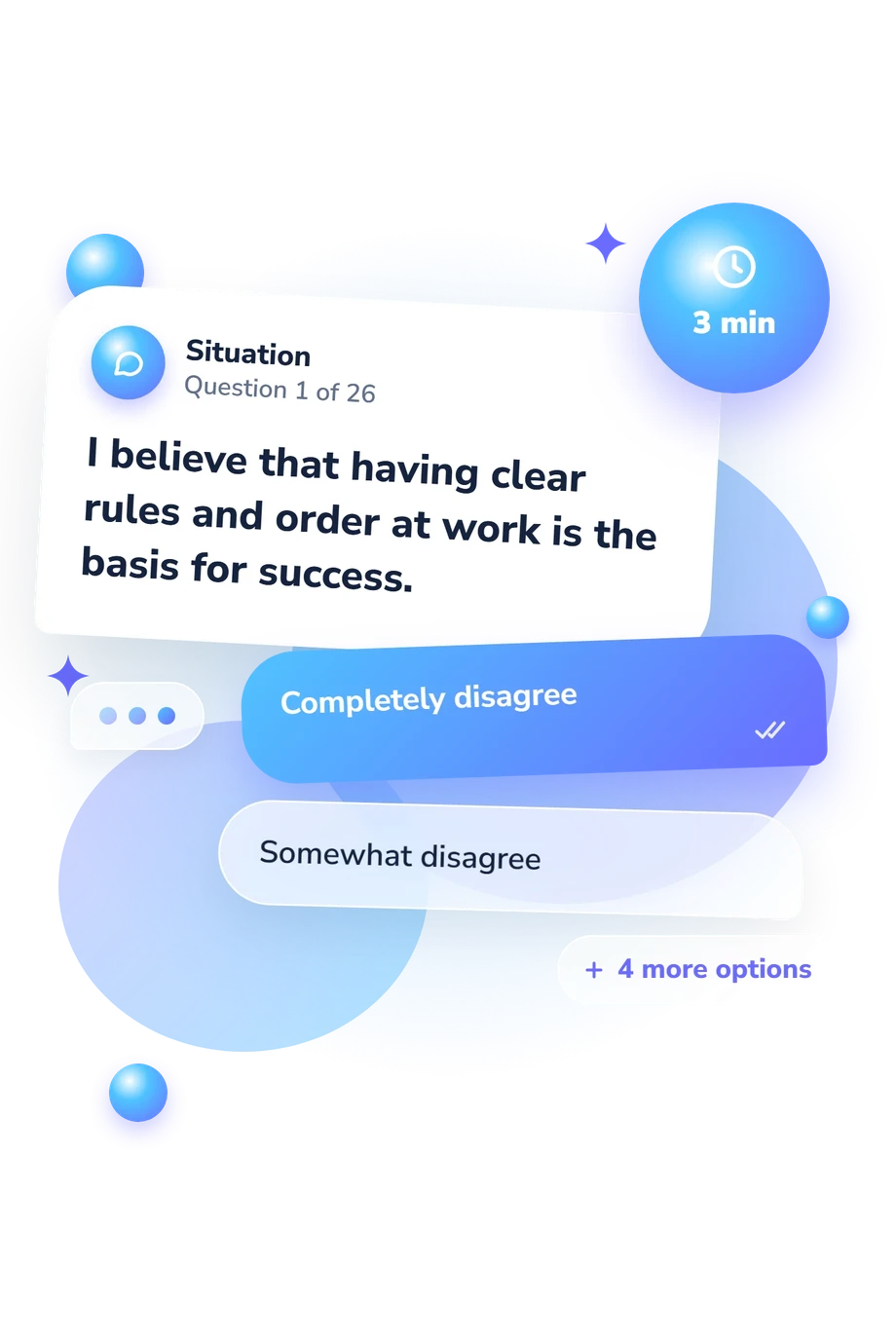
Example Questions From the Test
- Completely disagree
- Rather disagree
- Partly disagree
- Partly agree
- Somewhat agree
- Completely agree
- Completely disagree
- Somewhat disagree
- Partly disagree
- Partly agree
- Somewhat agree
- Completely agree
- Strongly disagree
- Somewhat disagree
- Partly disagree
- Partly agree
- Somewhat agree
- Strongly agree
Need for Order and Predictability Test - Description and methodology of the test
People considering whether their responses to loose rules, unclear situations, or last-minute changes are worth examining can use the Need for Order and Predictability Test as a focused self-reflection exercise. It offers a way to examine how unsettled routines, expectations, or explanations affect everyday reactions. A need for order assessment describes separate tendencies related to order and predictability rather than identifying why structure matters to you.
What This Assessment Explores
The questionnaire examines two connected tendencies. Some statements concern schedules, neatness, rules, belongings, and having a place or plan for everything. Others address unclear causes, unpredictable people, disrupted plans, and situations where future events are difficult to anticipate. As an order and predictability questionnaire, it distinguishes organizing daily life from seeking certainty about what will happen.
The displayed dimensions are:
- Need for Predictability: 6-36. It measures the importance of clear expectations, stable information, and confidence about future events; bands are Low need (6-15), Moderate need (16-26), and High need (27-36).
- Need for Order: 7-42. It measures systematic structure in surroundings, behavior, and thinking; bands are Low (7-18), Moderate (19-30), and High (31-42).
The result describes the respondent's level on each dimension separately, without establishing that one is more prominent than the other.
Methodology and Scientific Basis
Each item uses a six-point agreement format, moving from complete or strong disagreement to complete or strong agreement. The statements are self-report prompts about preferences and reactions, so the profile depends on how the respondent sees their usual behavior and circumstances.
In the predictability-focused part of the questionnaire, uncertainty-related responses are reported separately from the order dimension. The questionnaire reports two displayed scale scores and places them in the stated descriptive bands; it does not state any weighting, reverse-keying, or method for calculating the band boundaries.
Its closest named source is the Need for Order and Predictability method (Yasin, 2024). The construct is also consistent with need for cognitive closure as discussed by Webster and Kruglanski (1994), while Yasin and Khukhlaev (2023) report a Russian-language adaptation of that broader questionnaire. Because the online questionnaire is conceptually consistent with these sources rather than a documented standardized reproduction or validated adaptation, its profile is best interpreted as structured self-reflection and considered alongside current stress, recent disruption, work demands, and self-awareness.
- Yasin, M. I. (2024). Diagnostic Method “Need for Order and Predictability”. Journal of Modern Foreign Psychology, 13(3), 31-40. 10.17759/jmfp.2024130303
- Webster, D. M., & Kruglanski, A. W. (1994). Individual differences in need for cognitive closure. Journal of Personality and Social Psychology, 67(6), 1049-1062. 10.1037/0022-3514.67.6.1049
- Yasin, M. I., & Khukhlaev, O. E. (2023). Russian-language adaptation of the questionnaire by D. Webster and A. Kruglanski “The Need for Cognitive Closure”. Psychology. Journal of the Higher School of Economics, 20(2), 282-299. 10.17323/1813-8918-2023-2-282-299
Updated: