
Subjective and Objective Uncertainty Stress Scale Test
How the Scales are Structured
Who Usually Takes This Test?
See How You Compare
Below is a preview of how scores are typically distributed across each scale.
Example Questions From the Test
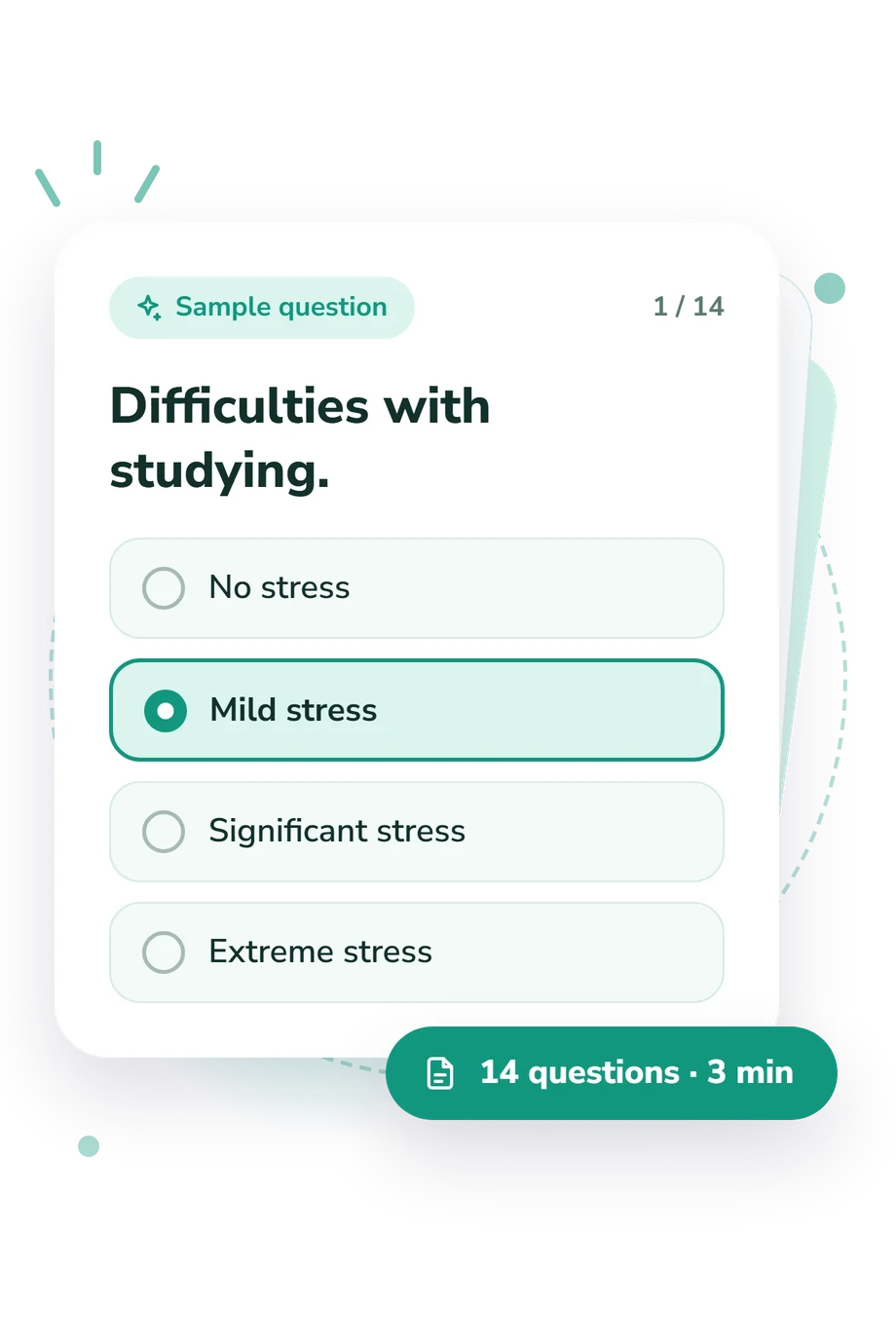
- No stress
- Mild stress
- Significant stress
- Extreme stress
- No stress
- Mild stress
- Significant stress
- Extreme stress
- No stress
- Mild stress
- Significant stress
- Extreme stress
Subjective and Objective Uncertainty Stress Scale Test - Description and methodology of the test
For readers who want to understand how uncertain circumstances affect them, the Subjective and Objective Uncertainty Stress Scale Test offers a structured self-report of pressure linked to familiar problems and wider events. An uncertainty stress questionnaire can be useful when financial strain, relationships, rapid change, or worries about truth and safety feel difficult to manage. The result highlights patterns worth examining in everyday coping.
What This Assessment Explores
This uncertainty stress scale distinguishes pressure from personal situations and broader conditions that are hard to predict or control. Items address study, relationships, finances, family support, health threats, news, climate, career planning, social trust, and the future. They make stress from uncertainty visible across everyday adaptation and wider change.
Three displayed dimensions are:
- Objective (18-28) shows stress linked to global, unpredictable conditions and limited information or resources; Low 18-20, Moderate 21-24, High 25-28.
- Subjective Uncertainty (7-17) shows tension when familiar situations exceed perceived coping resources; Low 7-10, Moderate 11-14, High 15-17.
- Uncertainty Stress Level (14-56) shows overall strain across everyday and broader uncertainty; Low 14-27, Moderate 28-41, High 42-56.
Together, they indicate whether pressure is more external, personal, or combined.
Methodology and Scientific Basis
Each item uses four response options, moving from No stress through Mild stress and Significant stress to Extreme or Excessive stress. Respondents rate perceived intensity rather than choose a factual answer. The displayed bands organize the profile into Low, Moderate, and High categories; the questionnaire does not specify an answer-by-answer point conversion, so no additional scoring rule can be inferred. The cited studies concern the published SOUS-14 and do not establish psychometric properties for these exact online result bands.
Methodologically, the questionnaire is conceptually consistent with SOUS-14, the source instrument described by Morosanova, Potanina, and Pashchenko in 2024. A 2025 study by Zinchenko, Morosanova, and Potanina examined the instrument's factor structure, score consistency, and comparability across a university student sample. These studies provide evidence about the published SOUS-14, but they do not establish the validity or reliability of this online questionnaire.
As an uncertainty stress assessment, the result is a structured snapshot of perceived strain. Current context, mood, interpretation of wording, self-awareness, and response bias can affect self-report, so the result is best considered alongside the person's broader circumstances. It can support reflection on coping with uncertainty without serving as a standalone clinical conclusion.
- Morosanova, Varvara I., Anna M. Potanina, and Alexander K. Pashchenko. (2024). Diagnostics of Stress of Subjective and Objective Uncertainty: Development and Validation of a Questionnaire. Russian Psychological Journal, 21(3), 112-132. 10.21702/rpj.2024.3.7
- Zinchenko, Yury P., Varvara I. Morosanova, and Anna M. Potanina. (2025). The Russian subjective and objective uncertainty stress (SOUS-14) scale: factor validity, internal reliability, and measurement invariance in university student sample. Frontiers in Psychology, 16, 1583172. 10.3389/fpsyg.2025.1583172
Updated: