
Freudly+971 508685814hello@freudly.ai
Freudly
infantilism

Infantilism Severity Scale Test
Take the online Infantilism Severity Scale Test - AI psychologist FreudlyYou can take Infantilism Severity Scale Testhere. Online version of a simple and accurate psychological test with interpretation.en
Understand how immaturity shows up in emotions, motivation, and social skills in about 9 minutes. Get clear, targeted insights to support therapy, coaching, or personal growth.
Start Online Test
Questions: 489 minutes
08:30
October 2, 2025
October 2, 2025
Material has been updated
October 2, 2025
Material has been published
26,963 views
2,548 completions
2,225 likes
Verified by Daniel Hall
Psychologist with 25 years of experience
Share
Scale Explorer

How the Scales are Structured

example score
6/18
Underdeveloped Coping Behavior (UCB)
Measures how developed a person’s coping behavior is for handling difficulties and overcoming obstacles.
Well-developed coping
Moderately limited coping
Highly limited coping
06: Well-developed coping | 712: Moderately limited coping | 1318: Highly limited coping
A score of 6 suggests generally adequate coping resources, with only occasional difficulty persisting through challenging situations.
example score
6/15
Behavioral Disorganization (BD)
Measures how organized and disciplined a person’s behavior tends to be versus chaotic and spontaneous.
Organized
Mixed
Disorganized
05: Organized | 610: Mixed | 1115: Disorganized
A score of 6 falls in the Mixed range, suggesting generally adequate orderliness with occasional lapses into spontaneity or inconsistent follow-through.
example score
10/27
Dependent Attitude (DA)
Measures the extent to which a person tends to rely on others and avoid taking responsibility for decisions and actions.
Low dependency
Moderate dependency
High dependency
09: Low dependency | 1018: Moderate dependency | 1927: High dependency
A score of 10 falls in the Moderate dependency range, suggesting a noticeable but not pronounced tendency to lean on others in responsibility-taking situations.
example score
12/18
Poor Reflection (PR)
Measures how developed self-analysis and reflection are, where higher scores indicate weaker reflexivity.
Developed reflection
Moderate reflection difficulties
Weak reflection
06: Developed reflection | 712: Moderate reflection difficulties | 1318: Weak reflection
A score of 12 falls in the Moderate reflection difficulties range, suggesting self-analysis may be inconsistent and insights about one’s actions may not always guide behavior.
example score
4/12
Orientation Toward Entertainment and Hedonism (OTEaH)
Measures the degree to which a person is oriented toward pleasure-seeking and entertainment versus restraint and rational priorities.
Restrained
Balanced
Hedonistic
04: Restrained | 58: Balanced | 912: Hedonistic
A score of 4 falls in the Restrained range, suggesting a generally practical, self-controlled approach with relatively low emphasis on entertainment and immediate pleasure.
example score
6/21
Predominance of Material Values (PoMV)
Measures how strongly material values and wealth are prioritized over moral and spiritual values.
Low material focus
Balanced/Mixed focus
High material focus
07: Low material focus | 814: Balanced/Mixed focus | 1521: High material focus
A score of 6 falls in the Low material focus range, suggesting material goals are less dominant than moral or personal values in your current priorities.
example score
5/12
Lack of Work Motivation (LoWM)
Measures the degree of reduced work motivation, where higher scores reflect greater passivity and less drive for achievement and professional development.
High motivation
Mixed motivation
Low motivation
04: High motivation | 58: Mixed motivation | 912: Low motivation
A score of 5 falls in the Mixed motivation range, suggesting generally adequate engagement with occasional dips in initiative or goal pursuit.
example score
15/21
Emotional-Volitional Immaturity (EVI)
This scale measures the maturity of emotional regulation and volitional self-control, including impulsivity and stability under stress.
Mature/Stabile
Mixed Control
Marked Immaturity
07: Mature/Stabile | 814: Mixed Control | 1521: Marked Immaturity
A score of 15 falls in the Marked Immaturity range, suggesting more frequent difficulties with emotion regulation, impulsivity, and sustaining self-control.
example score
97/144
Overall Infantilism Level (OIL)
Measures the overall degree of immaturity across emotional-volitional control, independence, responsibility, and work motivation.
Low
Moderate
High
060: Low | 6190: Moderate | 91144: High
A score of 97 falls in the High range, suggesting a stronger presence of infantile traits such as dependency, impulsivity, and reduced responsibility in everyday behavior and motivation.
Start Online Test
just completed the test
DATA-BASED USER COHORTS

Who Usually Takes This Test?

Feeling stuck and dependent
41%OF USERS
Adults who feel emotionally immature, rely on others, avoid responsibility, or keep repeating “teen-like” patterns in work and relationships.
Therapy and self-reflection seekers
34%OF USERS
People in counseling or doing personal growth who want to pinpoint which parts of immaturity—motivation, willpower, morals, or social skills—need attention.
Parents and educators
25%OF USERS
Parents, teachers, and youth mentors using a quick screen to understand a teen’s readiness for independence, decision-making, and handling life challenges.
BASED ON AGGREGATED, ANONYMIZED DATA FROM TENS OF THOUSANDS OF FREUDLY USERS.
Benchmarking

See How You Compare

Once you complete the test, your results are compared with real-world data from people in your country.
Below is a preview of how scores are typically distributed across each scale.
Underdeveloped coping behavior (Ucb)
Average
10.8
Normal range
813.5
min.
0
max.
18
This curve shows how scores are typically distributed.
Once you complete the test, your result will appear on the scale so you can see how you compare.
Disorganized Behavior (DB)
Average
6.2
Normal range
4.28.1
min.
0
max.
15
This curve shows how scores are typically distributed.
Once you complete the test, your result will appear on the scale so you can see how you compare.
Dependency Stance (DS)
Average
19.4
Normal range
14.923.8
min.
0
max.
27
This curve shows how scores are typically distributed.
Once you complete the test, your result will appear on the scale so you can see how you compare.
Weak reflection (Wr)
Average
12.5
Normal range
1015
min.
0
max.
18
This curve shows how scores are typically distributed.
Once you complete the test, your result will appear on the scale so you can see how you compare.
Focus on Entertainment, Hedonism (FoEH)
Average
8.2
Normal range
6.210.1
min.
0
max.
12
This curve shows how scores are typically distributed.
Once you complete the test, your result will appear on the scale so you can see how you compare.
Predominance of material values (Pomv)
Average
8.6
Normal range
4.812.4
min.
0
max.
21
This curve shows how scores are typically distributed.
Once you complete the test, your result will appear on the scale so you can see how you compare.
Lack of work motivation (Lowm)
Average
4.5
Normal range
2.86.3
min.
0
max.
12
This curve shows how scores are typically distributed.
Once you complete the test, your result will appear on the scale so you can see how you compare.
Emotional-Volitional Immaturity (EI)
Average
15.2
Normal range
11.219.1
min.
0
max.
21
This curve shows how scores are typically distributed.
Once you complete the test, your result will appear on the scale so you can see how you compare.
General Level of Infantilism (GLoI)
Average
86.3
Normal range
65.6107
min.
0
max.
144
This curve shows how scores are typically distributed.
Once you complete the test, your result will appear on the scale so you can see how you compare.
Featured On
SAMPLE QUESTIONS

Example Questions From the Test

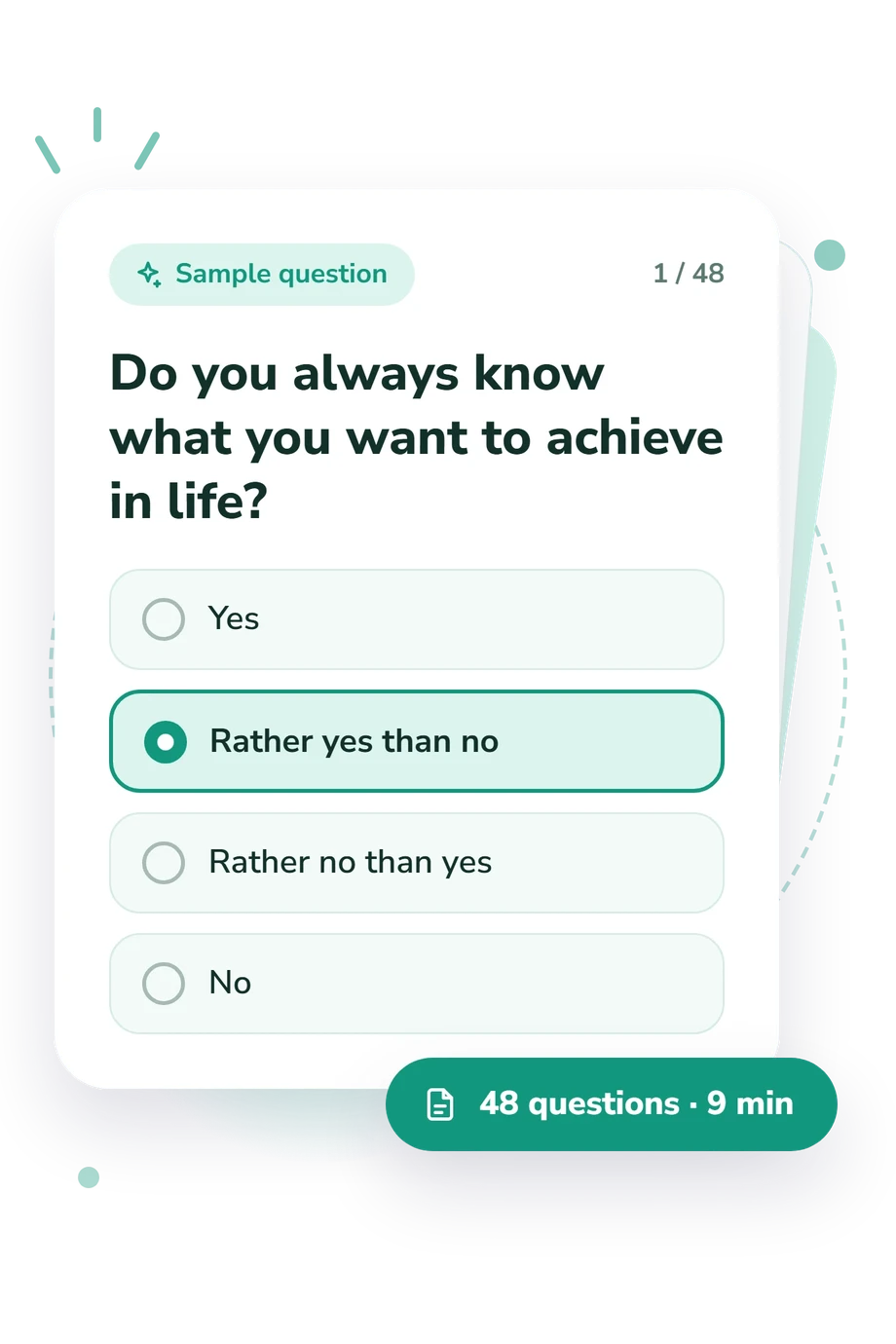
Each item in this questionnaire has four response options. For each item, select the one response that best applies to you. Please note that there are no “right” or “wrong” answers. Only one response may be selected for each question. If you are unsure or do not know which option to choose, indicate the response you would select if you did know.
    • Yes
    • Rather yes than no
    • Rather no than yes
    • No
    • Yes
    • Rather yes than no
    • Rather no than yes
    • No
    • Yes
    • Rather yes than no
    • Rather no than yes
    • No
WHAT THE TEST MEASURES
About This Assessment
Level of Infantilism Expression, LIE Test

Infantilism Severity Scale Test - Symptoms and Signs

infantilism
personal maturity
organization

This instrument is designed to assess the degree and pattern of infantilism-related traits across domains of functioning. The Infantilism Severity Scale provides a structured self-report approach to identifying areas of relative immaturity that may affect emotional regulation, motivation, autonomy, and interpersonal behavior.

The measure includes 48 items and typically requires about 9 minutes to complete. Item content focuses on indicators such as emotional and volitional immaturity, delayed social and moral development, reduced achievement orientation, dependency and avoidance of responsibility, disorganized or inconsistent behavior, limited self-reflection, and difficulty coping with everyday demands.

Scores are intended to support clinical formulation by clarifying which components of immaturity are most salient rather than functioning as a stand-alone diagnosis. The Infantilism Severity Scale is commonly used in intake and ongoing psychological assessment to guide treatment planning and to monitor change over time; authorship is attributed to Erik H. Erikson.

Author: Erik H. Erikson
Literature: Arnett, J. J. Emerging adulthood: The winding road from the late teens through the twenties. Oxford University Press. 2004.
Popular tests
Comments
Leave a Comment