
J. Greenberg's Burnout Test
How the Scales are Structured
Who Usually Takes This Test?
See How You Compare
Below is a preview of how scores are typically distributed across each scale.
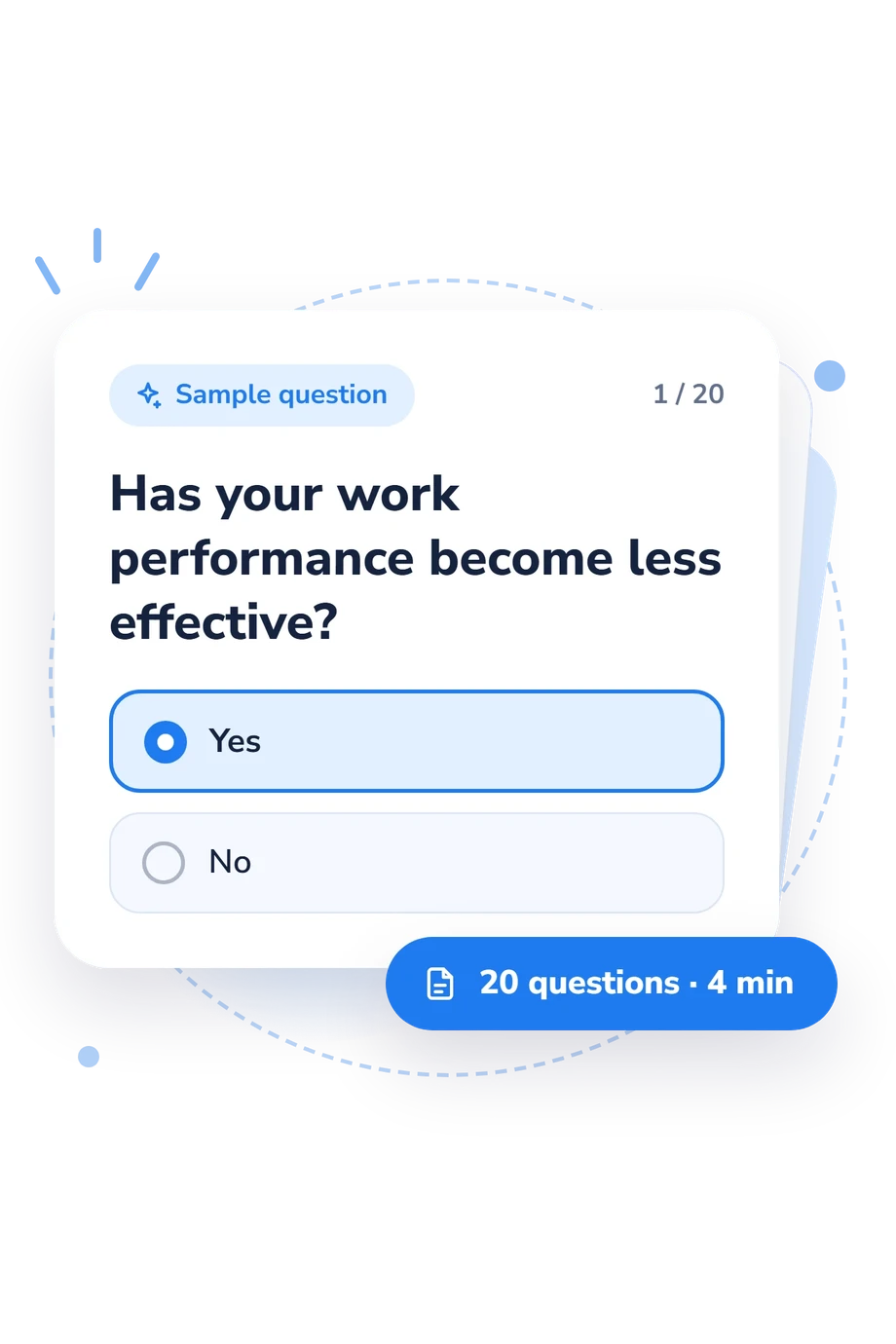
Example Questions From the Test
- Yes
- No
- Yes
- No
- Yes
- No
Burnout Test - Description and methodology of the test
People who are unsure whether demanding work has begun to affect their functioning may use the Burnout Test to organize that concern. The result gives them a descriptive band showing the overall pattern of endorsed experiences, which can help them decide what deserves closer attention. Its online burnout assessment format keeps the yes-or-no response process accessible while preserving a focused snapshot rather than a detailed account of context.
What This Assessment Explores
Burnout is read as a tendency toward emotional and occupational exhaustion. The items cover work, physical, emotional, and coping-related situations or manifestations, while the single scale reads the overall tendency rather than separate symptoms. The burnout symptoms assessment therefore connects these experiences to one result.
These themes shape the result:
- Work functioning shows whether initiative, pace, effectiveness, or accomplishment has shifted.
- Physical strain reflects fatigue, sleep disruption, and bodily complaints.
- Emotional response captures mood swings, irritability, frustration, suspicion, and helplessness.
- Coping-related experiences indicate rigidity, critical judgments, excessive use of mood-altering substances or medication, and reduced humor.
The Burnout Scale is 0-20: Low 0-10, Moderate 11-14, High 15-20. Low scores indicate no signs, moderate scores suggest possible onset, and high scores indicate pronounced burnout. Scores of 15 or higher may indicate burnout; more than half positive responses may suggest disengagement.
Methodology and Evidence Base
Each item uses a Yes-or-No response, giving the questionnaire a binary rather than graded format. The scoring display does not show how much each response contributes, so the result should not be read as a measure of frequency, severity, or duration for each experience. As an occupational exhaustion questionnaire, it offers a structured snapshot, not a detailed clinical profile.
Conceptually, the questionnaire is consistent with Greenberg's Burnout or Brownout Questionnaire. The Maslach and Jackson 1981 measurement study and the 2001 work of Maslach, Schaufeli, and Leiter provide related construct context, describing dimensions of exhaustion, distancing from work, and reduced effectiveness. These sources clarify relevant constructs, while this questionnaire retains its own wording and response format.
Interpret the displayed band as the pattern endorsed when answering, not as a clinical determination. Self-report can shift with current workload, health, sleep, mood, self-awareness, and response style. A high result can identify a need to examine the surrounding circumstances, while a lower result does not rule out meaningful strain or other difficulties.
- Greenberg, Jerrold S. Comprehensive Stress Management. 3rd ed. Dubuque, IA: W.C. Brown Co., 1990.
- Maslach, Christina, Wilmar B. Schaufeli, and Michael P. Leiter. "Job Burnout." Annual Review of Psychology 52, no. 1 (2001): 397-422. 10.1146/annurev.psych.52.1.397
- Maslach, Christina, and Susan E. Jackson. "The Measurement of Experienced Burnout." Journal of Occupational Behavior 2, no. 2 (1981): 99-113. 10.1002/job.4030020205
Updated: