
Children of Alcoholics Screening Test (CAST)
How the Scales are Structured
Who Usually Takes This Test?
See How You Compare
Below is a preview of how scores are typically distributed across each scale.
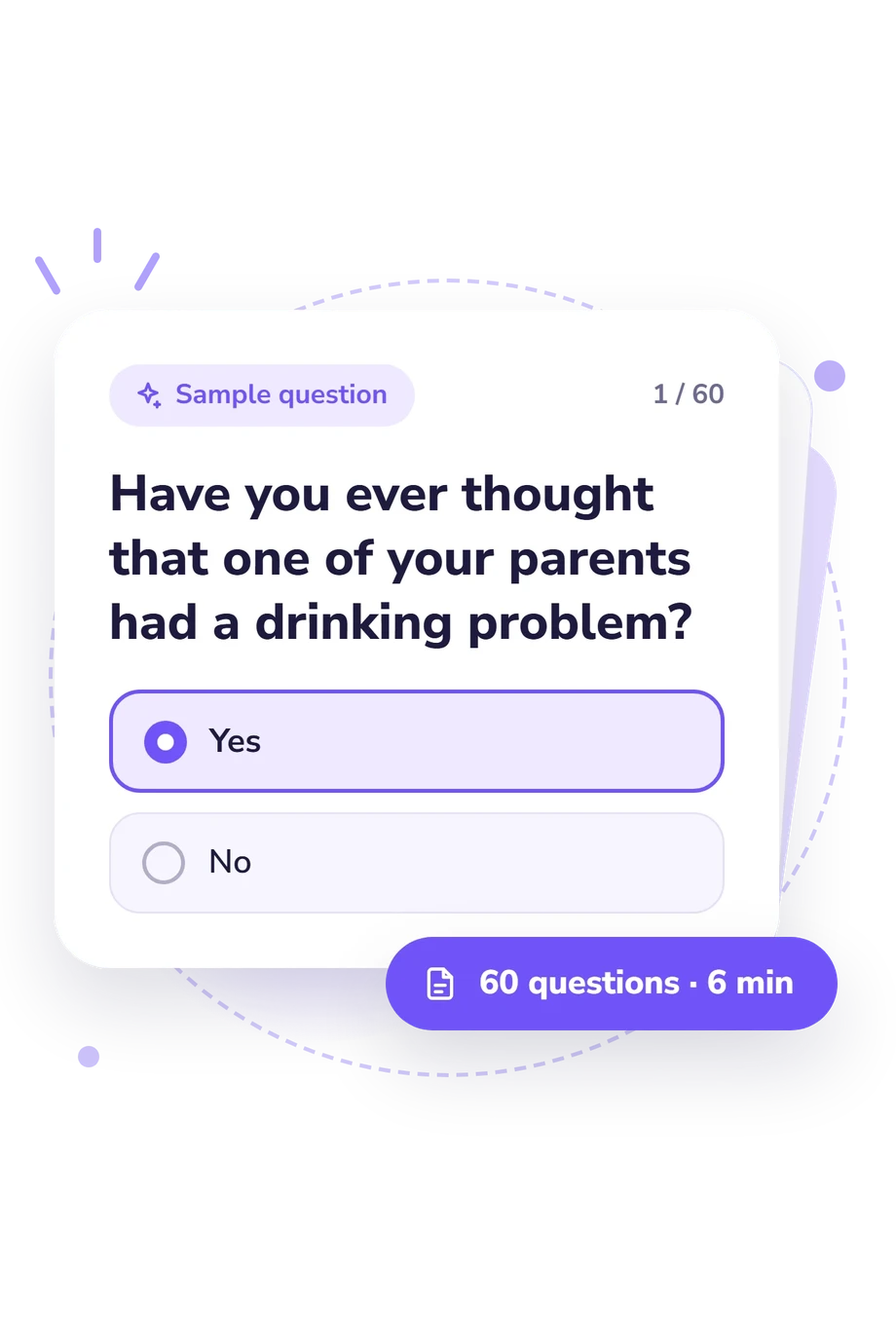
Example Questions From the Test
- Yes
- No
- Yes
- No
- Yes
- No
Children of Alcoholics Screening Test (CAST) - Description and methodology of the test
For adults reflecting on parental alcohol misuse, the questionnaire gives adult children of alcoholics a structure for organizing memories, emotions, conflict, and coping responses. The Children of Alcoholics Screening Test (CAST) indicates the level shown for each area of family involvement and personal impact in the respondent’s answers. It is a starting point for self-reflection and a fuller conversation about lived experience.
What This Assessment Explores
Parental drinking can affect emotions, safety, relationships, responsibilities, and coping. The CAST test items cover fear, shame, loneliness, sleep disruption, conflict, protection, and efforts to change drinking. The dimensions are:
- Aspect 4 (0-10) reflects efforts to address drinking or protect oneself; Low initiative 0-3; Moderate initiative 4-7; High initiative 8-10.
- Domain 3 (0-9) reflects involvement in family violence or conflict; Low involvement 0-2; Moderate involvement 3-6; High involvement 7-9.
- Aspect 2 (0-10) reflects physical and psychological impact; Low impact 0-3; Moderate impact 4-6; High impact 7-10.
- Aspect 1 (0-9) reflects attitudes and emotional involvement toward the parent and alcoholism; Low involvement 0-2; Moderate involvement 3-6; High involvement 7-9.
- Overall Level of Codependency (0-30) reflects involvement in parental alcoholism and possible emotional and behavioral effects of family alcoholism; Low 0-3; Moderate 4-10; High 11-30.
Methodology and Scientific Basis
Each item offers Yes or No, asking whether an experience occurred rather than rating frequency or intensity. Responses are grouped into dimensions and an overall profile; displayed ranges label result bands, but do not show how answers are weighted. Because the online scoring design and answer weights are not presented as a standardized clinical system, its bands should be read as descriptive results rather than universal clinical norms.
Evidence comes from Jones’s 1983 validity study of CAST, Sheridan’s 1995 psychometric assessment, and Clair and Genest’s 1992 reliability study. These papers examined the published instrument’s reliability and its relationships with family functioning, personal adjustment, and alcohol-related stress. As an online screening questionnaire for children of alcoholics, it is conceptually consistent with that research, but the studies do not prove identical wording, administration, samples, or norms.
Published CAST findings are not automatic validation of this digital presentation or universal clinical cutoffs. Memory, current distress, family contact, and willingness to disclose can shape answers, so the result is an organized indicator of reported experiences rather than a diagnosis and needs personal context for interpretation.
- Jones, J. W. (1983). The Children of Alcoholics Screening Test: A validity study. Bulletin of the Society of Psychologists in Addictive Behaviors, 2(3), 155-163.
- Sheridan, M. J. (1995). A psychometric assessment of the Children of Alcoholics Screening Test (CAST). Journal of Studies on Alcohol, 56(2), 156-160. 10.15288/jsa.1995.56.156
- Clair, D., & Genest, M. (1992). The Children of Alcoholics Screening Test: Reliability and relationship to family environment, adjustment, and alcohol-related stressors of adolescent offspring of alcoholics. Journal of Clinical Psychology, 48(3), 414-420. 10.1002/1097-4679(199205)48:3<414::AID-JCLP2270480321>3.0.CO;2-N
Updated: