
Smoking Behavior Type Questionnaire Test
How the Scales are Structured
Who Usually Takes This Test?
See How You Compare
Below is a preview of how scores are typically distributed across each scale.
Example Questions From the Test
- Always
- Often
- Not very often
- Rarely
- Never
- Always
- Often
- Not very often
- Rarely
- Never
- Always
- Often
- Not very often
- Rarely
- Never
Smoking Behavior Type Questionnaire Test - Description and methodology of the test
People who want to understand why they smoke, rather than only how often, can use the Smoking Behavior Type Questionnaire Test to examine the functions attached to smoking. It examines smoking habits through automatic routines, nicotine urges, emotional discomfort, relaxation, sensory handling, and the search for energy. The result offers a profile of the motives most prominent in their answers.
What This Assessment Explores
Smoking reflects a pattern of functions. Items clarify reasons for smoking through automatic use, urges, emotion, relaxation, handling, pleasure, and stimulation. The profile shows prominent routes into tobacco use.
Scales are:
- Reflex (Habit), 3-15, measures automatic smoking: Low habit-driven 3-7; Moderate habit-driven 8-10; High habit-driven 11-15.
- Craving (Dependence), 3-15, measures nicotine dependence: Low craving 3-7; Moderate craving 8-10; High craving 11-15.
- Support (Tension Reduction), 3-15, measures smoking for support or tension relief: Low 3-7; Moderate 8-10; High 11-15.
- Relaxation, 3-15, measures smoking for relaxation: Low 3-7; Moderate 8-10; High 11-15.
- Playing With the Cigarette, 3-15, measures cigarette handling: Low 3-7; Moderate 8-10; High 11-15.
- Stimulation, 3-15, measures smoking for energy: Low 3-7; Moderate 8-10; High 11-15.
Methodology and Scientific Basis
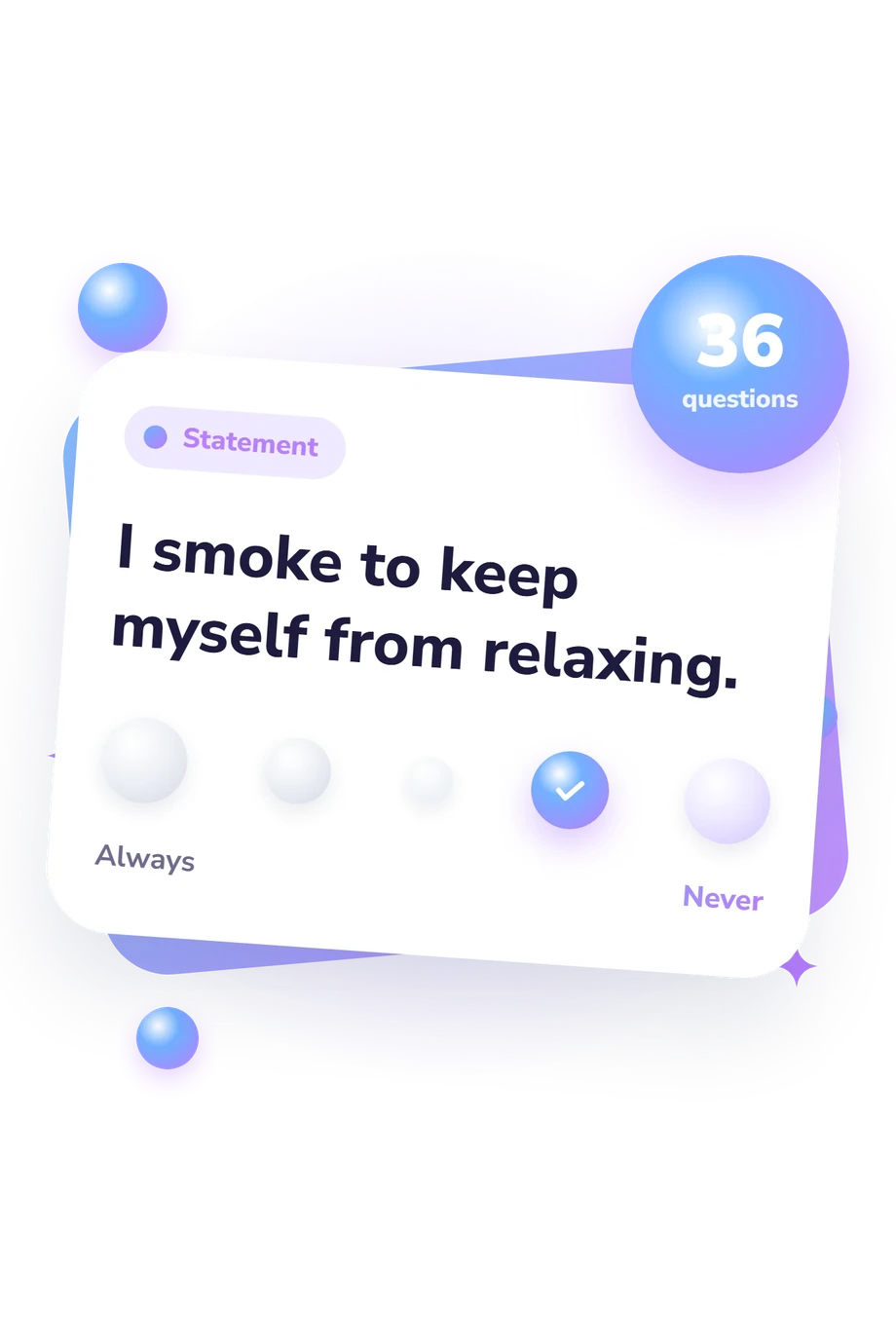
Responses use five frequency choices-Always, Often, Not very often, Rarely, or Never-with some screens numbering them 1 to 5. Answers are grouped by function, and each dimension receives its own result and band; the questionnaire does not specify how individual responses are weighted to produce each dimension's score.
Smoker's Self-Testing Kit (Horn, 1969) is the closest named source for this self-assessment format. The questionnaire is conceptually consistent with the type-of-smoking dimensions described by Ikard, Green, and Horn (1969), while Horn and Waingrow (1966) offer a compatible model of behavior change; neither establishes that this online version is a verbatim or independently standardized reproduction.
The craving/dependence dimension is interpreted alongside the five other smoking-function dimensions, so an assessment of smoking dependence is one part of a broader profile. Tate, Schmitz, and Stanton (1991) connect these motives with the wider reasons-for-smoking literature.
Self-reported answers can reflect current stress, memory, and awareness of automatic behavior, so the result is a structured snapshot of how smoking functions in the respondent's personal life at the time of completion rather than a standalone clinical conclusion.
- Horn, Daniel. Smoker's Self-Testing Kit: Part 1, Tests. Public Health Service Publication No. 1904. Washington, DC: U.S. Department of Health, Education, and Welfare; 1969.
- Ikard, F. F., Green, D. E., and Horn, D. A Scale to Differentiate between Types of Smoking as Related to the Management of Affect. International Journal of the Addictions. 1969;4(4):649-659. 10.3109/10826086909062040.
- Horn, D., and Waingrow, S. Some Dimensions of a Model for Smoking Behavior Change. American Journal of Public Health and the Nation's Health. 1966;56(12 Suppl):21-26. 10.2105/ajph.56.12_suppl.21.
- Tate, J. C., Schmitz, J. M., and Stanton, A. L. A Critical Review of the Reasons for Smoking Scale. Journal of Substance Abuse. 1991;3(4):441-455. 10.1016/S0899-3289(10)80025-2.
Updated: