
Codependency Test
How the Scales are Structured
Who Usually Takes This Test?
See How You Compare
Below is a preview of how scores are typically distributed across each scale.
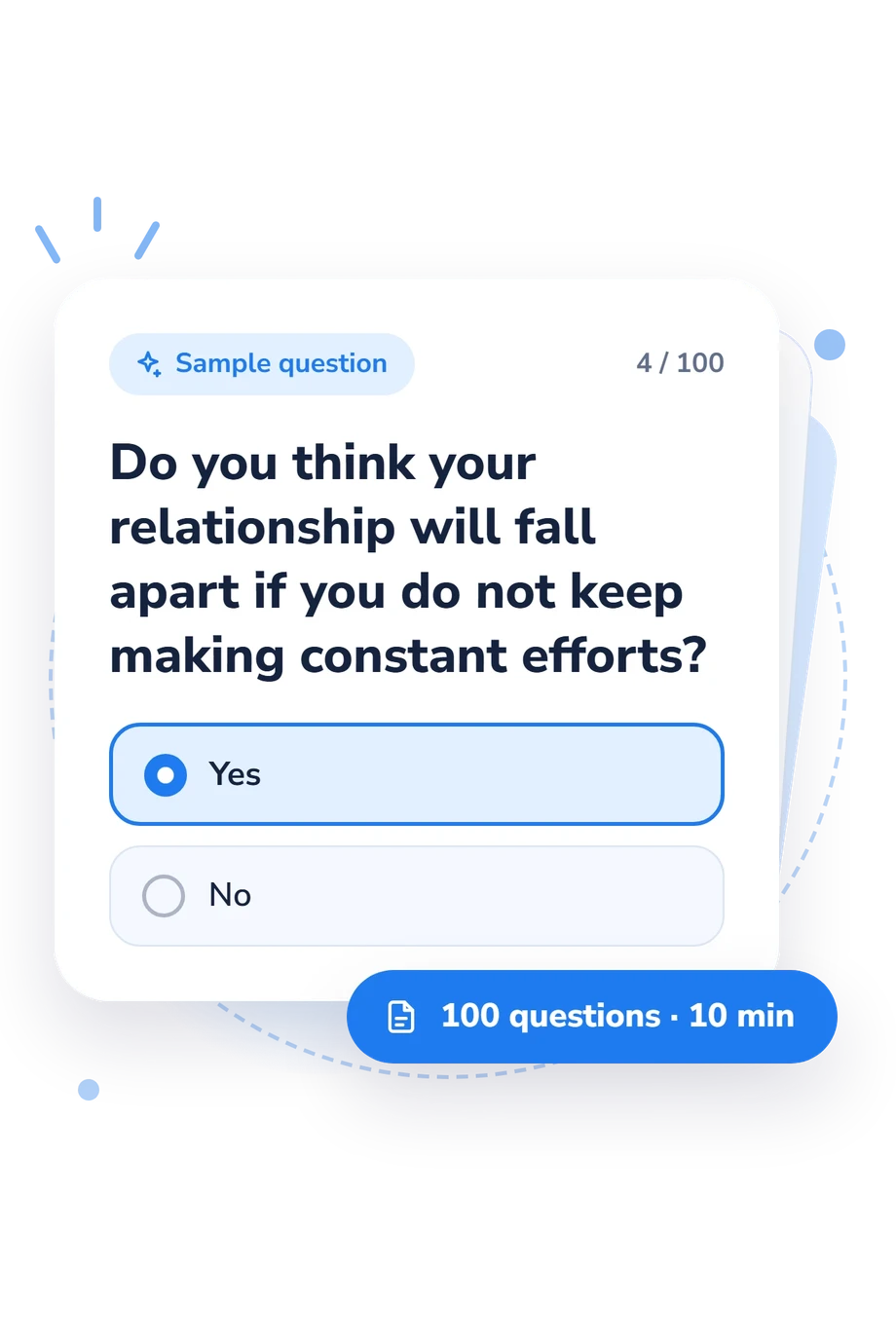
Example Questions From the Test
- Yes
- No
- Yes
- No
- Yes
- No
Codependency Test - Description and methodology of the test
People who notice chronic self-sacrifice, fear of conflict, or difficulty protecting their interests may use this assessment to examine relationship patterns more closely. The codependency test is intended for people reflecting on how dependence, responsibility, and personal boundaries shape close partnerships. Because its yes-or-no items describe concrete relationship situations, this codependency quiz helps connect the overall result with the circumstances in which those tendencies appear.
What This Assessment Explores
The questionnaire examines whether closeness with a partner involves self-neglect, responsibility, fear, control, or difficulty asserting needs. It highlights patterns affecting functioning, safety, and consent.
For someone wondering whether these patterns apply to them, this am I codependent quiz result groups the themes into an overall indication of codependent traits to consider alongside relationship circumstances. The items cover these areas:
- Self-neglect and over-responsibility show whether a person puts a partner’s needs or problems above their own.
- Boundary and autonomy difficulties indicate trouble saying no, defending interests, or maintaining privacy.
- Emotional dependence and relationship impact reflect rejection fears, conflict patterns, and effects on sleep, work, finances, or safety.
The Codependency Level scale runs from 0-50: Low 0-5, Moderate 6-20, and High 21-50. The catalogue treats it as severity of codependent personality traits: Low means no or minimal codependency, Moderate suggests some traits, and High indicates pronounced codependency that may warrant attention to interpersonal relationships and personal boundaries.
Methodology and Evidence Base
Each item uses a yes-or-no response and asks about situations such as self-sacrifice, silence during conflict, financial rescue, fear of being alone, or unwanted sex. Responses are combined into a total score, but the questionnaire does not state how many points each answer contributes, so no per-item rule should be inferred.
Its closest conceptual anchor is the Codependency Self-Inventory Scale, a published measure addressing self-sacrifice, responsibility, emotional dependence, and boundary difficulties. The questionnaire is conceptually consistent with that work. Related college-population research and criteria for codependency offer context, but they do not establish norms for this online version.
Because this codependent relationship quiz focuses on partner dynamics, its result is a relationship-focused self-report indication of current tendencies, not a diagnosis or fixed identity. No population norms, reliability estimates, or standardized administration are specified, so the bands are descriptive catalogue levels rather than universal clinical cutoffs. Results can shift with current stress, memory, self-awareness, and willingness to disclose. Items involving coercion, dangerous passivity, self-harm, or sexual pressure deserve attention to safety beyond the numerical result.
- Weinhold, Barry K., and Janae B. Weinhold. Breaking Free of the Co-Dependency Trap. Walpole, NH: Stillpoint, 1989.
- Cretser, Gary A., and William K. Lombardo. Examining Codependency in a College Population. College Student Journal, 33(4), 629-637, 1999.
- Cermak, Timmen L. Diagnostic Criteria for Codependency. Journal of Psychoactive Drugs, 18(1), 15-20, 1986. 10.1080/02791072.1986.10524475
Updated: