
Treatment Adherence Scale Test
How the Scales are Structured
Who Usually Takes This Test?
See How You Compare
Below is a preview of how scores are typically distributed across each scale.
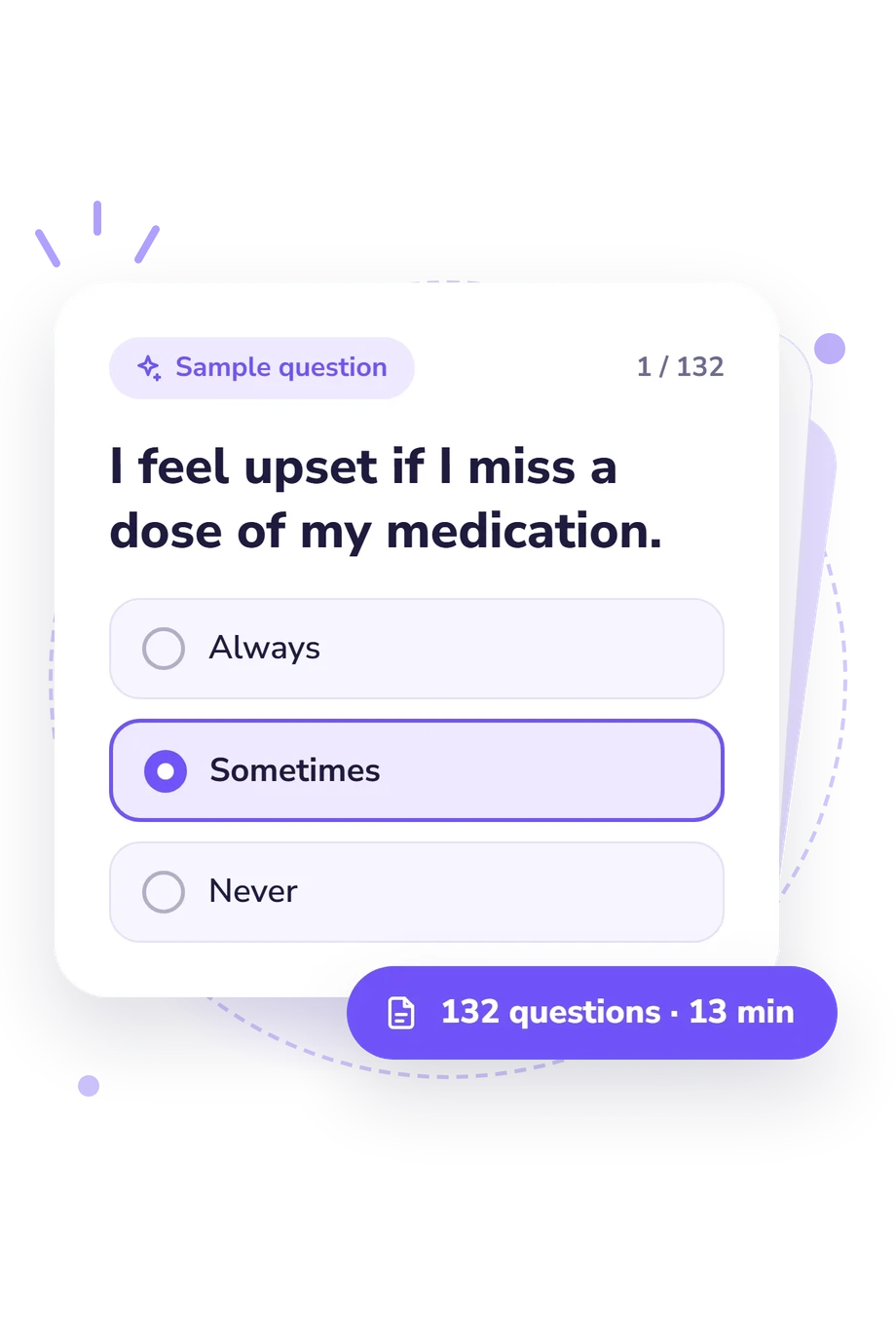
Example Questions From the Test
- Always
- Sometimes
- Never
- Always
- Sometimes
- Never
- Always
- Sometimes
- Never
Treatment Adherence Scale Test - Description and methodology of the test
People managing medication, appointments, and medical instructions may want a clearer picture of why adherence feels easier in some situations than others. The Treatment Adherence Scale Test organizes responses around behavioral, emotional, and socially motivated patterns rather than reducing adherence to one habit. This treatment adherence questionnaire can help readers recognize tendencies for further reflection.
What This Assessment Explores
Readers who want to understand prescribed-care habits can use this treatment adherence assessment to examine what may strengthen or weaken follow-through. Its situations include medication timing, appointments, side-effect worries, flare-ups, and support from others.
The result is organized into four dimensions:
- Behavioral (0-44; Low 0-15, Moderate 16-29, High 30-44) reflects following recommendations to overcome illness; a moderate result can signal caution about strict routines.
- Emotional (0-44; Low 0-15, Average 16-29, High 30-44) reflects adherence shaped by sensitivity; a moderate result may involve changing treatment attitudes or minimizing illness.
- Social (0-44; Low 0-15, Moderate 16-29, High 30-44) reflects approval-based motivation and perceived benefit, including an uncertain stance toward treatment.
- Overall Adherence (0-132; Low compliance 0-40, Moderate compliance 41-80, High compliance 81-132) summarizes follow-through and may reveal ambivalence or situational commitment.
Methodology and Evidence Base
Each item is a first-person statement about treatment behavior, feelings, planning, or social reactions. Respondents choose Always, Sometimes, or Never. Responses are combined into three component dimensions and an overall result; the displayed bands serve as descriptive categories for levels of tendency, including how adherence may vary with context, emotion, and social motivation.
This questionnaire is conceptually consistent with the Level of Compliance Questionnaire (Kadyrov et al., 2014), but it is not that instrument’s standardized administration; evidence for the published source does not validate this online form. Kapustina, Kadyrov, and Grigoreva (2019) analyzed psychometric properties of the source questionnaire, while Zakharova and Filshtinskaya (2020) studied psychosocial factors associated with treatment compliance in a Russian clinical context. Their findings support the relevance of the construct and help situate the questionnaire’s behavioral, emotional, and social emphasis.
Interpreting an adherence profile works best alongside current illness, treatment demands, and personal circumstances. Memory, self-awareness, anxiety, social approval, and recent health changes can influence self-report. The profile is most useful for identifying patterns and practical barriers that merit further reflection.
- Kadyrov, R. V., Asriyan, O. B., & Kovalchuk, S. A. (2014). The Level of Compliance Questionnaire: Monograph. Vladivostok: Maritime State University, 74 pp.
- Kapustina, T. V., Kadyrov, R. V., & Grigoreva, E. M. (2019). Analysis of Psychometric Properties of the Questionnaire Level of Compliance. Azimuth of Scientific Research: Pedagogy and Psychology, 8, no. 4(29), 303-308. 10.26140/anip-2019-0804-0071
- Zahkarova, E. V., & Filshtinskaya, E. G. (2020). Psychosocial Characteristics of Tuberculosis Patients in Russia and Treatment Compliance Factors. RUDN Journal of Psychology and Pedagogics, 17(2), 330-347. 10.22363/2313-1683-2020-17-2-330-347
Updated: