
Subject Position Scale Test
How the Scales are Structured
Who Usually Takes This Test?
See How You Compare
Below is a preview of how scores are typically distributed across each scale.
Example Questions From the Test
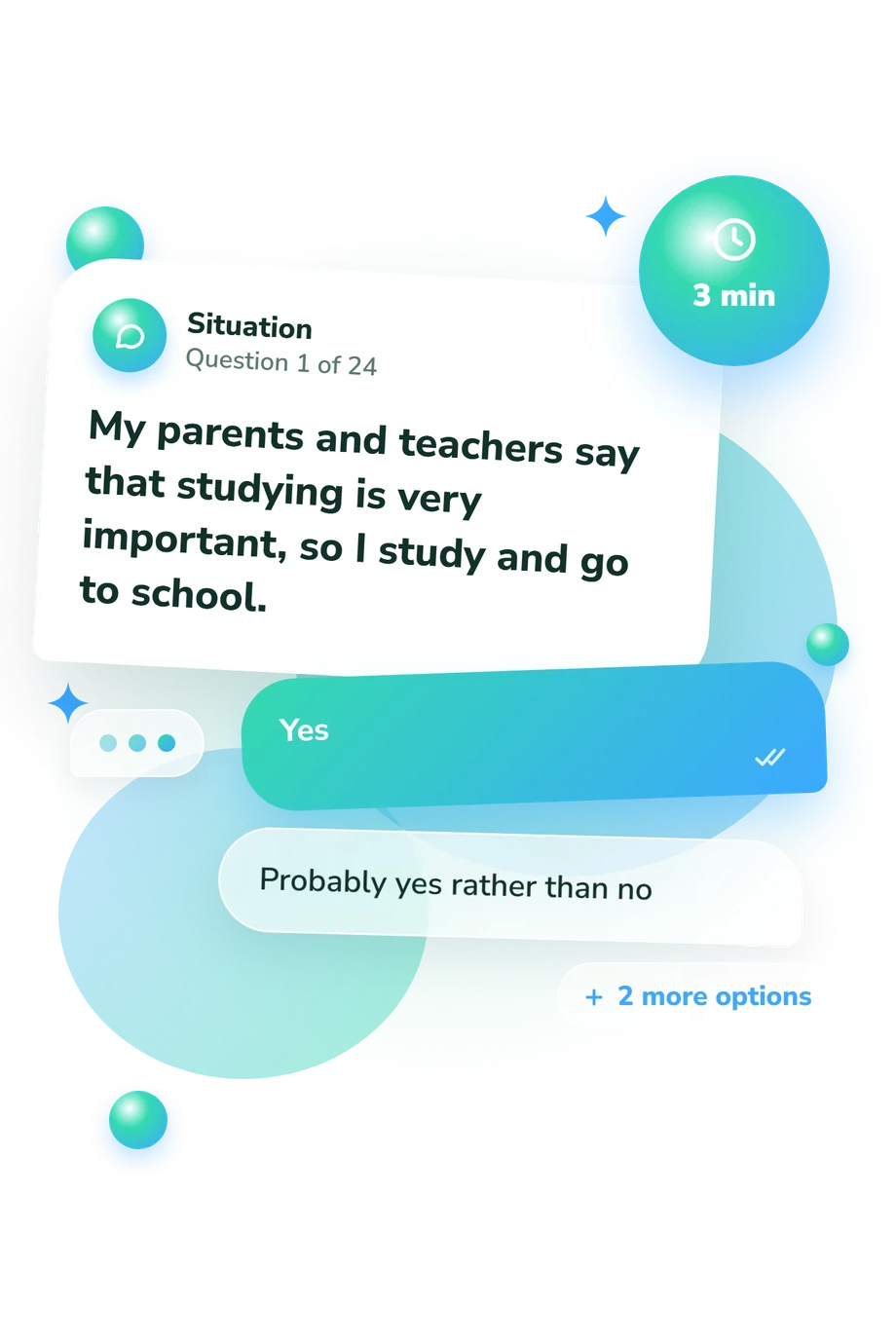
- Yes
- More yes than no
- More no than yes
- No
- Yes
- More yes than no
- More no than yes
- No
- Yes
- More yes than no
- More no than yes
- No
Subject Position Scale Test - Description and methodology of the test
This assessment is intended for learners, parents, educators, or anyone examining how a person relates to schoolwork and learning demands. The Subject Position Scale Test can help a reader see whether study is approached through personal interest, effort, and understanding or mainly through rules, praise, and outside pressure. As a subject position assessment, it offers a structured profile for reflection rather than a single verdict.
What This Assessment Explores
The questions examine how a learner relates to studying: whether effort is active and self-directed, whether difficult material is approached with curiosity, and whether schoolwork is driven by meaning, adult demands, praise, or avoidance. The resulting subject position profile helps clarify autonomy, intrinsic motivation, and negative attitudes toward learning.
It suits learners and adults reflecting on school or study habits and educational motivation.
The displayed scales describe these dimensions:
- Negative Attitude (0-16) reflects negativity toward achievement and learning content; higher values may indicate low motivation or interest. Bands: Low negativity (0-5), Moderate negativity (6-10), High negativity (11-16).
- Object Position (0-16) reflects reliance on adult instructions and praise; higher values may indicate dependence and less autonomy. Bands: More autonomous (0-5), Mixed orientation (6-11), More dependent (12-16).
- Subject Position (0-16) reflects active, meaningful learning; higher values indicate greater autonomy and intrinsic motivation. Bands: Low (0-5), Moderate (6-11), High (12-16).
Methodology and Scientific Basis
Each statement uses a four-point continuum: Yes, More yes than no, More no than yes, and No, with wording variations such as Rather or Probably. Items address adult instructions, praise, missed or disrupted classes, persistence with difficult work, independent solutions, and checking understanding. Scores are organized into the three dimensions; no single total or point-per-answer rule should be inferred from the ranges alone.
The structure is conceptually consistent with the Subject Position Questionnaire (Zaretskiy et al., 2014), which examines subject position in learning activity, and with later work by Zaretskiy (2013) and Zaretskii (2017). This online questionnaire is not a direct adaptation or validated reproduction of those publications; their construct provides the interpretive reference.
Interpret the bands as a profile of reported tendencies at the time of answering. The online version has no stated normative sample or clinical cutoff, so its bands describe tendencies rather than population norms or diagnoses. Self-report can shift with current experiences, social desirability, memory, and self-awareness; consider the result alongside context and observed behavior.
- Zaretskiy, Yu. V., Zaretskiy, V. K., & Kulagina, I. Yu. (2014). Technique to study the subject position of students of different ages. Psychological Science and Education, 19(1), 99-110. (In Russian).
- Zaretskiy, Yu. V. (2013). Subject Position on Learning Activity as a Resource for the Development and the Subject of the Study. Counseling Psychology and Psychotherapy, 21(2), 110-128. (In Russian).
- Zaretskii, Y. V. (2017). Subjectness Position Relative to Educational Activities in Different Age Periods. International Review of CRIRES: Innovating in the Tradition of Vygotsky, 4(1), 195-202. 10.51657/ric.v4i1.41010.
Updated: