
Legal and Civic Consciousness Test
How the Scales are Structured
Who Usually Takes This Test?
See How You Compare
Below is a preview of how scores are typically distributed across each scale.
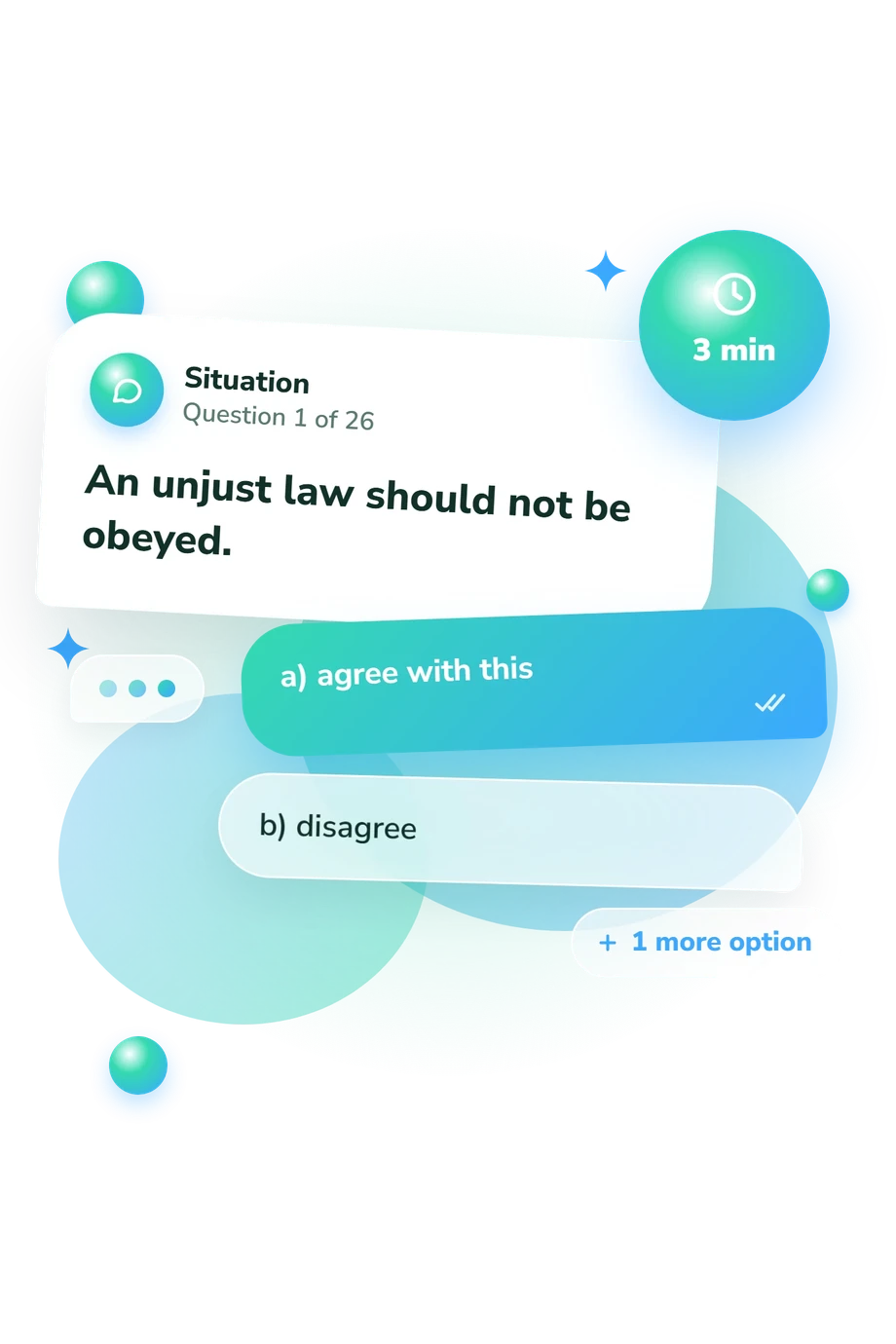
Example Questions From the Test
- a) Agree
- b) Disagree
- c) Unsure
- a) according to conscience
- b) strictly in accordance with labor law and job requirements
- c) Unsure
- Agree
- Disagree
- Not sure
Legal and Civic Consciousness Test - Description and methodology of the test
People examining how they understand law, responsibility, and public life can use the Legal and Civic Consciousness Test to identify the kinds of judgments represented in their result. One part of the result focuses on legal awareness, while separate domain scores and an overall level distinguish areas of the result.
What This Assessment Explores
The items cover law, fairness, rights, duties, government, self-government, work obligations, and social order. One dimension concerns civic maturity: the profile links public attitudes, initiative, and responsibility to formal regulation in everyday and professional settings.
The displayed dimensions and their result bands are:
- Legal Knowledge: 0-8 shows awareness needed for independent functioning; Low 0-3 means insufficient awareness, Moderate 4-6, High 7-8.
- Civic Domain: 0-8 reflects initiative and responsibility; Passive/infantile 0-4, Developing 5-6, Active civic stance 7-8.
- Business Domain: 0-8 reflects work and business obligations; Low 0-3, Moderate 4-6, High 7-8, with lower results favoring personal agreements.
- Everyday Life: 0-8 reflects daily legal and ethical conduct; Needs support 0-4, Developing 5-6, Strong 7-8.
- Overall Level of Legal Consciousness Development: 0-26 summarizes acceptance of norms across life domains; Low 0-13, Moderate 14-23, High 24-26; lower bands indicate less consistent legal consciousness.
Methodology and Scientific Basis
Each item is a statement with three response choices, usually two substantive positions and an unsure or uncertain option. Only some items use agree/disagree wording; others contrast positions such as conscience and labor-law compliance or rights and responsibilities.
Questions contrast moral judgment with formal requirements and address citizenship, government, rights, duties, work, and law's function. This lets the profile compare attitudes across domains.
Scoring is profile-based: responses contribute to four domain scores and an overall score. The displayed ranges show totals and bands, but their external normative basis and points assigned to each option are not documented, so an answer key should not be inferred.
Yasyukova (2005) provides the closest conceptual anchor. Kalinina (2014) addresses legal consciousness in vocational education, while Horák, Lacko, and Klocek (2021) review its conceptualization and measurement. The questionnaire is conceptually consistent with these works, not established by them as a standardized adaptation.
Because this is an online self-assessment of legal consciousness, current context, expectations, knowledge, and candor can affect answers; the pattern is best read as a reflection prompt rather than a complete judgment.
- Yasyukova, L. A. (2005). Methodology of L. A. Yasyukova, Part 1: Prediction and Prevention of Learning Problems, Socialization, and Professional Self-Determination of High School Students: Methodological Guide. Saint Petersburg: IMATON.
- Kalinina, R. R. (2014). Legal Consciousness of Youth in Conditions of Vocational Education: Problems and Solutions. Krasnoyarsk Science, 6(17), 43-51. 10.12731/2070-7568-2014-6-4
- Horák, F., Lacko, D., & Klocek, A. (2021). Legal Consciousness: A Systematic Review of its Conceptualization and Measurement Methods. Anuario de Psicología Jurídica, 31(1), 9-34. 10.5093/apj2021a2
Updated: