
Social Orientation Assessment Test
How the Scales are Structured
Who Usually Takes This Test?
See How You Compare
Below is a preview of how scores are typically distributed across each scale.
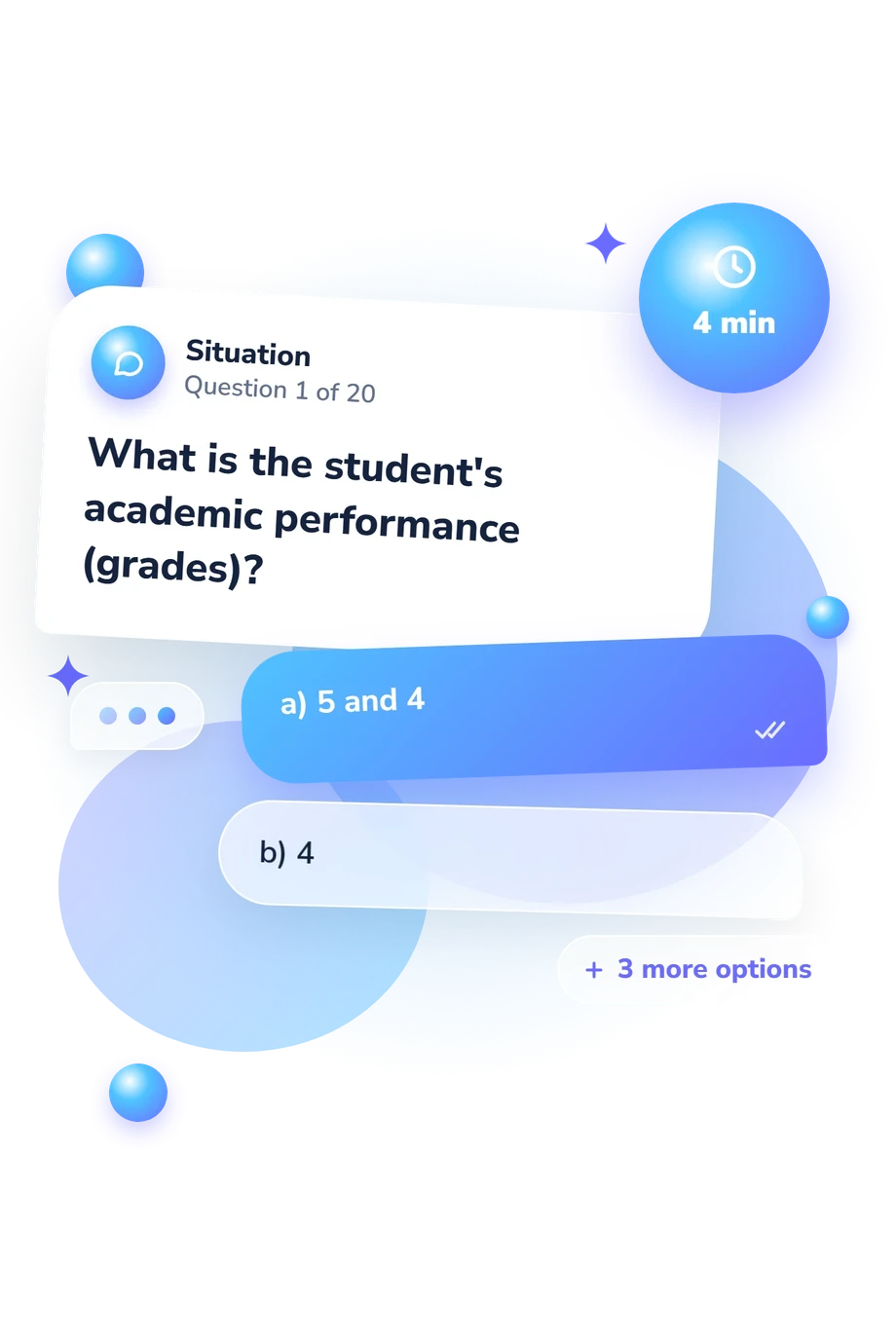
Example Questions From the Test
- a) 5 and 4
- b) 4
- c) 4 and 3
- g) 3
- d) 3 and 2
- a) consistently
- b) often
- v) from time to time
- g) sometimes
- d) no
- Always
- Often
- From time to time
- Sometimes
- No
Social Orientation Assessment Test - Description and methodology of the test
Teachers, parents, and caregivers who know a student's school behavior can use the Social Orientation Assessment Test as a structured snapshot of group conduct. The assessment examines student social behavior through duties, classmates, authority, shared expectations, and opportunities to show consideration. Its result describes the student's predominant social motivation and behavioral orientation in group settings.
What This Assessment Explores
Rather than measuring sociability alone, this assessment examines how a student approaches shared life at school. Its situations cover duties, homework, teacher expectations, classmates’ opinions, helping, promises, respect for belongings, conflict, and ways of showing superiority. Together, they indicate whether behavior leans toward self-interest, communication, or constructive participation.
This social orientation assessment describes the student's predominant social motivation and behavioral orientation in relation to peers and group responsibilities. It can help adults interpret the orientation shown across everyday school situations.
The displayed scale is Social Orientation, scored from 20-100, with result bands:
- Selfish orientation (20-59) indicates that personal interest is more prominent in the situations represented by the responses.
- Communicative orientation (60-79) indicates a communicative orientation in social interactions.
- Constructive orientation (80-100) indicates a stronger tendency toward responsible, helpful, group-supportive behavior.
Methodology and Scientific Basis
Each item offers ordered choices, usually moving from willing participation toward reluctant, indifferent, or self-focused behavior, with neutral options. Questions cover duties, helping, rule-following, consideration, promises, conflict, and status. The respondent selects the description that best fits the student, making this an observer-report questionnaire.
The selected responses produce a social orientation score rather than an interview. They are combined and read through the displayed bands. Because no item-by-item weighting rule is stated, the range should not be reverse-engineered into points per answer.
It is conceptually consistent with Knight’s Social Orientation Construct, which examined cooperative, competitive, and individualistic orientations through behavioral and sociometric methods. Related work by Knight and Kagan examined prosocial and competitive behavior. These studies support the construct, but do not show that this questionnaire is their published instrument or a validated adaptation.
The questionnaire’s behavioral emphasis is consistent with Allport’s general social-psychological work, but that connection does not validate it. The displayed bands describe orientation categories, not item weighting or clinical thresholds. Interpretation can shift with the informant’s perspective, memory, current context, and wish to present the student favorably.
- George P. Knight. "Behavioral and sociometric methods of identifying cooperators, competitors, and individualists: Support for the validity of the social orientation construct." Developmental Psychology, 17(4), 430-433 (1981). DOI 10.1037/0012-1649.17.4.430
- George P. Knight and Spencer Kagan. "Development of Prosocial and Competitive Behaviors in Anglo-American and Mexican-American Children." Child Development, 48(4), 1385-1394 (1977). DOI 10.2307/1128497
- Floyd Henry Allport. Social Psychology. Boston: Houghton Mifflin Company, 1924.
Updated: