
Fear Test
How the Scales are Structured
Who Usually Takes This Test?
See How You Compare
Below is a preview of how scores are typically distributed across each scale.
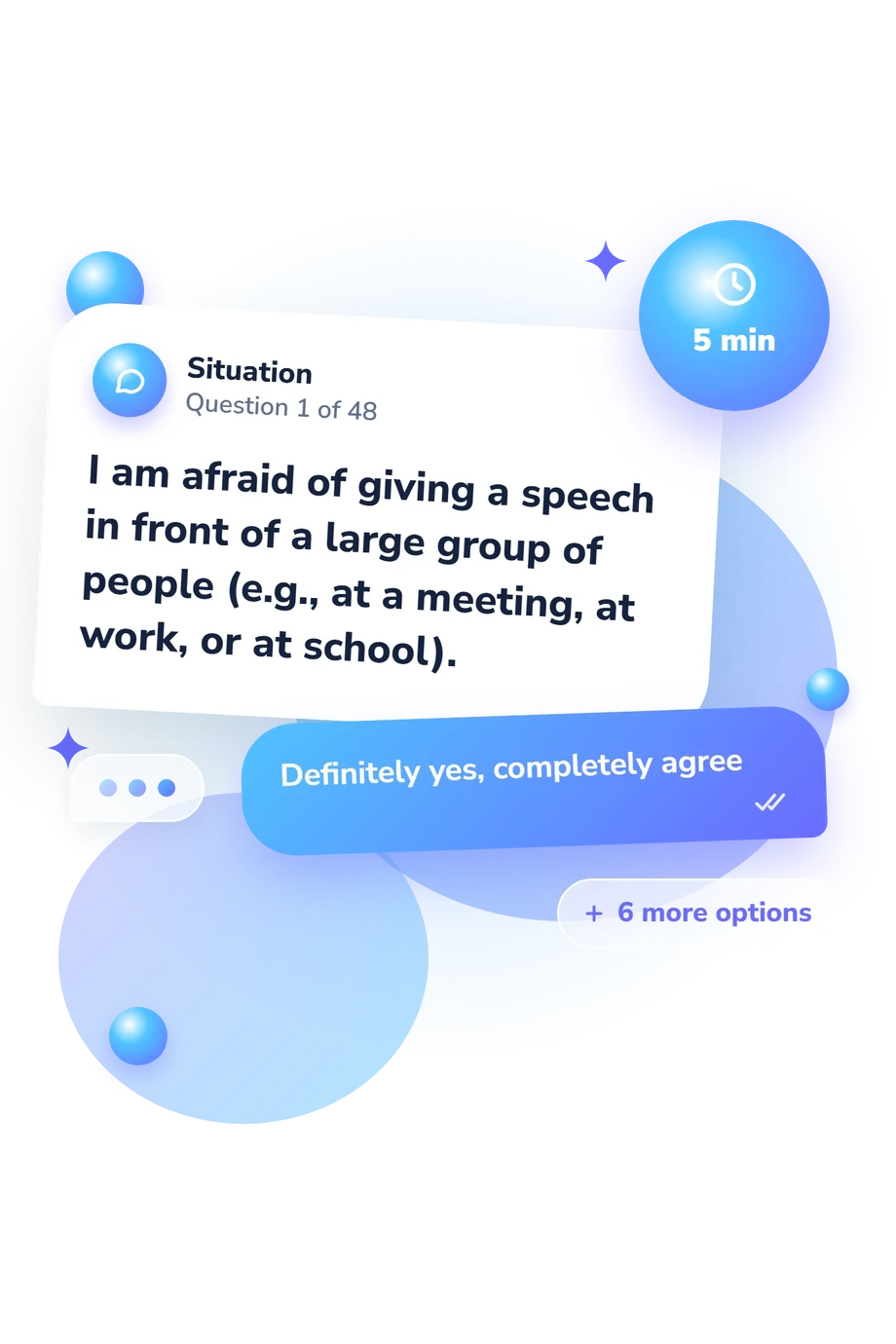
Example Questions From the Test
- Definitely yes, I completely agree
- Yes, I agree
- Possibly yes, I partly agree
- Neither agree nor disagree
- Possibly no, I partly disagree
- No, I do not agree
- Definitely no, I completely disagree
- Definitely yes, completely agree
- Yes, agree
- Probably yes, somewhat agree
- Neither agree nor disagree
- Probably no, somewhat disagree
- No, disagree
- Definitely no, completely disagree
- Definitely yes, completely agree
- Yes, agree
- Probably yes, partly agree
- Neither agree nor disagree
- Probably not, partly disagree
- No, disagree
- Definitely not, completely disagree
Fear Test - Description and methodology of the test
People who want to compare caution with willingness to act when choices feel uncertain may use this fear and courage test as a practical exercise. The Fear Test helps a reader examine how concern about minor worries relates to readiness for dangerous action and confidence in taking action. It links appraisal of imagined threats with courage, risk-taking, and confidence dimensions, clarifying differences between hesitation and action.
What This Assessment Explores
These items cover social exposure, physical discomfort, darkness, death, confrontation, uncertainty, and dangerous action. They assess concern about minor worries, willingness to disregard insignificant fears, readiness for dangerous action, and confidence in taking action. This courage and risk-taking assessment links concern appraisal with action tendency.
The three reported outputs are:
- Scale I (16-112) measures courage and risk-taking tendency: Cautious (16-47), Bold (48-79), or Reckless (80-112). Higher scores indicate readiness for dangerous action and possible extreme behavior.
- Scale II (8-56) measures attitudes toward imagined fears and minor worries: More concern-prone (8-23), Balanced (24-40), or Low worry focus (41-56). Higher scores suggest lower anxiety and more rational threat appraisal.
- Total Score (24-168) reflects self-confidence and action tendency: Low confidence (24-71), Moderate confidence (72-124), or High confidence (125-168). Higher scores indicate greater courage and less fear in new or dangerous situations, alongside overall confidence.
Methodology and Scientific Basis
Across the form, respondents choose among seven agreement points, from definite agreement through a neutral midpoint to definite disagreement. This fear questionnaire addresses public speaking, medical procedures, darkness, unfamiliar settings, uncertainty, and dangerous choices, capturing degrees of concern or willingness to act.
The ordered choices let respondents express degrees of agreement rather than forcing a yes-or-no answer. Those responses produce the three displayed outputs, each presented with its corresponding result bands. Interpret them as a pattern across concern, courage, and confidence: caution in one situation may coexist with confidence in another.
Courage content is conceptually consistent with the Woodard-Pury Courage Scale (Woodard & Pury, 2007). That comparison concerns the courage construct only; it does not make this online questionnaire an adaptation or standardized version of the published scale.
Because self-reported willingness to take risks can vary with honesty, current mood, and personal experience, read the displayed bands as prompts for considering confidence, worry, and action tendencies, not as a diagnosis.
- Woodard, C. R., & Pury, C. L. S. (2007). The Construct of Courage: Categorization and Measurement. Consulting Psychology Journal: Practice and Research, 59(2), 135-147. 10.1037/1065-9293.59.2.135
- Schmieschek, H. (1970). Questionnaire for the Determination of Accentuated Personalities. Psychiatry, Neurology and Medical Psychology, 22(10), 378-381.
- Spielberger, C. D. (1983). Manual for the State-Trait Anxiety Inventory (STAI). Consulting Psychologists Press.
Updated: