
Infantilism Level Assessment Test
How the Scales are Structured
Who Usually Takes This Test?
See How You Compare
Below is a preview of how scores are typically distributed across each scale.
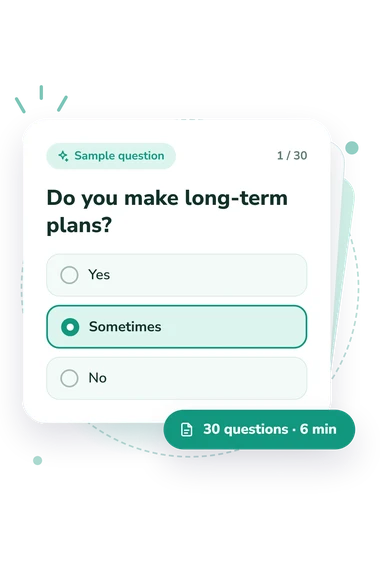
Example Questions From the Test
- Yes
- Sometimes
- No
- Yes
- Sometimes
- No
- Yes
- Sometimes
- No
Infantilism Level Assessment Test - Description and methodology of the test
Adults who want to examine patterns of dependence, self-control, motivation, and responsibility can use the Infantilism Level Assessment Test as a structured starting point for reflection. This infantilism test focuses on how mature and immature tendencies may appear in everyday choices, relationships, and reactions. The result indicates the broad degree of the measured tendency for easier self-understanding.
What This Assessment Explores
Rather than treating immaturity as one habit, this questionnaire considers how emotional, social, and cognitive patterns can combine in adult life. It suits readers reflecting on responsibility, dependence, decision-making, relationships, motivation, and reactions to limits or criticism. The result indicates the broad level of the measured tendency, while mature and immature responses may coexist.
The themes are grouped into the following connected aspects:
- The overall Infantilism Level (0-60) summarizes emotional, social, and cognitive immaturity; bands are Low 0-20, Moderate 21-40, and High 41-60.
- Emotional regulation reflects impulses, mood shifts, helplessness, outbursts, and recovery from upset.
- Responsibility and agency reflect decisions, persistence, consequences, and willingness to leave comfort zones.
- Social orientation captures approval, criticism, dependence, conflict, rules, cooperation, and values.
As an assessment of psychological infantilism, the result describes tendencies in situations rather than assigning a fixed character label.
Methodology and Evidence Base
Items ask about situations such as planning, impulse control, criticism, persistence, conflict, and reliance on help. Responses use Yes, Sometimes, or No, with some items displaying numeric labels beside those choices. The result is reported on one scale, but the questionnaire does not specify how each response contributes, so no per-answer point value should be assumed.
The questionnaire is conceptually consistent with Seregina’s work on infantilism, which links infantilism with emotional regulation, responsibility, dependence, motivation, and social functioning. This questionnaire is not a documented reproduction of that work’s full instrument. Sabelnikova and Khmeleva discuss the construct and its operationalization, while Podolskaya and Utenkov offer related applied evidence on recognizing such tendencies in students.
For interpretation, the band describes a current or characteristic tendency rather than a permanent identity. This online adult infantilism questionnaire has a stated scale and bands but no normative standardization, reliability estimate, or diagnostic validation. Self-report results can shift with mood, self-awareness, memory, and favorable responding, so context and broader assessment matter when deeper evaluation is needed.
- Seregina, Anna Alexandrovna. (2006). Socio-Psychological Conditions for Overcoming Infantilism among Unemployed Youth: Dissertation Abstract for the Degree of Candidate of Psychological Sciences, specialty 19.00.05. Moscow: Russian State Social University, 25 pp. EDN NKHFYZ.
- Sabelnikova, Elena V., and Natalia L. Khmeleva. (2018). Infantilism: Theoretical Construct and Operationalization. Russian Education & Society, 60(1), 74-88. 10.1080/10609393.2018.1436297
- Podolskaya, Tatiana A., and Aleksey V. Utenkov. (2018). Detecting and Overcoming Infantilism in Students at Teachers Colleges. Psychology in Russia: State of the Art, 11(1), 84-94. 10.11621/pir.2018.0107